Chocolate Orange Gelato
Dry and deep before it is sweet, with a citrus-oil lift riding over the top and a peel note that holds on well after the chocolate has faded.
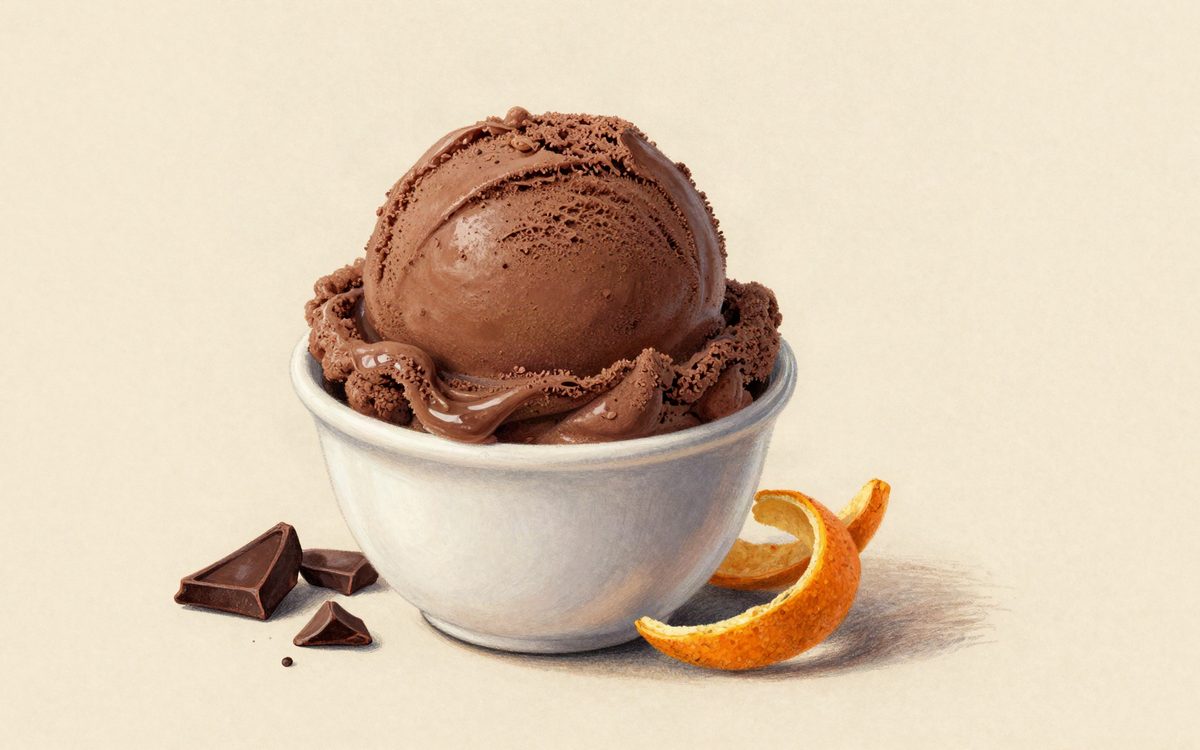
Buy the fruit for its skin, not its juice. Unwaxed is the only word on that label worth reading, because the aroma sits in the oil of the peel and a waxed skin puts a coating between the zester and the thing you want. The cocoa deserves the same attention: a cheap powder is usually alkalised hard until it smells of almost nothing, while one declared at 22 to 24 percent fat still opens with a smell, and the 70 percent bar should list cocoa butter rather than vegetable fat. Nothing in this formula covers for a weak ingredient, because no juice is diluting anything: 14 g of zest and 20 g of Cointreau are the whole citrus side.
Orange aroma is limonene, and limonene lives in the oil of the peel. Zest at 14 g per kilo, about two oranges, gives more perfume than 100 g of juice would, and Cointreau at 20 g per kilo closes the aromatic picture.
The liqueur is also the most dangerous ingredient in the balance. At a PAC of 318 against sucrose at 100, those 20 g contribute 6.4 points of PAC on their own, which is why dextrose falls to zero in this recipe and sucrose does all the sweetening at 140 g per kilo, the highest sucrose dose of these six chocolate recipes. Even so, PAC finishes at 273.29, the highest of the group and the closest to the 300 ceiling.
The cocoa is split three ways, 42 g of powder, 14 g of cocoa paste and 50 g of 70% couverture, because cocoa paste yields nearly twice the cocoa solids per gram of protein that powder does. That split is what buys headroom against the 5% protein ceiling, and protein lands at 4.58%.
Ingredients
Makes 1000 g of finished base.
| Ingredient | Grams | Home measure |
|---|---|---|
| Whole Milk | 643 | 2 2/3 cups |
| Sugar (Sucrose) | 140 | 2/3 cup plus 1 tablespoon |
| Dark Chocolate 70% | 50 | |
| Heavy Cream 35% | 45 | 3 tablespoons |
| Cocoa Powder 22-24% | 42 | |
| Skim Milk Powder | 27 | 1/4 cup plus 1 tablespoon |
| Cointreau | 20 | |
| Cocoa Paste | 14 | |
| Orange Zest | 14 | |
| Carob Seed Flour | 4 | |
| Salt | 1 |
Loads these exact grams into the free balancer, ready to edit.
Method
Zest infusion, still-freeze, Cointreau stirred in cold
- 1Whisk every dry ingredient together first: sugars, milk powder, stabiliser and salt. Dry-blending them stops the stabiliser clumping when it meets liquid.
- 2Warm the liquids to 40 C (104 F), then rain the dry mix in while whisking hard.
- 3Heat to 82 C (180 F) and hold for 2 minutes so the stabiliser hydrates.
- 4Melt the chocolate to 45 C (113 F) and stir it into the hot base off the heat, then blend 60 seconds until glossy.
- 5Off the heat, whisk in the paste, then blend 60 seconds so the fat emulsifies instead of separating.
- 6Chill in an ice bath to under 5 C (41 F) within 2 hours. Slow cooling is where bacteria and coarse crystals both start.
- 7Age 6 to 12 hours in the fridge under 5 C (41 F). This is when the stabiliser and the milk protein take up water.
- 8Freeze in a shallow metal pan 2 to 3 cm deep, breaking the crystals with a fork every 30 to 40 minutes, 4 to 6 times.
- 9Freeze firm, then temper 10 to 15 minutes in the fridge before scooping.
The balance
All six against the professional range for Milk Gelato.
PAC at 273.29 is the highest of these six chocolate recipes, and it is not an accident, it is the price of the liqueur. Cointreau has a PAC of 318 against sucrose at 100, so 20 g per kilo adds 6.4 points on its own, and the balance answered by taking dextrose to zero and letting 140 g of sucrose do the sweetening. That also explains why sugars finish at 16.1%, the lowest figure in this group: part of the freezing point depression is being bought with alcohol instead of with more sugar. Protein at 4.58% is the other tight number, which is why 14 g of cocoa paste replaces some of the powder, since paste carries more cocoa solids per gram of protein. Total solids come to 38.14%, mid-range, and fat to 7.48%, in the lower part of its range, with lactose at 7.58% of the water phase.
Estimated nutrition: ~190 kcal · Fat 7.5 g · Sugars 16.1 g · Protein 4.6 g (per 100 g of mix, from the balanced composition).
Alcohol is volatile and must never see the heat. The 20 g of Cointreau per kilo work out to about 0.8% ethanol in the mix, inside the 1% that professional practice accepts, and they go in cold, into a base that has already been pasteurized and chilled, at the end of maturation. If they go in hot the alcohol evaporates, you lose the aroma and you also lose the 6.4 points of PAC the balance was counting on, so the gelato freezes harder than planned. The zest goes in during pasteurization, and only the orange layer of the peel, never the white pith, which is bitter and stays bitter through everything. Let it infuse 20 minutes off the heat and strain, making up the volume you took out with whole milk. Do not push the Cointreau higher hoping for more orange: above 1% ethanol the mix will not set in the machine and you end up with cream.
If it goes wrong
Orange juice or another acid went in. At pH 3.5 to 4.0 the casein is pushed toward its isoelectric point, and 4.5% cocoa solids make it worse.
Use the 14 g of zest and the 20 g of Cointreau and nothing acidic. This recipe is designed with no juice in it at all.
There is more than 1% ethanol in the mix, usually from adding Cointreau by eye rather than by weight.
Hold to 20 g per kilo, which is about 0.8% ethanol, and weigh it. That dose is what PAC 273.29 assumes.
White pith came off with the zest.
Take only the colored layer, infuse 20 minutes off the heat, then strain and top the base back up with whole milk.
Suitable for: Vegetarian, Egg-free
Contains alcohol.
Allergens: milk
- https://www.keep-calm-and-eat-ice-cream.com/chocolate-orange-ice-cream/
- https://www.asaucykitchen.com/chocolate-orange-ice-cream/
- https://icecreamcalc.com/2021/03/07/cointreau-gelato/
- https://icecreamcalc.com/knowledge-base/balancing/
- The science behind it: Couverture Chocolate for Gelato
- Ingredient sheet: Dark Chocolate 70%
Want to change an ingredient and watch the numbers move? Open the free balancer