Chocolate Gelato
Expect bitterness before sweetness: dry, dark cocoa on the front of the tongue, then a slow fatty melt that carries the flavour on past the cold.
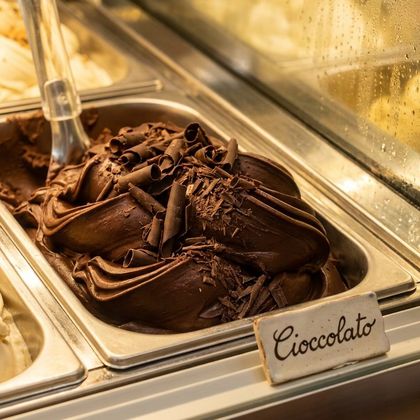
Nothing on this sheet matters more than what comes out of the cocoa tin. The powder should be alkalised and 22 to 24 percent fat, because the non-fat solids in it, about three-quarters of its weight, are what carry the bitterness and the colour; a thin, cheap powder gives dusty flavour and a grey scoop. The bar should be a 70 percent couverture whose only fat is cocoa butter, since that is what builds the dense body and the slow melt in the mouth. At 45 g of powder and 60 g of couverture per kilo, the two together land near 5 percent cocoa solids, which is where it reads as chocolate and not as chocolate milk.
Together the two deliver around 5.3% cocoa solids in the finished mix. That is the band where the flavor reads as chocolate rather than as chocolate milk.
Cocoa dries the mix out: each gram brings roughly 0.97 g of dry solids and no water at all, which is why whole milk at 681 g per kilo is the diluent here and cream is reduced to 25 g, purely to fine-tune fat.
Ingredients
Makes 1000 g of finished base.
| Ingredient | Grams | Home measure |
|---|---|---|
| Whole Milk | 681 | 2 3/4 cups |
| Sugar (Sucrose) | 115 | 1/2 cup plus 1 tablespoon |
| Dark Chocolate 70% | 60 | |
| Cocoa Powder 22-24% | 45 | |
| Dextrose (Glucose) | 45 | 1/4 cup |
| Heavy Cream 35% | 25 | 1 1/2 tablespoons |
| Non-Fat Dry Milk | 24 | 1/4 cup |
| Stabilizer (Neutral) | 4 | |
| Salt | 1 |
Loads these exact grams into the free balancer, ready to edit.
Method
Hot-hydrate the cocoa, 12-hour rest, then still-freeze
- 1Whisk every dry ingredient together first: sugars, milk powder, stabiliser and salt. Dry-blending them stops the stabiliser clumping when it meets liquid.
- 2Warm the liquids to 40 C (104 F), then rain the dry mix in while whisking hard.
- 3Heat to 82 C (180 F) and hold for 2 minutes so the stabiliser hydrates.
- 4Melt the chocolate to 45 C (113 F) and stir it into the hot base off the heat, then blend 60 seconds until glossy.
- 5Chill in an ice bath to under 5 C (41 F) within 2 hours. Slow cooling is where bacteria and coarse crystals both start.
- 6Age 6 to 12 hours in the fridge under 5 C (41 F). This is when the stabiliser and the milk protein take up water.
- 7Freeze in a shallow metal pan 2 to 3 cm deep, breaking the crystals with a fork every 30 to 40 minutes, 4 to 6 times.
- 8Freeze firm, then temper 10 to 15 minutes in the fridge before scooping.
The balance
All six against the professional range for Milk Gelato.
Fat at 6.6% is the lowest of any recipe in this chocolate group, and it is the number that says the most about how this one is built. The range allows up to 12%, but the cocoa butter in 60 g of 70% couverture plus the fat inside 45 g of cocoa powder already carry the mouthfeel, so dairy cream stays at 25 g per kilo and the cocoa gets tasted rather than coated. Dextrose at 45 g per kilo is the other deliberate lever: cocoa and chocolate contribute almost no freezing point depression of their own, 2 and 30 against sucrose at 100, so without it a chocolate mix sets hard in the cabinet. With it, PAC lands at 263.95 inside 220 to 300 and POD at 169.83 inside 140 to 200. Total solids come to 38.25% and protein to 4.48%, both inside range, with lactose at 7.56% of the water phase.
Estimated nutrition: ~186 kcal · Fat 6.6 g · Sugars 17.5 g · Protein 4.5 g (per 100 g of mix, from the balanced composition).
Cocoa powder has to be hydrated hot and must never be tipped into a cold mix, or it lumps and you find dry pockets on the spoon. Blend the cocoa with the sugars dry, add that to the milk at 40 to 45 C while stirring, bring it up to 65 C, and only then drop in the chopped 70% chocolate off the heat so it melts on residual heat. Pasteurize at 65 C for 30 minutes, or 85 C for 25 seconds. Do not go above 85 C with cocoa in the mix: cocoa solids catalyze a Maillard reaction with the lactose and you get a scorched note that does not go away. The starch in cocoa also asks for a longer rest, 12 hours at 4 C against the 4 to 6 hours a white base needs. Do not acidify this one.
If it goes wrong
The 45 g of cocoa powder went into a cold or lukewarm mix and never hydrated.
Blend it dry with the sugars first, then add to the milk at 40 to 45 C with the whisk moving.
The dextrose was cut or replaced by sucrose. Cocoa and chocolate bring almost no PAC of their own, 2 and 30 against sucrose at 100.
Keep the 45 g of dextrose per kilo. That is what puts PAC at 263.95 instead of somewhere near the bottom of the range.
The mix went above 85 C with cocoa already in it, and the cocoa solids drove a Maillard reaction with the lactose.
Hold to 85 C for 25 seconds, or 65 C for 30 minutes, and never let the pan run past that.
Suitable for: Vegetarian, Egg-free
Allergens: milk
- https://icecreamcalc.com/2021/03/12/chocolate-gelato/
- https://www.recipesfromitaly.com/chocolate-gelato-recipe/
- https://www.keylink.org/gelato/cocoa-powder
- The science behind it: Couverture Chocolate for Gelato
- Ingredient sheet: Dark Chocolate 70%
Want to change an ingredient and watch the numbers move? Open the free balancer