Chocolate Dulce de Leche Gelato
Warm, lactic caramel arrives ahead of everything else, and the cocoa settles in underneath it, dark enough to cut the sweetness without turning bitter.
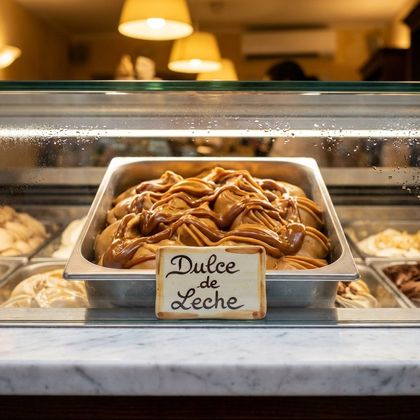
Boiling milk down with sugar until it caramelises is ordinary work in Argentina and around the River Plate, and there the result is treated as a flavour in its own right rather than a sauce poured over one. That changes how much goes in: 150 g per kilo when it carries the base, against 80 to 120 g when it is only a ribbon added afterwards. Those 150 g arrive with 7.35% sugar, 2% MSNF and 1.05% fat already inside them, which is why the sucrose lever can open at zero and the sheet still closes with just 45 g. The cocoa side is halved on purpose and built on 60% chocolate, whose softer tannin sits beside the caramel instead of arguing with it.
That is why the rest of the recipe looks so light. Free sucrose is only 45 g per kilo, against the 115 g the plain chocolate gelato in this same set needs, and non-fat dry milk drops to 8 g because the dulce de leche has already delivered most of the milk solids.
The chocolate is 60% rather than 70%, and the dose is restrained on purpose: 60 g of couverture plus 15 g of cocoa powder. Dulce de leche is intensely sweet and lactic, and the tannin of a 70% would fight it instead of framing it. Salt at 1 g per kilo does the classic caramel job, keeping the combined sugars from reading as cloying at 18.25%, which is the highest sugar figure of these six chocolate recipes.
Ingredients
Makes 1000 g of finished base.
| Ingredient | Grams | Home measure |
|---|---|---|
| Whole Milk | 603 | 2 1/2 cups |
| Dulce de Leche (Can) | 150 | |
| Heavy Cream 35% | 70 | 1/4 cup plus 1 tablespoon |
| Dark Chocolate 60% | 60 | |
| Sugar (Sucrose) | 45 | 3 1/2 tablespoons |
| Dextrose (Glucose) | 45 | 1/4 cup |
| Cocoa Powder 22-24% | 15 | |
| Non-Fat Dry Milk | 8 | 1 1/2 tablespoons |
| Stabilizer (Neutral) | 3 | |
| Salt | 1 |
Loads these exact grams into the free balancer, ready to edit.
Method
Still-freeze with a dulce de leche ribbon at the end
- 1Whisk every dry ingredient together first: sugars, milk powder, stabiliser and salt. Dry-blending them stops the stabiliser clumping when it meets liquid.
- 2Warm the liquids to 40 C (104 F), then rain the dry mix in while whisking hard.
- 3Heat to 82 C (180 F) and hold for 2 minutes so the stabiliser hydrates.
- 4Melt the chocolate to 45 C (113 F) and stir it into the hot base off the heat, then blend 60 seconds until glossy.
- 5Chill in an ice bath to under 5 C (41 F) within 2 hours. Slow cooling is where bacteria and coarse crystals both start.
- 6Age 6 to 12 hours in the fridge under 5 C (41 F). This is when the stabiliser and the milk protein take up water.
- 7Freeze in a shallow metal pan 2 to 3 cm deep, breaking the crystals with a fork every 30 to 40 minutes, 4 to 6 times.
- 8Freeze firm, then temper 10 to 15 minutes in the fridge before scooping.
The balance
All six against the professional range for Milk Gelato.
Sugars at 18.25% are the highest of any chocolate recipe here, and that is a consequence rather than a preference: dulce de leche is a supersaturated sugar system, and 150 g of it carries 7.35% sugar on its own. Sucrose was cut to 45 g per kilo to absorb that, and PAC still lands at 263.96, near the middle of 220 to 300. MSNF at 8.61% is the second number worth reading, sitting close to the 8% floor with only 8 g of added non-fat dry milk, because the dulce de leche is already supplying about 2 points of it. Total solids at 38.19% and water at 61.81% are both mid-range, fat at 8.24% comes from 70 g of cream plus the 1.05% the dulce de leche contributes, and lactose finishes at 7.59% of the water phase, clearing the sandiness check.
Estimated nutrition: ~194 kcal · Fat 8.2 g · Sugars 18.3 g · Protein 4.2 g (per 100 g of mix, from the balanced composition).
Canned dulce de leche has already been through a complete Maillard reaction and must not be cooked again. Above 90 C it darkens further, picks up the bitterness of burnt sugar, and can granulate as supersaturated lactose crystallizes out. Dissolve it into the dairy base at 75 to 78 C at most, stirring, and only once the base has been pasteurized and started to cool. The full order is: pasteurize the milk, cocoa powder, milk powder and sugars at 85 C; off the heat, melt the 60% chocolate and emulsify; drop to 78 C and stir in the dulce de leche; chill to 4 C within 2 hours; mature 8 to 12 hours. Because dulce de leche contributes a lot of PAC per gram, this base runs soft, so if it will not hold in the cabinet, cut dextrose before you cut dulce de leche. It is worth holding back 30 g of the 150 g to ribbon in at the machine outlet, which buys the visual and a spike of flavor without touching the balance, as long as those 30 g come out of the 150 and are not added on top of them.
If it goes wrong
The dulce de leche was heated too hard and its supersaturated lactose crystallized out.
Never take it past 90 C. Stir it in at 75 to 78 C, after pasteurization, once the base has started cooling.
Dulce de leche contributes a lot of PAC per gram and the mix is running at the soft end of its window.
Cut into the 45 g of dextrose first. Never cut the dulce de leche, since it is also carrying 2% of the MSNF and 1.05% of the fat.
The 60% couverture was swapped for a 70%, adding tannin that has nothing to balance against here.
Go back to 60 g of 60% couverture plus 15 g of cocoa powder, the dose this balance was built on.
Suitable for: Vegetarian, Egg-free
Allergens: milk
- https://www.emerils.com/125857/dulce-de-leche-gelato
- https://www.dreamscoops.com/ice-cream-science/ice-cream-calculator/
- https://www.icecreamscience.com/blog/chocolate-ice-cream-recipe
- https://icecreamcalc.com/2021/07/06/ingredient-tutorial/
- The science behind it: Condensed Milk in Gelato
- Ingredient sheet: Dulce de Leche (Can)
Want to change an ingredient and watch the numbers move? Open the free balancer