Chocolate Coconut Gelato
Bitterness leads, the fat rounds it off, and shreds of fruit stay chewy right through the cold, so the last thing on the tongue is not the cocoa.
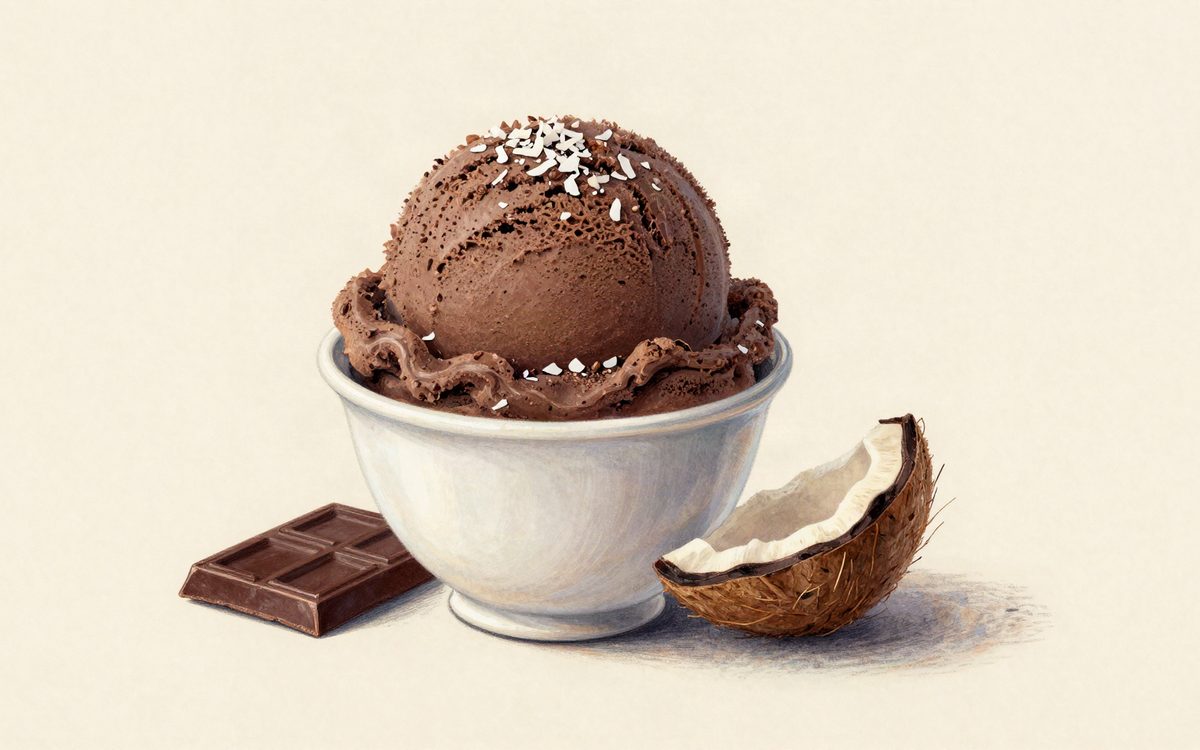
Palms growing in the tropics make a fat that refuses to behave like butter: firm at room temperature, giving way only near body heat, which happens to be the window a gelato has to melt in. This sheet borrows that fat without borrowing the format. Whole milk carries the base at 623 g per kilo, because what is wanted is a gelateria chocolate with coconut and not a plant-based product, and the fruit enters twice for two different jobs: 85 g fresh for fibre and bite, 12 g of coconut milk powder for aroma that arrives without water. Total solids close at 40.71 per cent, a deliberate step short of the 42 ceiling.
Coconut appears in two forms because they do different things. Fresh coconut at 85 g per kilo brings the fibre and the fruit character. Coconut milk powder at 12 g per kilo concentrates the aroma without adding a drop of water, and in this particular recipe water is the scarce commodity.
The binding constraint here is total solids. Coconut runs 53% solids and 34% fat, and stacked on top of the cocoa the first draft came in at 41.6% against a ceiling of 42%, a margin of 0.43 of a point, which is too thin to build a recipe on. Fresh coconut came down from 90 to 85 g, coconut milk powder from 25 to 12 g, and part of the cocoa powder was swapped for cocoa paste. The finished mix reads 40.71% solids and 59.29% water, still the densest of these six chocolate recipes but no longer sitting on the edge.
Ingredients
Makes 1000 g of finished base.
| Ingredient | Grams | Home measure |
|---|---|---|
| Whole Milk | 623 | 2 2/3 cups |
| Sugar (Sucrose) | 110 | 1/2 cup plus 1 tablespoon |
| Coconut | 85 | |
| Dextrose (Glucose) | 45 | 1/4 cup |
| Dark Chocolate 70% | 40 | |
| Cocoa Powder 22-24% | 38 | |
| Skim Milk Powder | 32 | 1/3 cup |
| Coconut Milk Powder | 12 | |
| Cocoa Paste | 10 | |
| Carob Seed Flour | 4 | |
| Salt | 1 |
Loads these exact grams into the free balancer, ready to edit.
Method
Blender base, still-freeze, serve warmer
- 1Whisk every dry ingredient together first: sugars, milk powder, stabiliser and salt. Dry-blending them stops the stabiliser clumping when it meets liquid.
- 2Warm the liquids to 40 C (104 F), then rain the dry mix in while whisking hard.
- 3Heat to 82 C (180 F) and hold for 2 minutes so the stabiliser hydrates.
- 4Melt the chocolate to 45 C (113 F) and stir it into the hot base off the heat, then blend 60 seconds until glossy.
- 5Off the heat, whisk in the paste, then blend 60 seconds so the fat emulsifies instead of separating.
- 6Chill in an ice bath to under 5 C (41 F) within 2 hours. Slow cooling is where bacteria and coarse crystals both start.
- 7Age 6 to 12 hours in the fridge under 5 C (41 F). This is when the stabiliser and the milk protein take up water.
- 8Freeze in a shallow metal pan 2 to 3 cm deep, breaking the crystals with a fork every 30 to 40 minutes, 4 to 6 times.
- 9Freeze firm, then temper 10 to 15 minutes in the fridge before scooping.
The balance
All six against the professional range for Milk Gelato.
Two indicators explain the whole shape of this recipe. Total solids at 40.71% is the highest in this chocolate group and sits high in the band, under the 42% ceiling, which is why there is no dairy cream in the ingredient list at all: coconut fat and cocoa butter already fill the fat slot, and fat still finishes at 8.74%, comfortably inside 6 to 12, without a gram of cream. Water at 59.29% is the lowest of the group, and the 58% floor is precisely what stopped the coconut dose from going higher. PAC at 259.85 sits a little under the middle of 220 to 300, but coconut fat is fully solid at display temperature and makes the tub eat firmer than that number alone predicts. MSNF at 8.65% and protein at 4.71% both stay in range on 32 g of skim milk powder, with lactose at 7.95% of the water phase clearing the sandiness check.
Estimated nutrition: ~207 kcal · Fat 8.7 g · Sugars 16.9 g · Protein 4.7 g (per 100 g of mix, from the balanced composition).
Coconut fat is almost entirely saturated medium-chain and melts between 24 and 26 C, much higher than butterfat. In the mouth it releases fine, but at -12 C in the cabinet it is completely set and the gelato eats harder than PAC 259.85 suggests, so serve this one a little warmer, around -11 C. The second point is texture: fresh coconut is fibrous, and fibre holds free water, which helps against ice crystals but reads as straw if the shreds are coarse. Blend the coconut with part of the milk until it is smooth before it goes anywhere near the base, and pass it through a fine sieve if you can. Dissolve the coconut milk powder separately, it lumps very easily. Pasteurize normally at 82 to 85 C, coconut takes heat well, and add the melted chocolate afterwards at 60 to 65 C.
If it goes wrong
The 85 g of fresh coconut went in coarse and the fibre stayed as visible shreds.
Blend the coconut smooth with part of the 623 g of milk before it enters the base, then sieve.
Coconut fat melts at 24 to 26 C and is fully crystallized at cabinet temperature, so the mix behaves stiffer than its PAC.
Serve at -11 C rather than -12 C. Do not add sugar to compensate, the 42% solids ceiling has no room for it.
The 12 g of coconut milk powder was tipped straight into the mix.
Dissolve it separately in a little warm milk first, then stir that into the base.
Suitable for: Vegetarian, Egg-free
Allergens: milk
- https://icecreamcalc.com/2021/03/12/chocolate-gelato/
- https://icecreamcalc.com/knowledge-base/balancing/
- https://www.dairyscience.info/ice-cream/154-ice-cream-mix.html
- https://www.scuolagelato.it/en/gelato-naturale-balancing-software/
- The science behind it: Coconut Milk for Vegan Gelato
- Ingredient sheet: Coconut
Want to change an ingredient and watch the numbers move? Open the free balancer