Chocolate Brownie Gelato
It eats darker than it looks, with dry baked crumbs that break between the teeth while everything around them melts soft and slow.
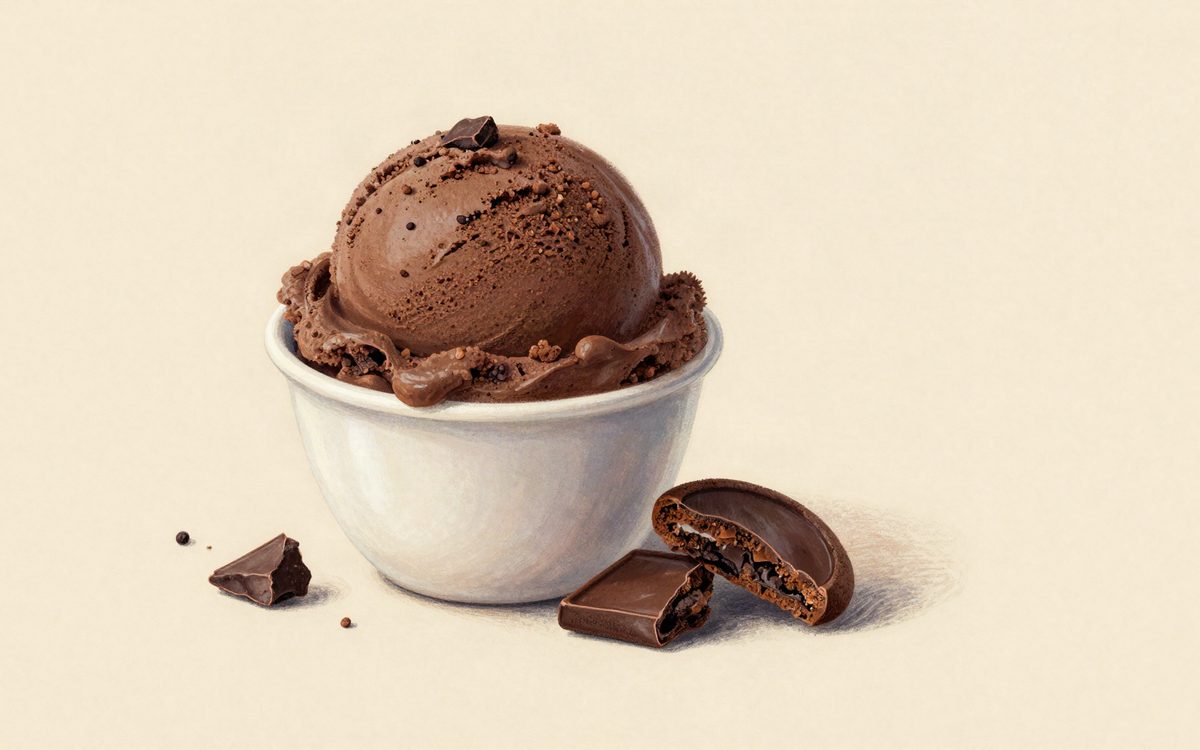
Two labels decide how this one tastes, and neither of them is the dairy. Cocoa powder should state its fat on the tin, and the 22 to 24 percent grade is the one worth paying for, since thinner powders carry less cocoa butter and read dusty and short once frozen. On the chocolate, check that cocoa butter is the only fat named, because coatings built on vegetable fat set waxy against a cold tongue. The biscuit looks like the least technical purchase and behaves like the most important one, because it has to be baked dry enough to stay crisp in suspension. At 80 g per kilo it brings its own chocolate and sugar, which is why the base behind it stays lighter than a straight chocolate gelato: 50 g of couverture and 35 g of cocoa, no more.
Worth saying plainly: this is a reconstruction rather than a literal brownie. A real brownie is wetter and softer than a biscuit, so the inclusion here will read crisper and less fudgy than the name suggests. The sugar, fat and dry solids profile lines up closely, the moisture does not.
The consequence shows up in total solids, which read 39.26 percent against a ceiling of 42. That is in the upper half for a milk gelato, and the biscuit plus the couverture are what put it there. It is also why there is no cream in the recipe at all: fat comes out at 6.04 percent, barely above its floor of 6, because biscuit, couverture and cocoa deliver fat before any dairy does.
Ingredients
Makes 1000 g of finished base.
| Ingredient | Grams | Home measure |
|---|---|---|
| Whole Milk | 413 | 1 3/4 cups |
| Skim Milk | 261 | 1 cup |
| Sugar (Sucrose) | 85 | 1/3 cup plus 2 tablespoons |
| Chocolate Biscuit | 80 | |
| Dark Chocolate 60% | 50 | |
| Dextrose (Glucose) | 45 | 1/4 cup |
| Cocoa Powder 22-24% | 35 | |
| Non-Fat Dry Milk | 26 | 1/4 cup plus 1 tablespoon |
| Stabilizer (Neutral) | 4 | |
| Salt | 1 |
Loads these exact grams into the free balancer, ready to edit.
Method
Still-freeze with the biscuit folded in on the last stir
- 1Whisk every dry ingredient together first: sugars, milk powder, stabiliser and salt. Dry-blending them stops the stabiliser clumping when it meets liquid.
- 2Warm the liquids to 40 C (104 F), then rain the dry mix in while whisking hard.
- 3Heat to 82 C (180 F) and hold for 2 minutes so the stabiliser hydrates.
- 4Melt the chocolate to 45 C (113 F) and stir it into the hot base off the heat, then blend 60 seconds until glossy.
- 5Chill in an ice bath to under 5 C (41 F) within 2 hours. Slow cooling is where bacteria and coarse crystals both start.
- 6Age 6 to 12 hours in the fridge under 5 C (41 F). This is when the stabiliser and the milk protein take up water.
- 7Freeze in a shallow metal pan 2 to 3 cm deep, breaking the crystals with a fork every 30 to 40 minutes, 4 to 6 times.
- 8Freeze firm, then temper 10 to 15 minutes in the fridge before scooping.
The balance
All six against the professional range for Milk Gelato.
Start with the two numbers that pin this formula down. Solids at 39.26 percent leave less than three points of headroom under the 42 ceiling, which means every gram of extra biscuit or chocolate has to come out of something else. And fat at 6.04 percent sits almost on its floor of 6, which is unusual for anything called a chocolate gelato and is a direct consequence of the inclusion: the balance spent its fat budget on cocoa and couverture rather than on cream. The lever that made it work is 261 g of skim milk per kilo alongside 413 g of whole milk, used as a diluent to bring water back to 60.74 percent without losing milk solids, with MSNF landing at 8.56 percent just clear of its 8 floor. That combination is only safe because lactose comes to 7.68 percent of the water phase, under the level where it would crystallize and turn the gelato sandy, which is what lets 26 g of non-fat dry milk sit on top of 674 g of liquid milk.
Estimated nutrition: ~187 kcal · Fat 6 g · Sugars 17.4 g · Protein 4.6 g (per 100 g of mix, from the balanced composition).
The order of operations is the whole recipe. Pasteurize the base with the cocoa at 85 C, melt the 60 percent couverture off the heat at around 70 C and stir it in, rest the mix 12 hours, and fold the biscuit in only at the very end of freezing. Never pasteurize the biscuit with the base: it dissolves, you lose the only reason the flavor exists, and what you have left is a slightly dull chocolate gelato. The other thing to accept up front is that this base is not rich. With fat at 6.04 percent it is built to be a carrier for the inclusion, not to be eaten plain, and the temptation to fix that by pouring in cream runs straight into the solids ceiling, since they already read 39.26 percent out of 42.
If it goes wrong
They were folded in too early, or broken too fine, so the crumb drank water from the mix.
Fold coarse pieces in on the last stir before hardening. If you want them to survive longer, coat them in melted chocolate first, which puts a fat barrier between the crumb and the water phase.
Solids at 39.26 percent with fat at only 6.04 percent gives you density without the fat that normally softens the eat.
Temper it 10 to 15 minutes in the fridge before serving. Do not add more biscuit to compensate, because that pushes solids toward the 42 ceiling and makes the problem worse.
That is by design. The base runs 50 g of couverture and 35 g of cocoa powder, lighter than a straight chocolate gelato, because the inclusion already carries baked chocolate flavor.
Eat it with the biscuit in the spoon, which is how it was balanced to taste. If you genuinely want a plain intense chocolate, use a chocolate gelato formula instead of raising the couverture here, since both fat and solids move when you do.
Suitable for: Vegetarian, Egg-free
Allergens: gluten, milk
- https://icecreamcalc.com/2021/03/12/chocolate-gelato/
- https://scoopsandsavor.com/best-chocolate-gelato-authentic-italian-recipe/
- https://italianchef.com/chocolate-gelato/
- The science behind it: Couverture Chocolate for Gelato
- Ingredient sheet: Dark Chocolate 60%
Want to change an ingredient and watch the numbers move? Open the free balancer