Chili Chocolate Gelato
Bitterness lands first and sits low, then a slow warmth climbs the back of the throat, arriving after the cold has gone and staying well past it.
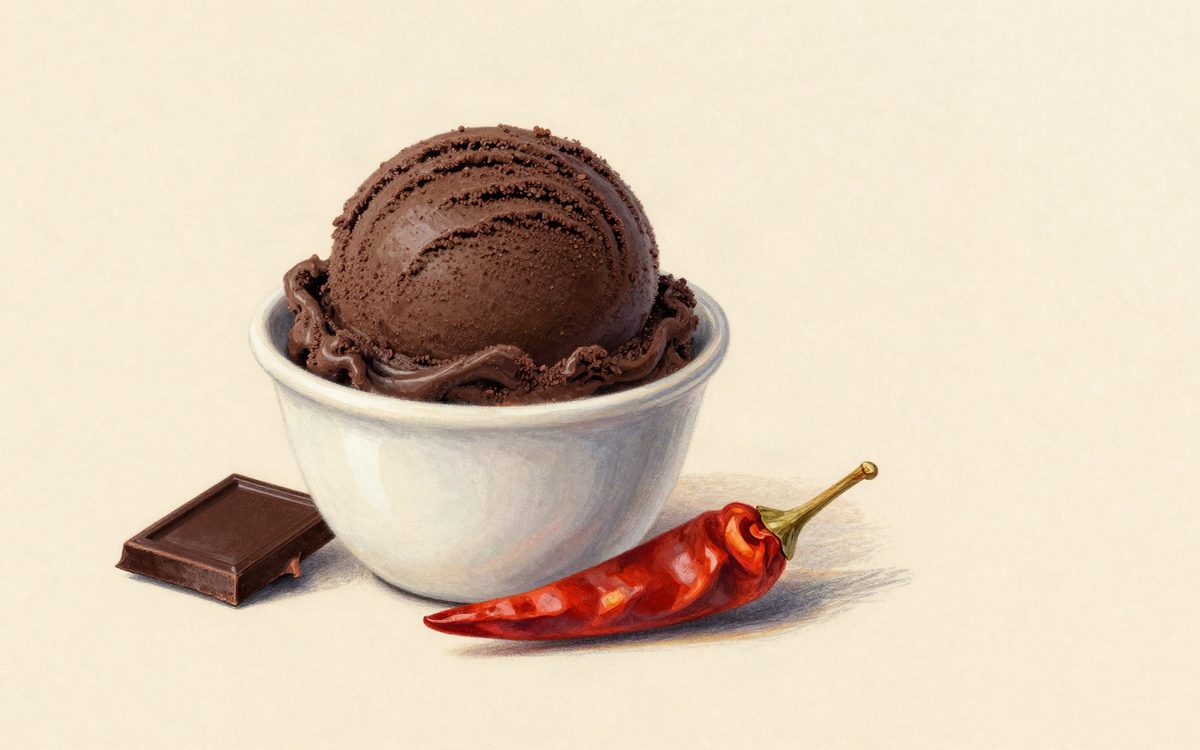
Turn the cocoa packet over and find the fat figure before you look at the price. Powder at 22 to 24 percent cocoa butter carries flavour the way the low-fat sort never will; the cheap version tastes dusty, dries the finish and gets no better when you use more of it. The same test works on the bar: cocoa mass and cocoa butter at the top of the list, sugar after them, and nothing vegetable standing in for cocoa butter. Three forms go in here for depth rather than for weight, 45 g of powder, 15 g of cocoa paste and 55 g of chocolate at 70 percent, over milk alone with no cream at all, and 2 g of salt that sharpens both the cacao and the heat.
The reference dose for cayenne in a chocolate ice cream is about a quarter teaspoon per liter, somewhere between 0.4 and 0.6 g per kilo. That is 0.05 percent of the mass, below the resolution of any balancing calculation and with no measurable effect on the eight indicators. So it goes in as an addition you dose by taste, and the sheet stays honest about it.
What makes this base different from a straight chocolate gelato is that there is no cream in it. The only liquid dairy is 695 g of whole milk per kilo, and fat comes out at 6.40 percent inside a 6 to 12 band, most of it cocoa butter rather than dairy fat. Salt is set at 2 g per kilo, double what the other flavors in this family use, because sodium sharpens both the perception of capsaicin and the bitterness of cocoa, and bitterness plus burn is the whole point of the flavor.
Ingredients
Makes 1000 g of finished base.
| Ingredient | Grams | Home measure |
|---|---|---|
| Whole Milk | 695 | 3 cups |
| Sugar (Sucrose) | 120 | 1/2 cup plus 2 tablespoons |
| Dark Chocolate 70% | 55 | |
| Cocoa Powder 22-24% | 45 | |
| Dextrose (Glucose) | 40 | 3 1/2 tablespoons |
| Skim Milk Powder | 24 | 1/4 cup |
| Cocoa Paste | 15 | |
| Carob Seed Flour | 4 | |
| Salt | 2 |
Loads these exact grams into the free balancer, ready to edit.
Method
Hot-milk chocolate base, blended still-freeze
- 1Whisk every dry ingredient together first: sugars, milk powder, stabiliser and salt. Dry-blending them stops the stabiliser clumping when it meets liquid.
- 2Warm the liquids to 40 C (104 F), then rain the dry mix in while whisking hard.
- 3Heat to 82 C (180 F) and hold for 2 minutes so the stabiliser hydrates.
- 4Melt the chocolate to 45 C (113 F) and stir it into the hot base off the heat, then blend 60 seconds until glossy.
- 5Off the heat, whisk in the paste, then blend 60 seconds so the fat emulsifies instead of separating.
- 6Chill in an ice bath to under 5 C (41 F) within 2 hours. Slow cooling is where bacteria and coarse crystals both start.
- 7Age 6 to 12 hours in the fridge under 5 C (41 F). This is when the stabiliser and the milk protein take up water.
- 8Freeze in a shallow metal pan 2 to 3 cm deep, breaking the crystals with a fork every 30 to 40 minutes, 4 to 6 times.
- 9Freeze firm, then temper 10 to 15 minutes in the fridge before scooping.
The balance
All six against the professional range for Milk Gelato.
Fat at 6.40 percent is in the low part of its 6 to 12 band on purpose. Dairy fat coats the palate and mutes chili, because capsaicin dissolves into it, so keeping the fat low and mostly cocoa butter is what lets the burn actually arrive. The second reading worth understanding is the pair of milk solids figures: MSNF is 8.54 percent, only just clear of the 8 floor, while protein is 4.64 percent, close to its 5 ceiling. That looks contradictory until you notice where the protein comes from. Cocoa powder is protein rich but contributes no milk solids, so it pushes protein up without helping MSNF, which is why the skim milk powder had to stay down at 24 g rather than the 45 g a chestnut base can carry. PAC 264.76 sits mid band, with 120 g of sucrose and 40 g of dextrose sharing the load, dextrose there to keep the scoop workable without making the gelato sweeter than the cocoa can carry.
Estimated nutrition: ~186 kcal · Fat 6.4 g · Sugars 17.4 g · Protein 4.6 g (per 100 g of mix, from the balanced composition).
Capsaicin is fat soluble, not water soluble. If you throw chili powder into a cold or watery mix it will never disperse evenly and you get placid spoonfuls and vicious spoonfuls out of the same tub. Dissolve it into the melted chocolate at about 45 C, before that chocolate goes into the base. The second thing to know is that heat perception collapses in the cold, because the TRPV1 receptor is temperature sensitive. A dose that seems right in a warm base disappears at serving temperature, so always taste a spoonful that has been chilled, never the hot mix, and expect to need something like one and a half to two times the dose you would use in a room temperature dessert. Heat also builds during the maturation rest, so underdose deliberately and correct the next day. You can always add chili. You can never take it out.
If it goes wrong
The chili powder was added to the water phase or to a cold mix, so the capsaicin never dispersed.
Bloom the chili in the melted chocolate at around 45 C and only then combine it with the base, blending well. Fat is the carrier, so the chili has to meet the fat first.
The dose was judged on a warm base. Cold suppresses the receptor that reads capsaicin.
Put a spoonful in the freezer for 15 minutes and taste that before deciding. Assume you need roughly one and a half to two times the warm-tasting dose, and add the difference before the maturation rest.
Cocoa powder is very thirsty and this base has no cream to offset it, with fat sitting at only 6.40 percent.
Do not add more cocoa powder to make it darker, that is what causes it. Make sure the 4 g of carob seed flour was hydrated properly at 85 C and blend the base thoroughly before freezing.
Suitable for: Vegetarian, Egg-free
Allergens: milk
- https://bakingbytes.com/2018/07/06/chocolate-chili-ice-cream/
- https://barefeetinthekitchen.com/spicy-chocolate-ice-cream-recipe/
- https://www.frontiercoop.com/recipes/mexican-chocolate-ice-cream-with-cayenne
- https://icecreamcalc.com/2021/03/12/chocolate-gelato/
- The science behind it: Spice Infusion in Gelato
- Ingredient sheet: Dark Chocolate 70%
Want to change an ingredient and watch the numbers move? Open the free balancer