Cherry Gelato (Milk Base)
A tart, almond-edged fruit note cuts through soft milk, cold on the first spoon and still hanging on once the body has melted away.
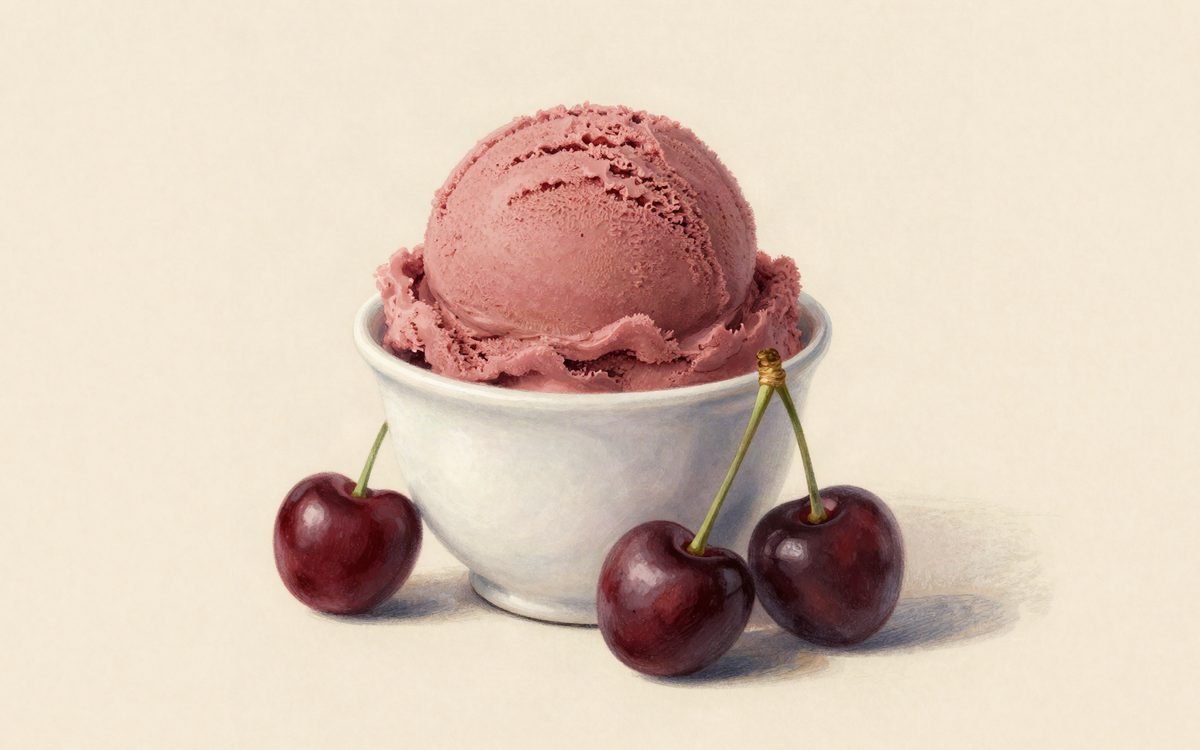
Sugar chemistry sets the ceiling here before anything else does. At 260 g/kg the fruit alone brings around 68 points of PAC, because its sugars are largely free glucose and fructose, small molecules that push the freezing point down far harder than sucrose does. So dextrose stops earning its place and drops out of the blend entirely. Sucrose and glucose powder cover the rest, the powder carrying solids and body while costing almost nothing in PAC. Ignore all that and the scoop slumps in the cabinet at minus 12 C. Respect it and what reaches the tongue is ripe stony fruit with an almond-bitter edge, cut clean by 6 g of lemon juice.
At 260 g/kg, the fruit alone brings something like 68 of PAC to the mix, and the finished figure is 268.94 against a 310 ceiling. That is why there is no dextrose in this formula at all: the cherries already did that job. The added sugar is 105 g/kg of sucrose plus 60 g/kg of glucose powder, which was chosen precisely because its PAC of 72 is low for the solids it delivers.
Getting this wrong is the classic cherry gelato failure. Build the blend the usual way, with dextrose in it, and the tub will not hold at -12 C in a display case.
The dairy is deliberately restrained so the fruit leads: fat at 6.32% inside the narrower 3.5 to 8 band for a milk-fruit base, MSNF at 8.68% inside 5 to 9.5, and protein at 3.5%. The 6 g/kg of lemon juice supplies the acid edge a ripe cherry loses and sharpens the almond-bitter note that is the fruit's signature.
Ingredients
Makes 1000 g of finished base.
| Ingredient | Grams | Home measure |
|---|---|---|
| Whole Milk | 378 | 1 1/2 cups |
| Cherry | 260 | |
| Heavy Cream 35% | 140 | 1/2 cup plus 2 tablespoons |
| Sugar (Sucrose) | 105 | 1/2 cup plus 1 tablespoon |
| Glucose Powder | 60 | 1/4 cup plus 1 tablespoon |
| Non-Fat Dry Milk | 47 | 1/2 cup |
| Lemon Juice | 6 | |
| Stabilizer (Neutral) | 3 | |
| Salt | 1 |
Loads these exact grams into the free balancer, ready to edit.
Method
Frozen cherry cubes, one blitz
- 1Whisk every dry ingredient together first: sugars, milk powder, stabiliser and salt. Dry-blending them stops the stabiliser clumping when it meets liquid.
- 2Warm the liquids to 40 C (104 F), then rain the dry mix in while whisking hard.
- 3Heat to 82 C (180 F) and hold for 2 minutes so the stabiliser hydrates.
- 4Chill in an ice bath to under 5 C (41 F) within 2 hours. Slow cooling is where bacteria and coarse crystals both start.
- 5Age 6 to 12 hours in the fridge under 5 C (41 F). This is when the stabiliser and the milk protein take up water.
- 6Fold the fruit in cold, after ageing. Heating it costs you the fresh aroma and nothing is gained.
- 7Freeze in a shallow metal pan 2 to 3 cm deep, breaking the crystals with a fork every 30 to 40 minutes, 4 to 6 times.
- 8Freeze firm, then temper 10 to 15 minutes in the fridge before scooping.
The balance
All six against the professional range for Milk Gelato with Fruit.
Two figures set everything. PAC at 268.94 sits in the lower half of the 240 to 310 window, and it got there mostly from the fruit itself, which is why the sugar blend is sucrose plus glucose powder with dextrose at zero. Total sugars land at 19.54%, comfortably inside the 17 to 25 range that a fruit and milk base uses, and POD finishes at 177.99 in the lower half of 150 to 230, so the mix is sweet enough to keep the cherry from reading sour without becoming syrup. Water at 64.24% is in the upper half of the 60 to 68 band and solids are the lowest of the group at 35.76%, both direct consequences of putting a quarter of the mix in as fresh fruit, which is also why the 47 g/kg of non-fat dry milk and the 3 g/kg of stabilizer are carrying more structural load than usual.
Estimated nutrition: ~175 kcal · Fat 6.3 g · Sugars 19.5 g · Protein 3.5 g (per 100 g of mix, from the balanced composition).
Pit the cherries without cracking the pits. Cherry pits contain amygdalin, which in the presence of water and enzyme releases benzaldehyde and traces of cyanide, so the old trick of cracking pits to infuse an almond note is not worth doing. If you want that note, use a vanilla bean or extract in the base. The pulp goes in raw, into the cold base, never cooked with it. Cherry oxidizes to a brown-wine color at air, so work fast and put the lemon juice on the pulp immediately. Because the fruit PAC is high, check hardness in the case before scaling the recipe up: if it runs soft, cut the fruit to 230 g/kg rather than adding sugar, since more sugar makes the problem worse.
If it goes wrong
PAC pushed past the ceiling, usually by adding dextrose to a fruit that already contributes about 68 of PAC on its own.
Keep dextrose at zero and, if it is still soft, drop the cherries from 260 to 230 g/kg. Never correct softness with more sugar.
The cherry pulp oxidized while sitting exposed, or it was heated.
Put the 6 g/kg of lemon juice on the pulp the moment it is pitted, work quickly, and add the puree raw to the already cold base.
The pulp was pasteurized along with the dairy, which cooks off the volatile fruit character.
Pasteurize the dairy base alone, cool it to 4 C, then blend in the raw fruit before churning.
Suitable for: Vegetarian, Egg-free
Allergens: milk
- Goff, H.D.; Hartel, R.W. - Ice Cream, 7a ed., Springer, 2013 (peso molecular dos acucares e depressao do ponto de congelamento)
- Corvitto, A. - Los secretos del helado: el helado sin secretos, Vilbo, 2004 (tabela PAC por fruta e correcao do blend)
- USDA FoodData Central - composicao da cereja doce crua (https://fdc.nal.usda.gov)
- Caviezel, L. - Scienza e tecnologia del gelato artigianale, Chiriotti Editori (gelato alla ciliegia)
- The science behind it: Why Acidic Fruit Curdles Dairy Gelato, and How to Stop It
- Ingredient sheet: Cherry
Want to change an ingredient and watch the numbers move? Open the free balancer