Cappuccino Gelato
What leads is the dairy: soft, almost foamed, sweet ahead of the roast, with bitterness turning up only at the finish and cinnamon sitting at the edge.
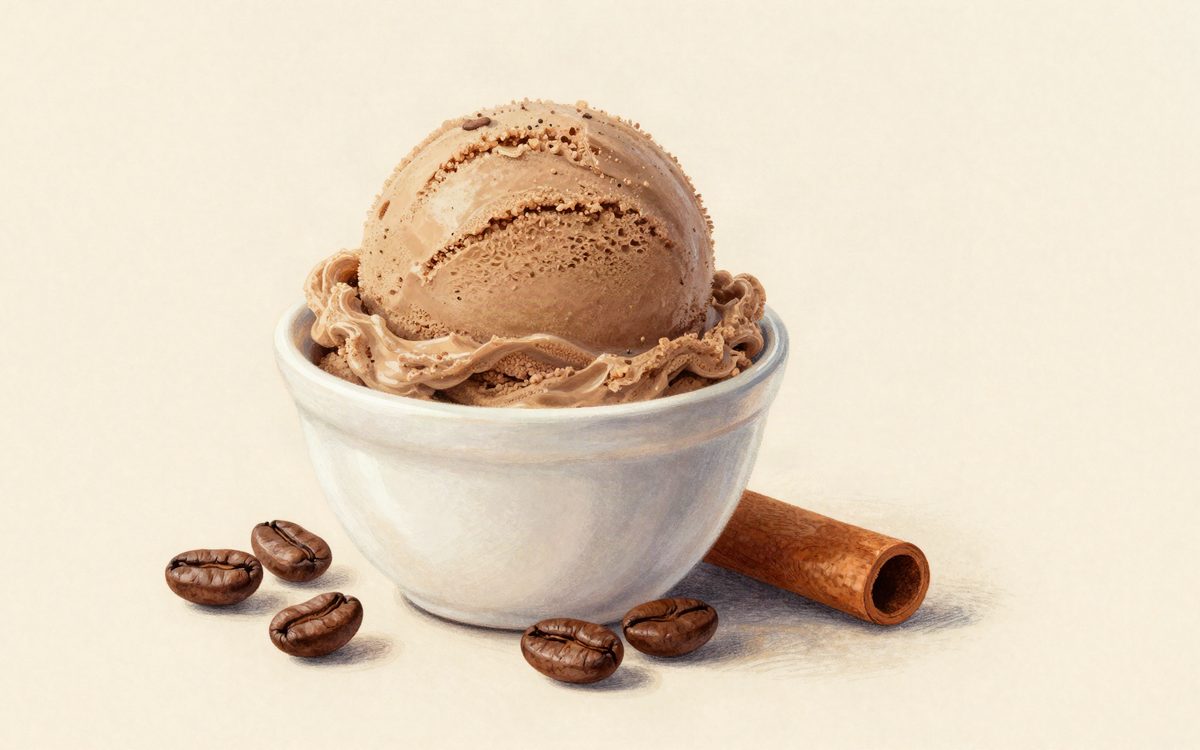
The first spoonful reads as milk. It is soft, faintly foamed in feel, and sweet before anything roasted shows up. Coffee comes a beat later, a dry bitterness at the back of the tongue that opens as the gelato warms towards eating temperature. Cinnamon is the last thing you notice and the first you would miss at 1 g per kilo, dusted rather than spiced in. That order is built in: MSNF sits at 10.58 percent, high in the professional band, while total coffee stays at 64 g per kilo, so the dairy holds the front the way steamed milk does in the cup.
So the coffee is kept small: 60 g/kg of espresso plus just 4 g/kg of instant, 64 g of coffee in total. The dairy side does the opposite. Skim milk powder runs to 51 g/kg against a 55 g/kg ceiling, and MSNF finishes at 10.58%, in the top third of the 8 to 11.5 band. That is where the cooked milk taste and the velvety, foam-like mouthfeel live.
Fat, meanwhile, stays at 7.57%, in the lower half of 6 to 12, and it is the leanest of the plain milk bases in this group. A cappuccino is milk, not cream, and loading the cream would blur the coffee instead of framing it.
The cinnamon is 1 g/kg, which is the dusting on top of an Italian cappuccino, not a spice gelato. Above about 3 g/kg it starts masking the coffee and its starch dries the texture out.
Ingredients
Makes 1000 g of finished base.
| Ingredient | Grams | Home measure |
|---|---|---|
| Whole Milk | 539 | 2 1/4 cups |
| Heavy Cream 35% | 160 | 2/3 cup |
| Sugar (Sucrose) | 160 | 3/4 cup plus 1 tablespoon |
| Espresso (Rich) | 60 | |
| Skim Milk Powder | 51 | 1/2 cup plus 1 tablespoon |
| Dextrose (Glucose) | 20 | 1 1/2 tablespoons |
| Instant Coffee | 4 | |
| Carob Seed Flour | 4 | |
| Cinnamon Powder | 1 | |
| Salt | 1 |
Loads these exact grams into the free balancer, ready to edit.
Method
Freeze solid, then food processor
- 1Whisk every dry ingredient together first: sugars, milk powder, stabiliser and salt. Dry-blending them stops the stabiliser clumping when it meets liquid.
- 2Warm the liquids to 40 C (104 F), then rain the dry mix in while whisking hard.
- 3Heat to 82 C (180 F) and hold for 2 minutes so the stabiliser hydrates.
- 4Chill in an ice bath to under 5 C (41 F) within 2 hours. Slow cooling is where bacteria and coarse crystals both start.
- 5Age 6 to 12 hours in the fridge under 5 C (41 F). This is when the stabiliser and the milk protein take up water.
- 6Freeze in a shallow metal pan 2 to 3 cm deep, breaking the crystals with a fork every 30 to 40 minutes, 4 to 6 times.
- 7Freeze firm, then temper 10 to 15 minutes in the fridge before scooping.
The balance
All six against the professional range for Milk Gelato.
The whole formula is a trade between two numbers that pull against each other. Pushing MSNF up to 10.58% is what makes it read as cappuccino rather than coffee, but milk solids are mostly lactose, which is barely sweet, so sucrose had to stay high at 160 g/kg to land POD at 182.66, high in the 140 to 200 band. Dextrose was then held to just 20 g/kg, because dextrose depresses the freezing point hard and PAC was already headed to 259.24 inside 220 to 300. The cost of milk-forward shows in the third number: lactose sits at 9.22% of the water phase, which passes, but with little room left. Around 11.5% MSNF, lactose saturates in the frozen water phase and crystallizes into the wet-sand texture called sandiness, which is why the 55 g/kg powder ceiling is not something to widen.
Estimated nutrition: ~188 kcal · Fat 7.6 g · Sugars 17.9 g · Protein 4 g (per 100 g of mix, from the balanced composition).
Two order-of-operations details decide this one. Hydrate the milk powder together with the sugar in milk at 40 C before raising the temperature, otherwise it forms lumps that never disperse. Ground cinnamon does not dissolve at all: mix the 1 g into the dry sugar first and pass the base through a stick blender, or it floats and then scorches on the pan bottom during pasteurization. The coffee goes in cold, after the base has come back down below 45 C, because hot espresso hitting hot dairy is acid enough to curdle it. Everything else is standard for a milk base: mature at 4 C, churn cold.
If it goes wrong
Lactose crystallizing. MSNF is already at 10.58% and lactose at 9.22% of the water phase, so extra powder tips it over.
Do not raise skim milk powder above 51 g/kg, and never past the 55 g/kg ceiling. Correct thin body with cream instead.
Milk powder added to hot liquid, or cinnamon dropped into the base where it floats and settles onto the hot pan bottom.
Hydrate the powder with the sugar in 40 C milk, and disperse the cinnamon in dry sugar before it meets any liquid.
Espresso added hot into a hot base, where its acidity coagulates the casein.
Cool the base below 45 C first, then stir in the 60 g of espresso and the 4 g of instant coffee cold.
Suitable for: Vegetarian, Egg-free
Allergens: milk
- https://www.greatitalianchefs.com/recipes/vanilla-cappuccino-gelato-recipe
- https://hamiltonbeach.com/cappuccino-gelato
- https://allourway.com/cappuccino-gelato-easy-no-churn/
- https://www.recipesfromitaly.com/coffee-gelato-recipe/
- The science behind it: Gelato Total Solids
- Ingredient sheet: Espresso (Rich)
Want to change an ingredient and watch the numbers move? Open the free balancer