Buontalenti Cream Gelato
Thick and pale yellow on the spoon, tasting of cooked milk and egg, finishing clean because there is nothing perfumed standing in front of it.
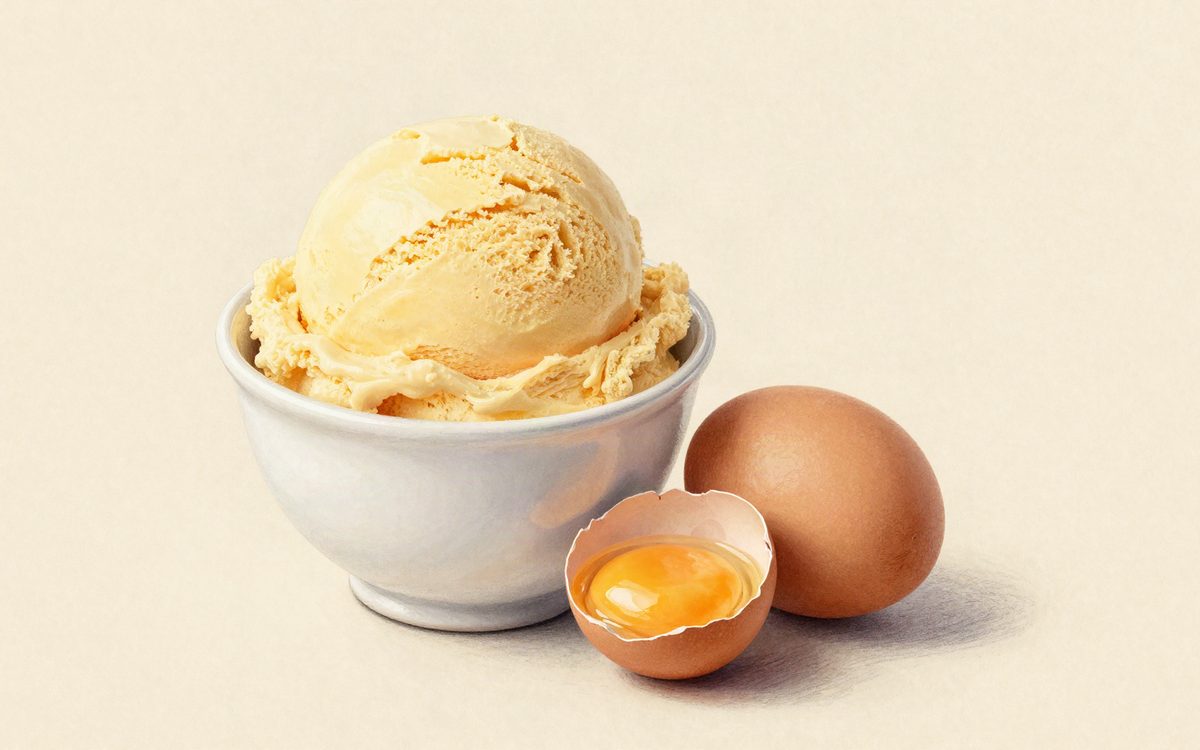
Florence is where this one belongs, and the name goes back to the Medici court. What defines it now is subtraction: milk, cream, egg yolk and sugar, and nothing standing in front of them. No vanilla to round the corners, no commercial stabiliser to smooth the texture. The structure still has to come from somewhere, and it comes from the yolk itself, whose lecithin and low-density lipoproteins emulsify the fat while its phospholipids hold water. That is why 85 g of yolk per kilo is the one figure here that cannot move, and why the spoonful tastes of cooked milk and egg and of nothing else.
The 85 g/kg of egg yolk is the entire structural system. Yolk lecithin and low density lipoproteins emulsify the fat, and its phospholipids hold water, which is the job the stabilizer would otherwise do. That yolk load is also what pushes protein to 4.69%, close under the 5% ceiling for a milk gelato, and it is why cream stops at 130 g/kg: the yolk alone brings about 27 g of fat, and total fat still finishes at 9.29% inside the 6 to 12 band.
The dose comes from the modern Badiani version, roughly 300 ml of milk, 300 ml of cream, four yolks and 120 g of sugar, which works out near 90 g of yolk per kilo of mix. It was rounded down here because yolk carries about 16% protein and the ceiling is 5%. For the same reason the milk powder was capped at 40 g/kg and ended at 34.
With 150 g/kg of sucrose plus 35 g/kg of dextrose, sugars land at 18.18% and POD at 180.29, in the upper half of 140 to 200. It reads as a dessert cream, but the flavor is only cooked milk and yolk, so nothing covers a mistake.
Ingredients
Makes 1000 g of finished base.
| Ingredient | Grams | Home measure |
|---|---|---|
| Whole Milk | 566 | 2 1/3 cups |
| Sugar (Sucrose) | 150 | 3/4 cup |
| Heavy Cream 35% | 130 | 1/2 cup plus 1 tablespoon |
| Egg Yolk | 85 | |
| Dextrose (Glucose) | 35 | 3 tablespoons |
| Skim Milk Powder | 34 | 1/3 cup plus 1 tablespoon |
Loads these exact grams into the free balancer, ready to edit.
Method
Whisk every 30 minutes, three rounds
- 1Whisk every dry ingredient together first: sugars, milk powder, stabiliser and salt. Dry-blending them stops the stabiliser clumping when it meets liquid.
- 2Warm the liquids to 40 C (104 F), then rain the dry mix in while whisking hard.
- 3Beat the yolks with part of the sugar, then temper: pour the warm base over the yolks in a thin stream, never the other way round.
- 4Bring to 82 to 85 C (180 to 185 F) and stop. Past 87 C the yolk coagulates and no amount of blending brings the flavour back.
- 5Chill in an ice bath to under 5 C (41 F) within 2 hours. Slow cooling is where bacteria and coarse crystals both start.
- 6Age 6 to 12 hours in the fridge under 5 C (41 F). This is when the stabiliser and the milk protein take up water.
- 7Freeze in a shallow metal pan 2 to 3 cm deep, breaking the crystals with a fork every 30 to 40 minutes, 4 to 6 times.
- 8Freeze firm, then temper 10 to 15 minutes in the fridge before scooping.
The balance
All six against the professional range for Milk Gelato.
Solids at 38.04% and fat at 9.29% are what allow the stabilizer line to be empty. This mix is essentially a creme anglaise: with 85 g/kg of yolk, the emulsion is built by lecithin migrating to the fat and water interface during maturation instead of by a gum holding water. Protein at 4.69% is the constraint that shaped everything else, since it sits just under the 5% ceiling, so cream had a floor of 60 g/kg and a ceiling of 220 g/kg and the milk powder had to stay low, ending at 34 g/kg with MSNF at 9.04%. PAC at 259.73 is mid band in 220 to 300, so the block firms up in a home freezer without turning brittle, and lactose at 7.95% of the water phase leaves real margin against sandiness, which is the payoff for keeping powder down.
Estimated nutrition: ~199 kcal · Fat 9.3 g · Sugars 18.2 g · Protein 4.7 g (per 100 g of mix, from the balanced composition).
This is the highest coagulation risk in the set, because 85 g/kg of yolk makes the mix a custard. Work at 82 to 85 C with continuous stirring and pull it off the heat the moment it arrives; above 87 C the yolk flocculates and no blender recovers it. If your setup has no fine temperature control, hold 65 C for 30 minutes instead, which pasteurizes the same with far less risk. Cool to 4 C in under two hours, because a yolk-rich mix is an ideal substrate for Salmonella if it lingers between 20 and 45 C. Mature at least 8 hours: without a stabilizer, maturation is not optional, it is when the emulsion actually forms. And since there is no vanilla to hide behind, never reuse a mix that scorched on the pan bottom.
If it goes wrong
The mix went past 87 C and the yolk protein flocculated.
Hold 82 to 85 C with constant stirring and pull off the heat immediately, or use the 65 C for 30 minutes route if you cannot control temperature closely.
Maturation was cut short. There is no stabilizer here, so the 8 hours are the emulsion.
Chill to 4 C fast and mature at least 8 hours before churning, so the yolk lecithin reaches the fat and water interface.
Overcooked yolk or a scorched pan bottom, with no vanilla or flavoring in the formula to mask it.
Start over in a clean pan, stir continuously, and drop the pot into an ice bath the second the target temperature is reached.
Suitable for: Vegetarian
Allergens: egg, milk
No ingredient in this recipe contains gluten.
- https://magazine.marketuscany.com/gelato-buontalenti/
- https://www.lanazione.it/cultura-e-spettacoli/gelato-gusto-buontalenti-c52e6aa2
- https://www.gelateriafiorentina.com/fiorentini-illustri-bernardo-buontalenti/
- https://pepolinoverde.wordpress.com/2022/08/12/gelato-alla-crema-fiorentina-crema-buontalenti/
- The science behind it: Custard Gelato Balance Guide
- Ingredient sheet: Egg Yolk
Want to change an ingredient and watch the numbers move? Open the free balancer