Brazil Nut Gelato
Rich and oily on the tongue, milky rather than sweet, with a faint sulphurous note behind the nut and a pinch of salt that keeps the finish clean.
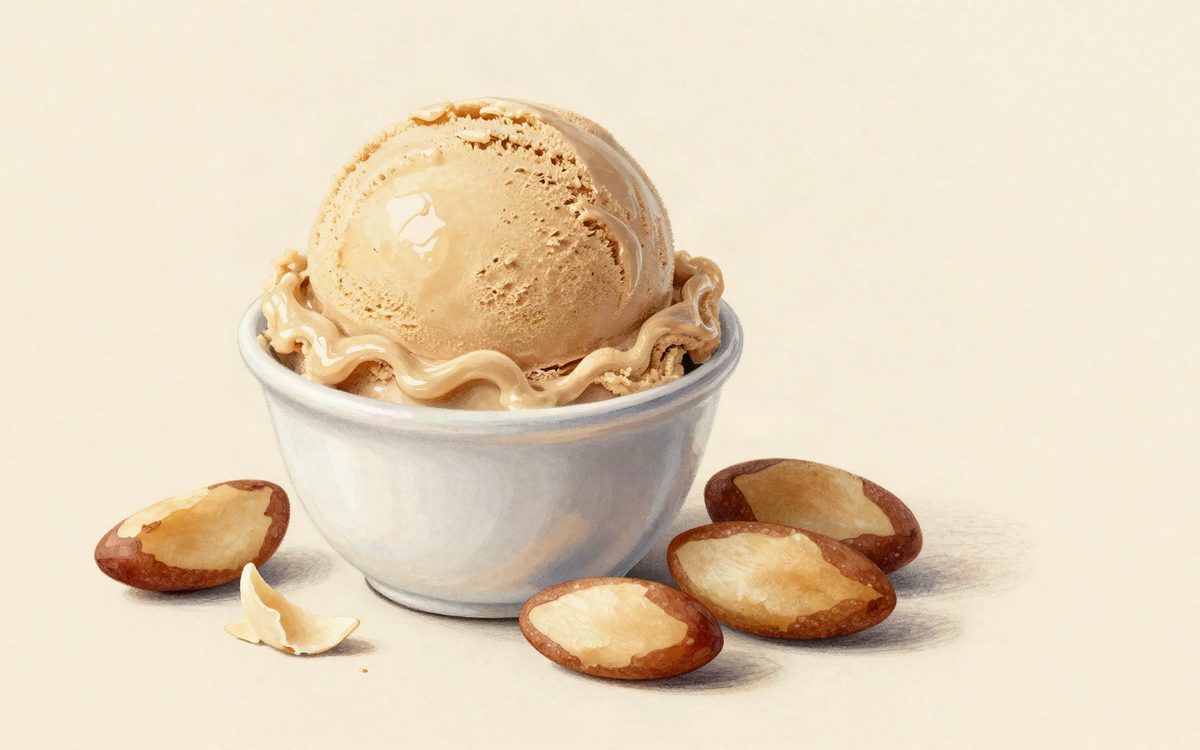
Gathered from the forests of Amazonia, where it goes by castanha-do-pará, this is one of the fattest nuts anyone can put into a gelato: about two thirds fat, with a faintly sulphurous edge that is unmistakable in a small dose and tiring in a large one. Balance and palate point the same way. At 70 g of pure paste per kilo the nut contributes roughly 4.6% fat and 1% vegetable protein, and the finished sheet reads 8.57% fat with protein at 4.7%, already brushing its 5% ceiling. A single gram of salt lifts the nut and trims the slight bitterness the skin leaves behind.
There is a taste limit as well as an arithmetic one. Brazil nut carries a distinctly sulfurous note that turns aggressive at high dose, unlike pistachio, which takes 90 g/kg without wearing out its welcome. 70 g/kg is the point where the flavor is unmistakable and still pleasant, and the 1 g of salt is there to lift it and to cut the faint bitterness of the skin.
Since the nut brings almost no sugar of its own, roughly 2%, the sugars have to come from outside: 140 g of sucrose and 35 g of dextrose per kilo, landing at 17.32% total sugars in a 16 to 22 window and POD 172.34 in a 140 to 200 window. Then 666 g of whole milk and 39 g of non-fat dry milk carry MSNF to 9.99%, right in the middle of the 8 to 11.5 band this base asks for.
Ingredients
Makes 1000 g of finished base.
| Ingredient | Grams | Home measure |
|---|---|---|
| Whole Milk | 666 | 2 3/4 cups |
| Sugar (Sucrose) | 140 | 2/3 cup plus 1 tablespoon |
| Brazil Nut Paste 100% | 70 | |
| Heavy Cream 35% | 45 | 3 tablespoons |
| Non-Fat Dry Milk | 39 | 1/3 cup plus 1 tablespoon |
| Dextrose (Glucose) | 35 | 3 tablespoons |
| Carob Seed Flour | 4 | |
| Salt | 1 |
Loads these exact grams into the free balancer, ready to edit.
Method
Nut paste stirred in at 60 to 65 C, then a shallow pan scraped every 30 minutes
- 1Whisk every dry ingredient together first: sugars, milk powder, stabiliser and salt. Dry-blending them stops the stabiliser clumping when it meets liquid.
- 2Warm the liquids to 40 C (104 F), then rain the dry mix in while whisking hard.
- 3Heat to 82 C (180 F) and hold for 2 minutes so the stabiliser hydrates.
- 4Off the heat, whisk in the paste, then blend 60 seconds so the fat emulsifies instead of separating.
- 5Chill in an ice bath to under 5 C (41 F) within 2 hours. Slow cooling is where bacteria and coarse crystals both start.
- 6Age 6 to 12 hours in the fridge under 5 C (41 F). This is when the stabiliser and the milk protein take up water.
- 7Freeze in a shallow metal pan 2 to 3 cm deep, breaking the crystals with a fork every 30 to 40 minutes, 4 to 6 times.
- 8Freeze firm, then temper 10 to 15 minutes in the fridge before scooping.
The balance
All six against the professional range for Milk Gelato.
Two numbers set the shape. MSNF at 9.99% is high, and that is the point of a nut gelato: milk solids give the body a fruit gelato gets from pulp, and they hold water so ice crystals stay small. The cost is lactose, which lands at 8.82% of the water phase, the highest in this group and still under the level where it crystallizes into sandiness, so the 39 g of non-fat dry milk is a ceiling rather than a suggestion. The second is fat at 8.57%, which comes mostly from the nut and not from cream: only 45 g of heavy cream per kilo, because the paste is already 66% fat. Balance it the other way, more cream and less paste, and you get a rich gelato that does not taste much of Brazil nut. PAC at 262.02 in a 220 to 300 range keeps it scoopable without the sugars crowding a flavor this quiet.
Estimated nutrition: ~196 kcal · Fat 8.6 g · Sugars 17.3 g · Protein 4.7 g (per 100 g of mix, from the balanced composition).
Three things are specific to this nut. First, selenium: a single Brazil nut carries roughly 68 to 96 mcg, and the NIH tolerable upper intake for adults is 400 mcg a day, so treat this as an occasional flavor rather than a daily one, and say so to whoever you serve it to. Second, rancidity: Brazil nut is the most oxidation prone nut in this group because of its polyunsaturated fat, so buy paste with a recent date, keep it refrigerated, and never heat it above 65 C. Third, order of work: pasteurize only the milk, cream, sugars and milk powder at 85 C for 30 seconds, then add the paste during cooling, at 60 to 65 C, with a stick blender, and age 8 hours at 4 C. There is no acid in this recipe, so there is no curdling risk, which makes it simpler than the fruit gelati on this site. The one thing you cannot control in the kitchen is aflatoxin in badly stored nuts: ask the supplier for a certificate, that is the only real control.
If it goes wrong
Oxidized paste. Brazil nut is high in polyunsaturated fat and goes rancid faster than almond or hazelnut.
Buy small quantities with a recent production date, keep the paste sealed and refrigerated, and never heat it past 65 C.
Milk powder added on top of the 39 g in the formula pushed lactose past what the water phase can hold.
Keep the non-fat dry milk at 39 g/kg. As written, lactose is already 8.82% of the water, close to the working limit.
Cream was increased to make it creamier, so dairy fat is now competing with nut fat for the same palate.
Hold cream at 45 g/kg and let the paste supply the fat. Total fat is already 8.57%, and most of it is coming from the nut.
Suitable for: Vegetarian, Egg-free
Allergens: milk, tree nuts
No ingredient in this recipe contains gluten.
- https://fdc.nal.usda.gov/
- https://tools.myfooddata.com/nutrition-facts/339423/oz/1
- https://ods.od.nih.gov/factsheets/Selenium-Consumer/
- https://www.gelq.it/en/7-nuts-ice-cream-pastes
- The science behind it: Starch vs Fat Nut Pastes
- Ingredient sheet: Brazil Nut Paste 100%
Want to change an ingredient and watch the numbers move? Open the free balancer