Blueberry Milk Gelato
Purple and tart at the front, it turns creamy halfway through the spoon and leaves a faint skin tannin behind, less sweet than most dairy fruit gelati.
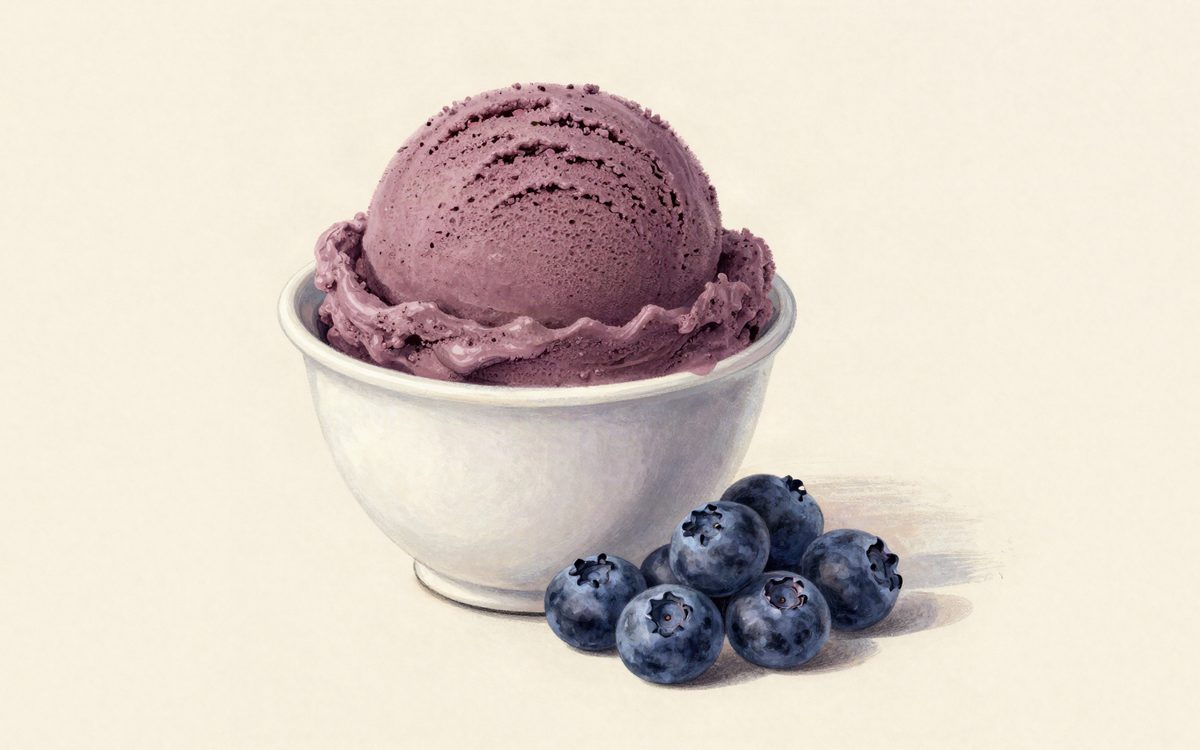
There is a reason this fruit misbehaves in a dairy base, and it is not the colour. Much of its sugar arrives already inverted, which shows up as PAC 19 against only 10 percent sugar, so at 260 g per kilo the berries hand the mix around 49 points of PAC before a single gram of sugar is weighed. That is why dextrose is optional on this sheet and sucrose with glucose powder do the work instead; lean on the usual PAC lever and the tub slumps in the display. Burst the berries before they go in, because the skin holds both the colour and most of the aroma, and keep the 8 g of lemon: without it ripe blueberry reads perfumed and a bit dull, and with it the fruit tastes like fruit.
That changes what you add. Dextrose, the usual lever for PAC, is not needed here, so this formula uses none: 110 g of sucrose and 60 g of glucose powder per kilo do the work instead, and PAC settles at 256.89, low in a 240 to 310 window. Ignore that and you get the classic fault of fruit gelato, a scoop that slumps in the display case.
The 8 g of lemon juice does two jobs. Ripe blueberry sits at pH 3.1 to 3.3 but with modest titratable acidity, so without a cut the flavor reads perfumed and dull. The lower pH also holds the anthocyanins in their red blue form; in a near neutral dairy mix they shift to a drab grey brown, which is where a blueberry gelato loses the argument visually.
Ingredients
Makes 1000 g of finished base.
| Ingredient | Grams | Home measure |
|---|---|---|
| Whole Milk | 368 | 1 1/2 cups |
| Blueberry | 260 | |
| Heavy Cream 35% | 140 | 1/2 cup plus 2 tablespoons |
| Sugar (Sucrose) | 110 | 1/2 cup plus 1 tablespoon |
| Glucose Powder | 60 | 1/4 cup plus 1 tablespoon |
| Non-Fat Dry Milk | 50 | 1/2 cup plus 1 tablespoon |
| Lemon Juice | 8 | |
| Stabilizer (Neutral) | 3 | |
| Salt | 1 |
Loads these exact grams into the free balancer, ready to edit.
Method
Burst the berries first, then a shallow metal pan scraped every 30 minutes
- 1Whisk every dry ingredient together first: sugars, milk powder, stabiliser and salt. Dry-blending them stops the stabiliser clumping when it meets liquid.
- 2Warm the liquids to 40 C (104 F), then rain the dry mix in while whisking hard.
- 3Heat to 82 C (180 F) and hold for 2 minutes so the stabiliser hydrates.
- 4Chill in an ice bath to under 5 C (41 F) within 2 hours. Slow cooling is where bacteria and coarse crystals both start.
- 5Age 6 to 12 hours in the fridge under 5 C (41 F). This is when the stabiliser and the milk protein take up water.
- 6Fold the fruit in cold, after ageing. Heating it costs you the fresh aroma and nothing is gained.
- 7Freeze in a shallow metal pan 2 to 3 cm deep, breaking the crystals with a fork every 30 to 40 minutes, 4 to 6 times.
- 8Freeze firm, then temper 10 to 15 minutes in the fridge before scooping.
The balance
All six against the professional range for Milk Gelato with Fruit.
MSNF sits at 8.88% in a 5 to 9.5 window, high on purpose: 50 g of non-fat dry milk plus 368 g of whole milk give the protein and milk solids that hold water where 260 g of fruit is trying to release it. The cost is lactose, and that is why the sandiness check matters here, coming out at 7.62% of the water phase, below the level where lactose crystallizes into a sandy scoop. Fat is 6.32% from 140 g of cream, mid window in a 3.5 to 8 range. A lot of milk solids with moderate fat is what makes this taste like blueberries and milk rather than blueberries and butter, since fat coats the palate and blunts fruit aromatics faster than anything else in the mix. Solids finish at 36.44%, comfortably mid range, and POD at 175.41 sits in the lower part of its range.
Estimated nutrition: ~177 kcal · Fat 6.3 g · Sugars 19.3 g · Protein 3.5 g (per 100 g of mix, from the balanced composition).
Heat the blueberries briefly and separately, just until they burst, roughly 3 minutes at 80 C, then chill them fast. Blueberry skin is close to waterproof: raw, the fruit gives up little color and little flavor, and it leaves whole skins that freeze hard in the scoop. This is the exception to the rule about not heating fruit for a dairy base, and it applies to blueberry precisely because its aroma is not carried by fragile volatiles. Once cold, blend and sieve, then fold into the already pasteurized and aged base along with the lemon juice, which fixes the color. Never mix hot pulp into the base: besides the risk of curdling, the extra heat destabilizes an emulsion that is already formed.
If it goes wrong
Raw berries released little pigment, and what did come out shifted color in a near neutral dairy mix.
Burst the fruit at 80 C for about 3 minutes first, chill it, and add the 8 g of lemon juice with the pulp so the anthocyanin stays in its red blue form.
Dextrose was added on top of the fruit's own inverted sugars.
Keep the sugars to 110 g of sucrose and 60 g of glucose powder. PAC is already 256.89 with the fruit's contribution counted in.
The pulp was not sieved.
Blend once the fruit is cold and pass it through a sieve before it meets the base. Skins freeze harder than the mix around them and read as grit.
Suitable for: Vegetarian, Egg-free
Allergens: milk
- USDA FoodData Central - composicao do mirtilo cru (https://fdc.nal.usda.gov)
- Goff, H.D.; Hartel, R.W. - Ice Cream, 7a ed., Springer, 2013 (PAC, agua congelavel e dureza na vitrine)
- Belitz, H.-D.; Grosch, W.; Schieberle, P. - Food Chemistry, 4a ed., Springer, 2009 (antocianinas: dependencia de cor com o pH)
- Corvitto, A. - Los secretos del helado: el helado sin secretos, Vilbo, 2004 (PAC das frutas e ajuste do blend de acucares)
- The science behind it: Why Acidic Fruit Curdles Dairy Gelato, and How to Stop It
- Ingredient sheet: Blueberry
Want to change an ingredient and watch the numbers move? Open the free balancer