Blackberry Sorbet
Smooth to the last scrape, with a dry, brambly tartness that stays cold in the mouth and a purple dark enough to mark the spoon.
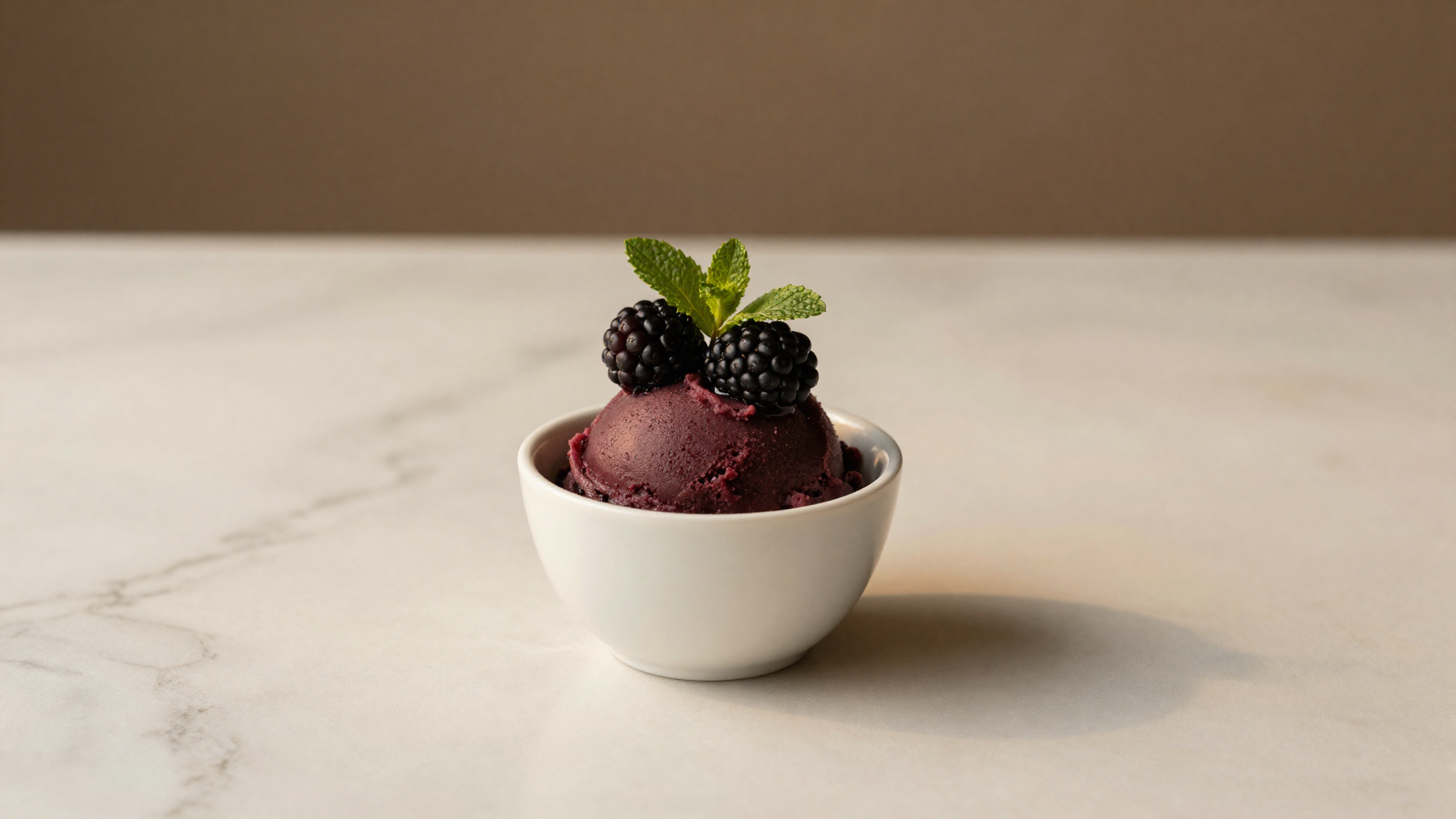
Grit and a set like paving stone are the two failures that spoil this in a home freezer, and neither has much to do with flavour. The pips cause the first, so the fruit goes in here as sieved pulp at 350 g per kilo, which keeps the weight of the berry without the drupelet sand. The second is sugar arithmetic. Sucrose on its own leaves the tub too hard to scoop, so the load is split: dextrose and glucose powder soften the freeze, while maltodextrin adds dry matter that builds body without piling on more sweetness. Carob seed flour and guar hold the water so the crystals stay fine, and the lemon stays at a token dose, since the fruit brings plenty of bite of its own.
In practice you sieve, and that changes the picture. Pushing the raw puree through a 1 mm screen removes the seeds and most of that protein with them, so 350 g of whole fruit written on paper behaves like more fruit character in the bowl. The finished mix measures 0.48% protein, in the middle of a 0 to 1 band.
Blackberry is a poor sugar source, around 5.5%, and very acidic, so the sugar budget is wide open: 110 g of sucrose, 80 g of dextrose, 45 g of glucose powder and 38 g of maltodextrin per kilo, landing at 28.12% total sugars inside a 25 to 31 window. Lemon juice stays at just 10 g, since the fruit already carries high titratable acidity. More acid here does not brighten anything, it only makes the sorbet harsh.
Ingredients
Makes 1000 g of finished base.
| Ingredient | Grams | Home measure |
|---|---|---|
| Water | 363 | 1 1/2 cups |
| Blackberry | 350 | |
| Sugar (Sucrose) | 110 | 1/2 cup plus 1 tablespoon |
| Dextrose (Glucose) | 80 | 1/3 cup plus 2 tablespoons |
| Glucose Powder | 45 | 4 tablespoons |
| Maltodextrin | 38 | |
| Lemon Juice | 10 | |
| Carob Seed Flour | 3 | |
| Guar Gum | 1 |
Loads these exact grams into the free balancer, ready to edit.
Method
Sieved raw puree into cold syrup, shallow pan scraped every 20 minutes
- 1Whisk every dry ingredient together first: sugars, milk powder, stabiliser and salt. Dry-blending them stops the stabiliser clumping when it meets liquid.
- 2Warm the liquids to 40 C (104 F), then rain the dry mix in while whisking hard.
- 3Heat to 82 C (180 F) and hold for 2 minutes so the stabiliser hydrates.
- 4Chill in an ice bath to under 5 C (41 F) within 2 hours. Slow cooling is where bacteria and coarse crystals both start.
- 5Age 6 to 12 hours in the fridge under 5 C (41 F). This is when the stabiliser and the milk protein take up water.
- 6Fold the fruit in cold, after ageing. Heating it costs you the fresh aroma and nothing is gained.
- 7Freeze in a shallow metal pan 2 to 3 cm deep, breaking the crystals with a fork every 30 to 40 minutes, 4 to 6 times.
- 8Freeze firm, then temper 10 to 15 minutes in the fridge before scooping.
The balance
All six against the professional range for Sorbetto.
PAC lands at 325.62 in a 280 to 340 band, which for a sorbet means spoonable at cabinet temperature, -11 to -14 C, instead of a block you chisel. It gets there on 80 g of dextrose, roughly double what a milk gelato would take, because there is no fat and no MSNF, 0% by definition of this base, to supply the body dairy normally gives. POD sits at 208.01, just above the floor of a 200 to 270 window: high enough to carry the fruit against the cold, not so high that it reads as candy. What keeps that sugar load from turning syrupy is maltodextrin at 38 g/kg, which closes solids to 31.15% without adding sweetness, plus 3 g of carob seed flour and 1 g of guar holding the water.
Estimated nutrition: ~126 kcal · Fat 0.2 g · Sugars 28.1 g · Protein 0.5 g (per 100 g of mix, from the balanced composition).
Sieving is a requirement, not a refinement. Blackberry drupelet seeds are hard and they lodge between teeth. Push the raw puree through a 1 mm screen before it goes anywhere near heat. Blackberry anthocyanins are stable at low pH but they brown with heat and with iron, so work in stainless steel or plastic, never bare aluminium or an iron pan. Pasteurize only the syrup, that is water plus sugars plus stabilizer, at 85 C, and combine it with the cold puree. Blackberry brings enough of its own pectin that you should not raise the stabilizer past the 4 g total of carob seed flour plus guar: beyond that the sorbet turns gummy on the spoon and the aroma gets muffled.
If it goes wrong
The puree went in unsieved.
Sieve the raw puree at 1 mm.
Heat, or contact with iron or bare aluminium, degraded the anthocyanins.
Heat only the syrup, to 85 C, in stainless steel, then combine it with the cold fruit.
Extra stabilizer piled on top of blackberry's own pectin.
Hold at 3 g of carob seed flour plus 1 g of guar per kilo. If the body still feels loose, add solids with maltodextrin rather than more gum.
Suitable for: Vegan, Vegetarian, Lactose-free, Egg-free
No ingredient in this recipe contains gluten.
- USDA FoodData Central, Blackberries, raw (acucares totais cerca de 4,9 g/100 g, proteina 1,39 g/100 g)
- So Good Magazine, Fruit sorbets from a syrup base (https://www.sogoodmagazine.com/pastry-blog/pastry-chef-articles/fruit-sorbets-from-a-syrup-base-a-practical-resource/)
- Luca Caviezel, Scienza e Tecnologia del Gelato Artigianale, sorbetti de frutas vermelhas
- Dream Scoops, Ice Cream Calculator (https://www.dreamscoops.com/ice-cream-science/ice-cream-calculator/)
- The science behind it: Anthocyanin Color Stability in Sorbet
- Ingredient sheet: Blackberry
- The story of this recipe: Blackberry Sorbet
Want to change an ingredient and watch the numbers move? Open the free balancer