Black Forest Chocolate Cherry Gelato
Dark and dry at the start, then the fruit cuts through it, sour on one edge and syrupy on the other, and it is the sourness that stays longest in the mouth.
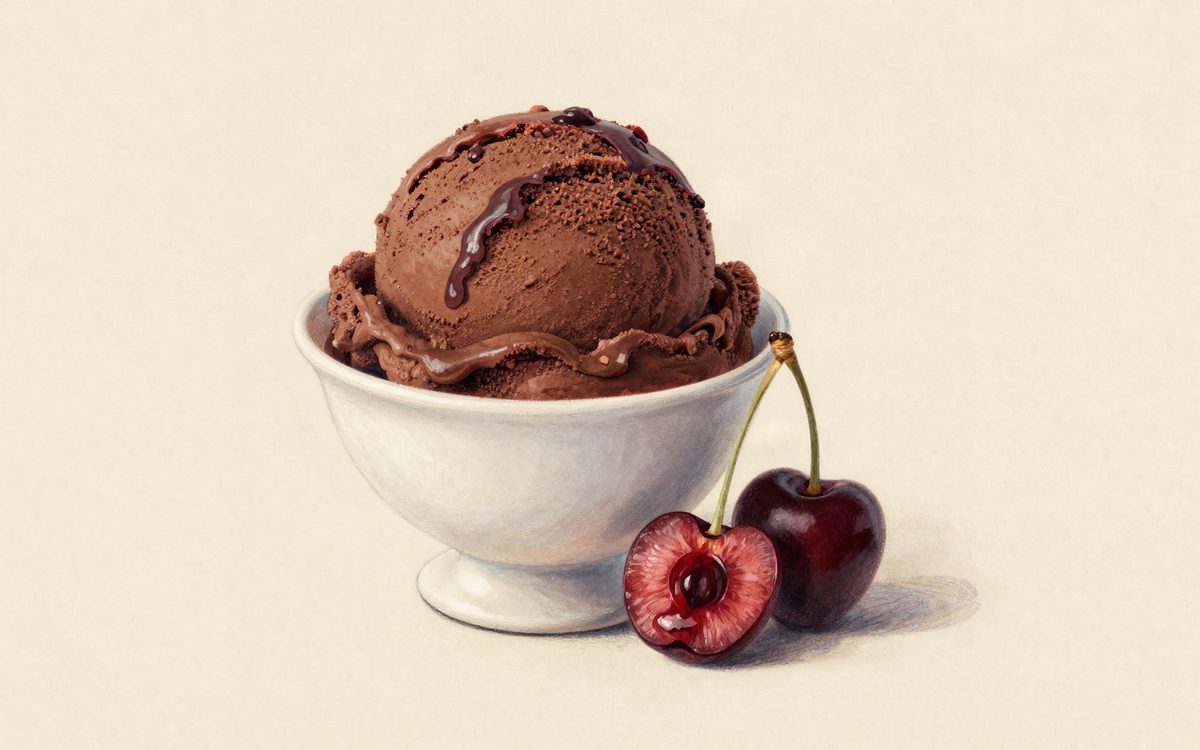
If the jar in your hand lists cherries, sugar and water and nothing else, it will do the job. The cheap ones lean on colouring and flavouring, and they read as generic sweet red once the cold flattens everything by a notch. Fresh fruit is the other half of the shop: firm, dark, heavy for its size, and worth tasting before it goes anywhere near the mix, because a bland cherry at room temperature disappears entirely at freezer temperature. Both forms are here for different reasons, 150 g of fresh per kilo for acidity and lift and 60 g in syrup for the darker candied note, against 45 g of cocoa powder and 35 g of chocolate at 70 percent.
Those 210 g/kg of fruit are why this sits on a milk and fruit base rather than a straight milk base. Cherry is a low solids fruit, so it dilutes hard and something has to push back. Solids land at 38.02% against a 32 to 40 window, and 45 g of glucose powder does most of that lifting because it adds solids without adding much sweetness. Total sugars finish at 18.63%, comfortably inside 17 to 25.
Protein is the tight number here: 4.19% against a 4.5 ceiling, the result of 34 g of skim milk powder plus what the cocoa brings. Worth knowing before you improvise, because another spoon of milk powder puts the mix out of range and into a chalky body. Lactose ends at 6.76% of the water phase, well under the level where it starts crystallizing into sandiness.
Ingredients
Makes 1000 g of finished base.
| Ingredient | Grams | Home measure |
|---|---|---|
| Whole Milk | 456 | 2 cups |
| Cherry | 150 | |
| Sugar (Sucrose) | 90 | 1/3 cup plus 2 tablespoons |
| Heavy Cream 35% | 65 | 1/4 cup |
| Cherry in Syrup | 60 | |
| Cocoa Powder 22-24% | 45 | |
| Glucose Powder | 45 | 4 tablespoons |
| Dark Chocolate 70% | 35 | |
| Skim Milk Powder | 34 | 1/3 cup plus 1 tablespoon |
| Dextrose (Glucose) | 15 | 1 1/2 tablespoons |
| Carob Seed Flour | 4 | |
| Salt | 1 |
Loads these exact grams into the free balancer, ready to edit.
Method
Cold cherry fold, then a shallow metal pan scraped every 30 minutes
- 1Whisk every dry ingredient together first: sugars, milk powder, stabiliser and salt. Dry-blending them stops the stabiliser clumping when it meets liquid.
- 2Warm the liquids to 40 C (104 F), then rain the dry mix in while whisking hard.
- 3Heat to 82 C (180 F) and hold for 2 minutes so the stabiliser hydrates.
- 4Melt the chocolate to 45 C (113 F) and stir it into the hot base off the heat, then blend 60 seconds until glossy.
- 5Chill in an ice bath to under 5 C (41 F) within 2 hours. Slow cooling is where bacteria and coarse crystals both start.
- 6Age 6 to 12 hours in the fridge under 5 C (41 F). This is when the stabiliser and the milk protein take up water.
- 7Fold the fruit in cold, after ageing. Heating it costs you the fresh aroma and nothing is gained.
- 8Freeze in a shallow metal pan 2 to 3 cm deep, breaking the crystals with a fork every 30 to 40 minutes, 4 to 6 times.
- 9Freeze firm, then temper 10 to 15 minutes in the fridge before scooping.
The balance
All six against the professional range for Milk Gelato with Fruit.
Two numbers explain the shape of this recipe. PAC at 260.08 sits low in the 240 to 310 band for a milk and fruit base, and that is deliberate: cherry brings free fructose and glucose of its own, so if the added sugars had leaned on dextrose the mix would have drifted toward the top of the band and needed a colder cabinet. Hence 90 g of sucrose, only 15 g of dextrose, and 45 g of glucose powder, which carries solids and body while barely moving POD. POD comes out at 170.58 in a 150 to 230 range, sweet enough to read as dessert without flattening the cocoa. Fat is the other one: 6.32% with just 65 g of cream per kilo, because 35 g of dark chocolate at 70% and 45 g of cocoa powder already bring cocoa butter. More cream here would coat the palate and mute the cherry acidity the whole flavor depends on.
Estimated nutrition: ~184 kcal · Fat 6.3 g · Sugars 18.6 g · Protein 4.2 g (per 100 g of mix, from the balanced composition).
The specific risk of this flavor is acid meeting hot milk. Cherry runs at pH 3.2 to 4.0 and you are adding 210 g of it per kilo to a dairy base, so the casein flocculates if the two meet warm. Pasteurize the dairy, cocoa and sugars together at 82 to 85 C, cool to 4 C, and only then stream the cold cherry in while stirring. Color is the second issue: cherry anthocyanin is a pH indicator and turns bluish in a neutral mix, which next to cocoa brown gives a grey, muddy scoop, so use natural cocoa rather than a heavily alkalized Dutch one and let the fruit acid protect the pigment. Third, pit the cherries one by one and check each one, since a missed pit is the most common accident with this flavor. If you want the kirsch, use no more than 15 g/kg, cold, at the end, and rebalance: a 40% spirit has a very high PAC and will drop the freezing point on you.
If it goes wrong
The cherry went in while the base was still warm. At pH 3.2 to 4.0 and 210 g/kg, the fruit acid flocculates casein.
Chill the dairy base to 4 C first, then add the cold fruit in a thin stream while stirring. Blending a curdled mix only hides the grain, it does not fix it.
Alkalized Dutch cocoa raised the pH of the mix and pushed the cherry anthocyanin toward its blue form.
Use natural cocoa powder for the 45 g in the formula, and keep the fresh cherry in. Its acid is what holds the red.
The cherry in syrup was drained, or replaced with more fresh fruit, so the mix lost sugar the balance had counted.
Keep the 60 g of cherry in syrup with its syrup. PAC is 260.08 for a reason; strip sugar out and the mix slides toward the 240 floor and sets solid.
Suitable for: Vegetarian, Egg-free
Allergens: milk
- https://icecreamcalc.com/knowledge-base/balancing/
- https://www.dairyscience.info/ice-cream/154-ice-cream-mix.html
- https://www.scuolagelato.it/en/gelato-naturale-balancing-software/
- https://mygelato.eu/en/wiki/212/friend-or-foe-master-lactose-in-your-gelato/
- The science behind it: Why Acidic Fruit Curdles Dairy Gelato, and How to Stop It
- Ingredient sheet: Cherry
Want to change an ingredient and watch the numbers move? Open the free balancer