Bergamot Sorbet
Perfumed first, then a controlled bitterness, with clean lemon acidity holding it upright and an Earl Grey aroma that stays long after the cold has gone.
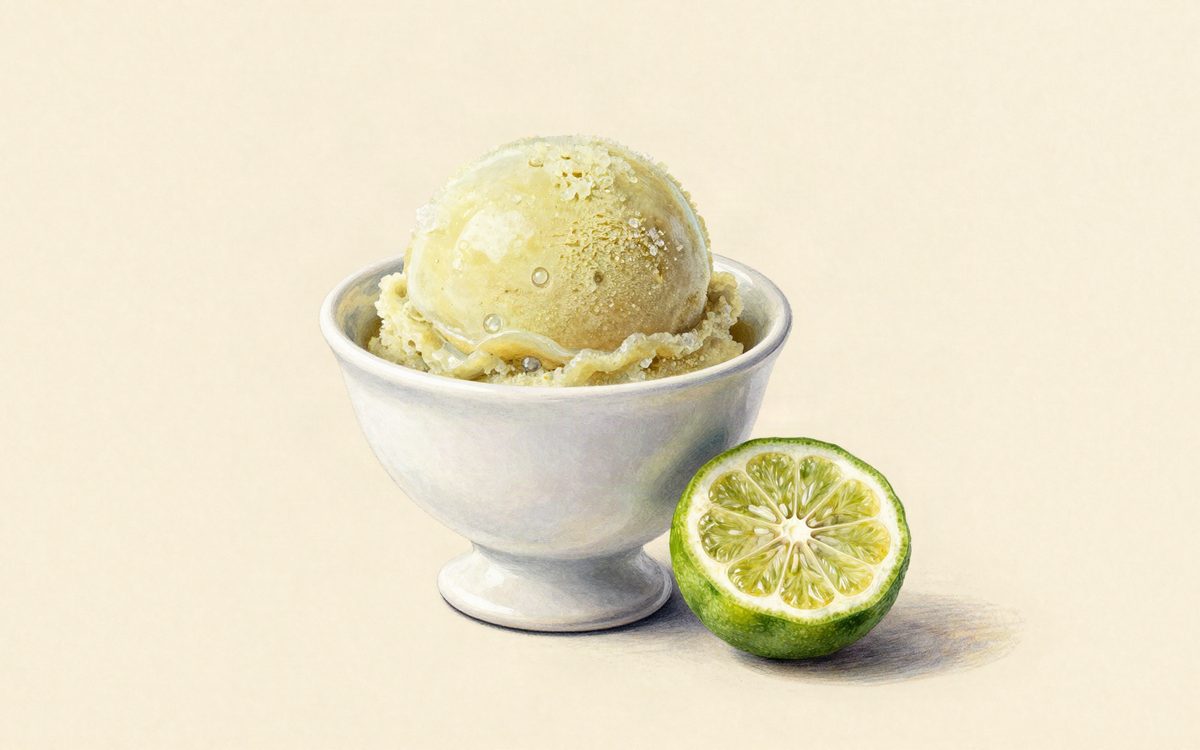
Freeze it badly and you get crystals; dose it badly and you get something harder to fix, a sorbet that reads medicinal from the first spoon. Citrus bergamia concentrates neoeriocitrin, naringin and neohesperidin, flavanones bound to neohesperidose, and that particular sugar linkage is the one the tongue reads as bitter, so every extra gram of juice buys aroma and bitterness together. The juice stops at 130 g per kilo here, not the 200 to 300 g a milder citrus would take, and 30 g of lemon puts a clean acid spine underneath it. Water at 541 g with a sugar blend landing PAC at 327 keeps the scoop soft rather than glassy.
The 30 g of lemon juice are not filler. Bergamot has modest acidity for a citrus and on its own reads perfumed and bitter with no spine. Lemon puts the clean acid back, and that is the difference between a sorbet that tastes like the Earl Grey aroma people recognise and one that tastes medicinal.
With only 130 g of juice, all of the body has to be built: 135 g of sucrose, 70 g of dextrose and 90 g of glucose powder against 541 g of water. Sugars close at 28.82 percent and solids at 30.22 percent, with POD stopping at 223.81 in a 200 to 270 window. Fat is 0.02 percent and protein 0.06 percent, which is to say this is sugar, water and citrus and nothing else.
Ingredients
Makes 1000 g of finished base.
| Ingredient | Grams | Home measure |
|---|---|---|
| Water | 541 | 2 1/4 cups |
| Sugar (Sucrose) | 135 | 2/3 cup |
| Bergamot | 130 | |
| Glucose Powder | 90 | 1/3 cup plus 2 tablespoons |
| Dextrose (Glucose) | 70 | 1/3 cup plus 1 tablespoon |
| Lemon Juice | 30 | |
| Stabilizer (Neutral) | 4 |
Loads these exact grams into the free balancer, ready to edit.
Method
Half hourly fork scrape
- 1Whisk every dry ingredient together first: sugars, milk powder, stabiliser and salt. Dry-blending them stops the stabiliser clumping when it meets liquid.
- 2Warm the liquids to 40 C (104 F), then rain the dry mix in while whisking hard.
- 3Heat to 82 C (180 F) and hold for 2 minutes so the stabiliser hydrates.
- 4Chill in an ice bath to under 5 C (41 F) within 2 hours. Slow cooling is where bacteria and coarse crystals both start.
- 5Age 6 to 12 hours in the fridge under 5 C (41 F). This is when the stabiliser and the milk protein take up water.
- 6Fold the fruit in cold, after ageing. Heating it costs you the fresh aroma and nothing is gained.
- 7Freeze in a shallow metal pan 2 to 3 cm deep, breaking the crystals with a fork every 30 to 40 minutes, 4 to 6 times.
- 8Freeze firm, then temper 10 to 15 minutes in the fridge before scooping.
The balance
All six against the professional range for Sorbetto.
POD has to stay under 270, and at 223.81 it sits in the lower half of its window, while the sorbet still has to reach at least 28 percent solids to hold together at all. Glucose powder is what makes both possible at once, because it carries solids at a fraction of the sweetening power of sucrose, and the 90 g dose exists for that reason alone. PAC comes out at 326.51 in a 280 to 340 band, on the soft side by design: a citrus sorbet that freezes hard tastes duller, because cold suppresses aroma faster than it suppresses bitterness. The practical consequence of that PAC is that this one stays workable without a machine, and also that it needs to be served colder, at about -13.1 C.
Estimated nutrition: ~121 kcal · Fat 0 g · Sugars 28.8 g · Protein 0.1 g (per 100 g of mix, from the balanced composition).
Bitterness in bergamot rises with how hard you extract and how long the juice sits on peel and albedo, where the neohesperidoside flavanones are most concentrated. Press by hand with light pressure, never with an auger juicer that grinds the white pith, and strain immediately instead of letting the juice rest on the pulp. If you want more aroma, take only the coloured layer of the peel with no white at all and infuse it in the already cooled syrup for 20 to 30 minutes before straining, which brings the perfume without the bulk of the albedo bitterness. Pasteurize only the syrup at 85 C, chill to 4 C, mature 4 hours, and add the chilled juice and lemon at the moment you start freezing. One note before you adjust anything: bitterness is perceived more strongly at serving temperature, so the frozen sorbet reads slightly more bitter than the mix did at 4 C, not less. Do not correct that by sweetening the mix.
If it goes wrong
The juice was extracted too aggressively or left standing on peel and pith, pulling neohesperidoside flavanones out of the albedo.
Hand press with light pressure, strain immediately, and keep the dose at 130 g. Do not compensate with sugar.
The 30 g of lemon juice were cut or left out, and bergamot's own acidity is modest for a citrus.
Put the lemon back at full dose and add it cold, at freezing time, alongside the bergamot juice.
PAC is 326.51 by design, on the soft side of the 280 to 340 band.
Freeze in a shallow tray in the coldest part of the freezer and serve it at about -13.1 C. Adding sugar to firm it up moves the wrong lever.
Suitable for: Vegan, Vegetarian, Lactose-free, Egg-free
- https://www.mdpi.com/2304-8158/13/13/2080
- https://pmc.ncbi.nlm.nih.gov/articles/PMC6680538/
- https://www.ncbi.nlm.nih.gov/pmc/articles/PMC6244945/
- https://www.sosa.cat/en/stabilize-ice-creams-sorbets/
- The science behind it: Supreming Citrus for Sorbet
- Ingredient sheet: Bergamot
Want to change an ingredient and watch the numbers move? Open the free balancer