Banana Gelato
The scoop melts slowly and lands somewhere between baked fruit and custard, sweet and dense, with the flavour deepening as it warms on the tongue.
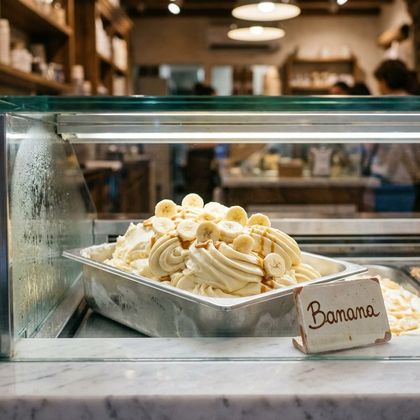
Buy fruit that is past pretty. Skins should be freckled brown and the flesh soft enough to bruise under a thumb, because that is when the starch has finished turning into sugar and the aroma peaks; a firm yellow banana tastes green and chalky once frozen, and nothing you add later corrects it. Commercial puree is the convenient route, though it usually arrives sweetened and heat treated, which flattens the fresh top notes. Whichever you buy, have the 10 g of lemon juice weighed and waiting, since cut flesh browns within minutes, and keep the fruit at 260 g per kilo so the added sugar can stay a blend of sucrose, glucose powder and dextrose instead of sucrose alone.
As balanced, sugars close at 19.79 percent and POD at 177.32, both in the lower half of their windows. The added sugar has to be a blend for that to work: 90 g of sucrose, 60 g of glucose powder to lift solids to 37.29 percent without lifting sweetness, and only 10 g of dextrose, because the fruit already arrives with antifreeze power of its own.
The 10 g of lemon juice are not seasoning, they are process. They drop the pH of the pulp and slow the polyphenol oxidase that turns cut banana grey within minutes. And the 47 g of skim milk powder are the MSNF lever: banana dilutes the dairy phase, and without the powder MSNF drifts toward the 5 percent floor instead of the 8.69 percent it reads here.
Ingredients
Makes 1000 g of finished base.
| Ingredient | Grams | Home measure |
|---|---|---|
| Whole Milk | 379 | 1 1/2 cups |
| Banana | 260 | |
| Heavy Cream 35% | 140 | 1/2 cup plus 2 tablespoons |
| Sugar (Sucrose) | 90 | 1/3 cup plus 2 tablespoons |
| Glucose Powder | 60 | 1/4 cup plus 1 tablespoon |
| Non-Fat Dry Milk | 47 | 1/2 cup |
| Lemon Juice | 10 | |
| Dextrose (Glucose) | 10 | 2 1/2 teaspoons |
| Stabilizer (Neutral) | 3 | |
| Salt | 1 |
Loads these exact grams into the free balancer, ready to edit.
Method
Frozen banana blitz
- 1Whisk every dry ingredient together first: sugars, milk powder, stabiliser and salt. Dry-blending them stops the stabiliser clumping when it meets liquid.
- 2Warm the liquids to 40 C (104 F), then rain the dry mix in while whisking hard.
- 3Heat to 82 C (180 F) and hold for 2 minutes so the stabiliser hydrates.
- 4Chill in an ice bath to under 5 C (41 F) within 2 hours. Slow cooling is where bacteria and coarse crystals both start.
- 5Age 6 to 12 hours in the fridge under 5 C (41 F). This is when the stabiliser and the milk protein take up water.
- 6Fold the fruit in cold, after ageing. Heating it costs you the fresh aroma and nothing is gained.
- 7Freeze in a shallow metal pan 2 to 3 cm deep, breaking the crystals with a fork every 30 to 40 minutes, 4 to 6 times.
- 8Freeze firm, then temper 10 to 15 minutes in the fridge before scooping.
The balance
All six against the professional range for Milk Gelato with Fruit.
Sugars at 19.79 percent against a 25 percent ceiling and POD at 177.32 against 230 both sit in the lower half of their windows. Fat constrains the dairy: a fruit and milk base is capped at 8 percent fat, well under a plain milk gelato, so the 140 g of cream take fat only to 6.28 percent. PAC lands at 263.66 in the lower half of the 240 to 310 band for a milk gelato with fruit, which reads as a tub that scoops cleanly once tempered in the fridge without going soft. Lactose is 4.74 percent of the mass and 7.56 percent of the water phase, and that is the practical limit on how much more milk powder you could add to chase MSNF.
Estimated nutrition: ~181 kcal · Fat 6.3 g · Sugars 19.8 g · Protein 3.5 g (per 100 g of mix, from the balanced composition).
Banana never goes through the pasteurizer. Pasteurize the white base, meaning milk, cream, milk powder, sugars and stabilizer, at 85 C, chill it fast to 4 C and mature 6 to 12 hours. Only then blend the banana with the lemon juice and fold it in. There are two reasons: cooked banana loses its fresh esters and starts tasting like banana candy, and residual amylase active at heat degrades starch and thins the mix. The lemon has to go into the pulp at the moment you process it, not afterwards, because the polyphenol oxidase acts before the mixture has time to cool. Pour the acidified pulp into the base and never the other way round, so the acid is diluted on contact and the caseins are not shocked by the pH. Freeze with the base at 4 C and serve between -12 and -11 C.
If it goes wrong
Polyphenol oxidase started working on the cut fruit before the lemon reached it.
Put the 10 g of lemon juice in the blender with the banana, not into the mix afterwards.
The fruit was heated along with the base.
Keep the banana out of the pasteurizer entirely. Fold the cold purée into a base that is already at 4 C and matured.
Residual amylase in warm banana degraded the starch and the base lost structure.
Same fix, cold addition only, and freeze the same day the purée is made.
Suitable for: Vegetarian, Egg-free
Allergens: milk
- Goff, H.D.; Hartel, R.W. - Ice Cream, 7a ed., Springer, 2013 (composicao do mix, MSNF e depressao do ponto de congelamento)
- Corvitto, A. - Los secretos del helado: el helado sin secretos, Vilbo, 2004 (tabelas POD/PAC e percentuais de fruta em base leite)
- USDA FoodData Central - composicao da banana crua (https://fdc.nal.usda.gov)
- Belitz, H.-D.; Grosch, W.; Schieberle, P. - Food Chemistry, 4a ed., Springer, 2009 (escurecimento enzimatico por polifenoloxidase)
- The science behind it: Polyphenol Oxidase
- Ingredient sheet: Banana
Want to change an ingredient and watch the numbers move? Open the free balancer