Dark Chocolate Hazelnut Bacio Gelato
Heavier on the spoon than most, it leads with bitter cocoa and lets roasted hazelnut climb up underneath, closing toasted, faintly salted and long.
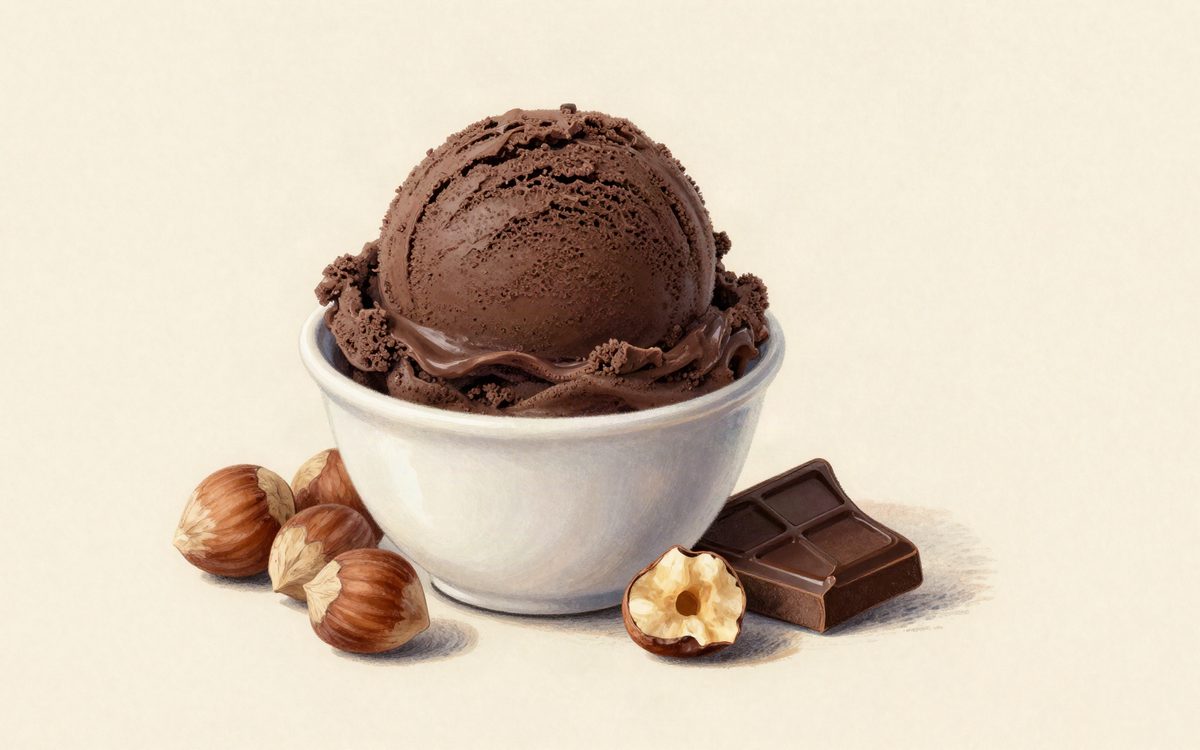
Perugia's contribution here is an order of assembly rather than a recipe: a whole hazelnut at the centre, gianduia packed around it, bitter chocolate on the outside. Frozen, that order becomes the brief. Cocoa has to lead and the nut has to stay audible under it, which is why the sheet carries 60 g of 70 percent dark chocolate as the bitter spine and only 10 g of cocoa powder to darken and deepen it without drying the palate, against 68 g of hazelnut paste holding its ground below. Carob seed flour keeps it spoonable, and at just under 40 percent solids it eats dense, a heavy scoop rather than a light one.
The hazelnut is deliberately lower than it would be in a plain nocciola, and the reason is arithmetic as much as taste. Hazelnut and chocolate together already put fat at 9.26 percent and protein at 4.77 percent, against ceilings of 12 and 5. There is no cream and no second dairy fat in the list for that exact reason: 678 g of whole milk carry the entire liquid phase on their own.
Total solids close at 39.86 percent with 42 as the ceiling, in the upper half of the window and exactly right for what this flavour is meant to be, which is a heavy spoon. POD stops at 166.88 with 200 available, so it reads bitter first and sweet second.
The stabilizer is different here too. Instead of a neutral blend it uses 4 g of carob seed flour, which behaves well in a high fat, high cocoa base but needs real heat to hydrate.
Ingredients
Makes 1000 g of finished base.
| Ingredient | Grams | Home measure |
|---|---|---|
| Whole Milk | 678 | 2 3/4 cups |
| Sugar (Sucrose) | 110 | 1/2 cup plus 1 tablespoon |
| Hazelnut Paste (Piedmont IGP) | 68 | |
| Dark Chocolate 70% | 60 | |
| Dextrose (Glucose) | 45 | 1/4 cup |
| Non-Fat Dry Milk | 24 | 1/4 cup |
| Cocoa Powder 22-24% | 10 | |
| Carob Seed Flour | 4 | |
| Salt | 1 |
Loads these exact grams into the free balancer, ready to edit.
Method
Warm blend, deep chill freezer set
- 1Whisk every dry ingredient together first: sugars, milk powder, stabiliser and salt. Dry-blending them stops the stabiliser clumping when it meets liquid.
- 2Warm the liquids to 40 C (104 F), then rain the dry mix in while whisking hard.
- 3Heat to 82 C (180 F) and hold for 2 minutes so the stabiliser hydrates.
- 4Melt the chocolate to 45 C (113 F) and stir it into the hot base off the heat, then blend 60 seconds until glossy.
- 5Off the heat, whisk in the paste, then blend 60 seconds so the fat emulsifies instead of separating.
- 6Chill in an ice bath to under 5 C (41 F) within 2 hours. Slow cooling is where bacteria and coarse crystals both start.
- 7Age 6 to 12 hours in the fridge under 5 C (41 F). This is when the stabiliser and the milk protein take up water.
- 8Freeze in a shallow metal pan 2 to 3 cm deep, breaking the crystals with a fork every 30 to 40 minutes, 4 to 6 times.
- 9Freeze firm, then temper 10 to 15 minutes in the fridge before scooping.
The balance
All six against the professional range for Milk Gelato.
Fat and protein are the two numbers that wrote this ingredient list. Fat at 9.26 percent leaves under 3 points of headroom to 12, and protein at 4.77 percent leaves almost none against 5, which is why the dairy is a single line of whole milk and the milk powder stops at 24 g. Every extra gram of chocolate or hazelnut moves both at once. On the sugar side, 110 g of sucrose plus 45 g of dextrose give total sugars of 17.18 percent, low in the 16 to 22 band, with PAC at 260.27. That PAC is mid range, but the eating temperature is not: hazelnut fat and cocoa solids both harden the product beyond what PAC alone predicts, so this one wants to be served around -11 C rather than colder. Lactose sits at 4.58 percent of the mass and 7.62 percent of the water phase, which clears the sandiness threshold.
Estimated nutrition: ~206 kcal · Fat 9.3 g · Sugars 17.2 g · Protein 4.8 g (per 100 g of mix, from the balanced composition).
This carries the heaviest cocoa solids load of the group, and cocoa powder competes with milk protein for free water. Dry cocoa tipped straight into hot milk forms lumps that no blender undoes and that show up as bitter specks in the finished gelato, so rub the 10 g of cocoa powder into the dry sucrose before any liquid touches it. The 70 percent chocolate should be melted and folded into the base at around 60 C: colder than that and the cocoa butter is thermally shocked and grains out. The hazelnut paste is the opposite case and goes in later, below 45 C, so its roast aroma survives. The 4 g of carob seed flour only hydrate with the mix held hot, so do not shortcut the 85 C step. Serve around -11 C.
If it goes wrong
The 10 g of cocoa powder went into hot liquid dry and lumped.
Rub it into the 110 g of sucrose first, then add liquid. Once it has lumped in the mix, blending will not recover it.
Served too cold for this build. Hazelnut fat plus cocoa solids stiffen it more than PAC 260.27 predicts.
Temper to about -11 C before scooping and hold it there rather than at the coldest point of the freezer.
The melted chocolate met a base that was too cold and the cocoa butter grained out.
Add the 60 g of chocolate already melted, with the base at around 60 C.
Suitable for: Vegetarian, Egg-free
Allergens: milk, tree nuts
- https://cozyitaliankitchen.com/bacio-gelato-chocolate-hazelnut-kiss/
- https://tasteatlas.com/bacio-gelato
- https://solo-dolce.com/recipe/homemade-bacio-gelato/
- The science behind it: Hazelnut Paste in Gelato
- Ingredient sheet: Hazelnut Paste (Piedmont IGP)
Want to change an ingredient and watch the numbers move? Open the free balancer