Bacio Gelato
Roasted nuttiness arrives first and stays warm on the tongue, bitter cocoa signing underneath it, and the finish reads far closer to praline than to chocolate.
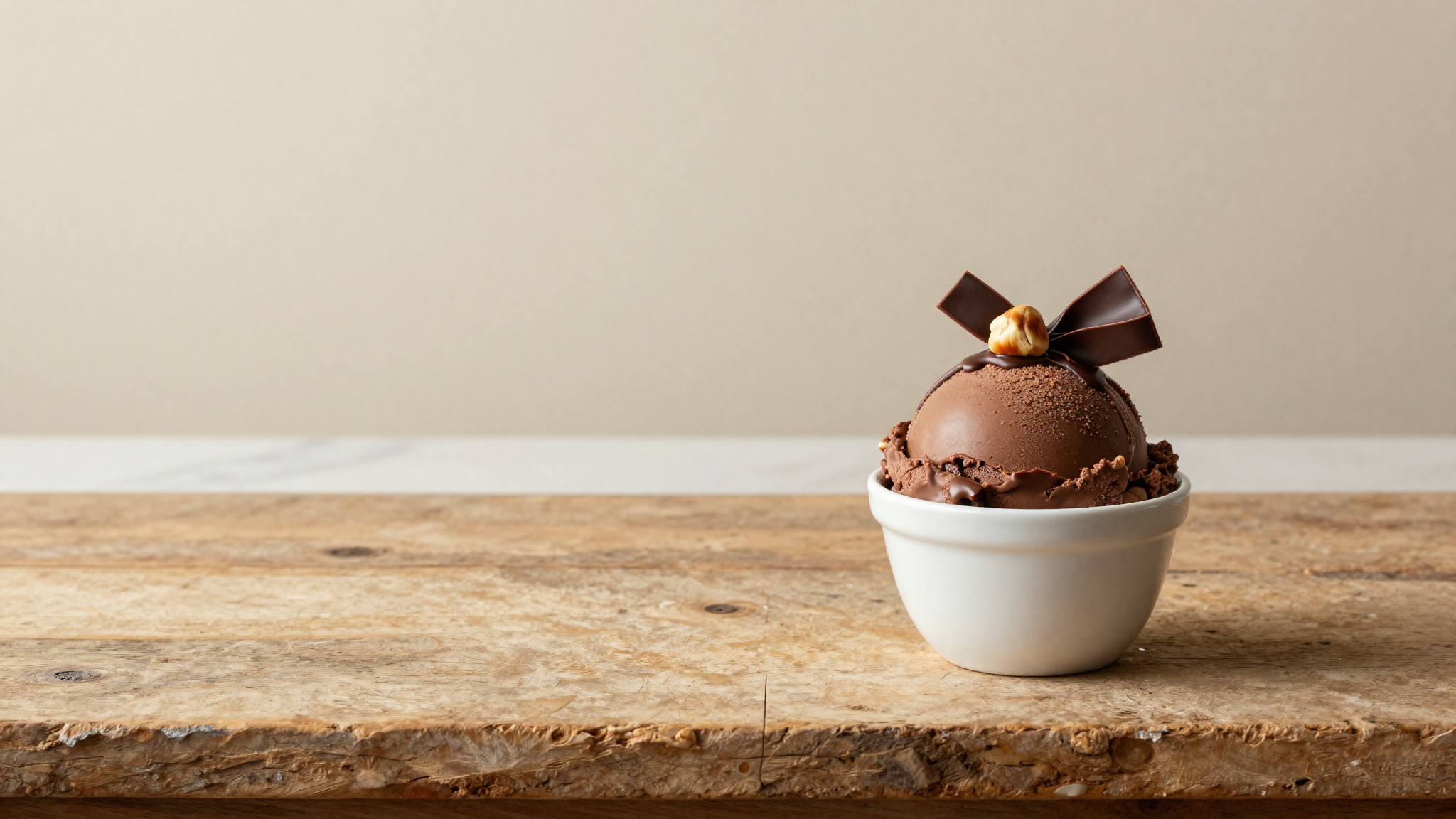
A kiss is what the name translates to, and Perugia's version of it puts roasted hazelnut in front with bitter cocoa signing from below. Keeping that order intact after freezing is the real work here, so the chocolate side is split into two ingredients doing different jobs. Cocoa paste at 25 g/kg brings aromatic body and its own cocoa butter, while 15 g of 22 to 24 percent powder brings colour and bitterness with almost no fat. Take the full 40 g from paste and the fat blows out. Take it all from powder and the taste goes flat and astringent. The 65 g of Piedmont IGP hazelnut paste is what keeps the nut audible through all of it.
The unusual line in this recipe is the dairy: 564 g of whole milk, 129 g of skim milk, and no cream at all. That is not an economy. The hazelnut paste and cocoa paste already deliver most of the fat before any dairy is weighed, so what the recipe still needs is MSNF and water arriving without fat, and skim milk is exactly that lever. Fat closes at 7.86 percent inside a 6 to 12 window, and MSNF at 8.44 percent, just clear of the 8 percent floor.
Total solids reach 38.18 percent and protein 4.73 percent against a 5 percent ceiling, which makes protein the second tight constraint after fat. Hazelnut and cocoa powder are both protein carriers, so there is very little slack left for extra milk powder.
Ingredients
Makes 1000 g of finished base.
| Ingredient | Grams | Home measure |
|---|---|---|
| Whole Milk | 564 | 2 1/3 cups |
| Sugar (Sucrose) | 130 | 2/3 cup |
| Skim Milk | 129 | 1/2 cup |
| Hazelnut Paste (Piedmont IGP) | 65 | |
| Dextrose (Glucose) | 45 | 1/4 cup |
| Cocoa Paste | 25 | |
| Non-Fat Dry Milk | 23 | 1/4 cup |
| Cocoa Powder 22-24% | 15 | |
| Stabilizer (Neutral) | 3 | |
| Salt | 1 |
Loads these exact grams into the free balancer, ready to edit.
Method
Twice blended freezer block
- 1Whisk every dry ingredient together first: sugars, milk powder, stabiliser and salt. Dry-blending them stops the stabiliser clumping when it meets liquid.
- 2Warm the liquids to 40 C (104 F), then rain the dry mix in while whisking hard.
- 3Heat to 82 C (180 F) and hold for 2 minutes so the stabiliser hydrates.
- 4Off the heat, whisk in the paste, then blend 60 seconds so the fat emulsifies instead of separating.
- 5Chill in an ice bath to under 5 C (41 F) within 2 hours. Slow cooling is where bacteria and coarse crystals both start.
- 6Age 6 to 12 hours in the fridge under 5 C (41 F). This is when the stabiliser and the milk protein take up water.
- 7Freeze in a shallow metal pan 2 to 3 cm deep, breaking the crystals with a fork every 30 to 40 minutes, 4 to 6 times.
- 8Freeze firm, then temper 10 to 15 minutes in the fridge before scooping.
The balance
All six against the professional range for Milk Gelato.
The sugar side is quiet on purpose: 130 g of sucrose and 45 g of dextrose, nothing else. Total sugars come out at 17.4 percent, low in the 16 to 22 band, and POD at 169.12 with 200 available, which is what lets the cocoa read as bitter rather than sweet. The dextrose is there for PAC, not for taste: it pushes PAC to 262.69 in a 220 to 300 band while barely moving sweetness. The figure that quietly matters is lactose, at 4.6 percent of the mass and 7.45 percent of the water phase. Nut and cocoa bases carry a lot of solids, and if you chase MSNF by piling on milk powder the lactose crosses the point where it crystallizes in the freezer and the texture turns sandy after a few days. At 23 g of skim milk powder it stays under.
Estimated nutrition: ~192 kcal · Fat 7.9 g · Sugars 17.4 g · Protein 4.7 g (per 100 g of mix, from the balanced composition).
Order of addition decides the texture in this one. Cocoa powder contains starch and has to hydrate hot: rub it dry with part of the sugar, add it to the mix around 40 to 45 C, then take everything to 85 C. Added cold it never hydrates and the gelato keeps a chalky edge. Cocoa paste melts at 34 to 36 C, so add it already liquid once the mix is past 50 C, otherwise it seizes into pellets. The hazelnut paste goes in last, with the mix already pasteurized and falling below 60 C, followed by an immersion blender. The roasted volatiles in the paste are the same pyrazines and aldehydes that evaporate at 85 C, so pasteurizing the paste along with everything else throws away exactly what you paid for. The blending is not optional either: 90 g of nut and cocoa paste per kilo will not disperse on their own and will separate during maturation. Add nothing acidic to this base, because cocoa powder tannins sharpen as pH drops. Mature 8 to 12 hours at 4 C.
If it goes wrong
Cocoa powder added cold, so its starch never hydrated.
Rub the 15 g of cocoa powder dry into part of the 130 g of sucrose, add it around 40 to 45 C, then hold the mix at 85 C.
The 90 g of hazelnut and cocoa paste were never emulsified into the base.
Immersion blend hard once the paste is in, below 60 C, and only then mature 8 to 12 hours at 4 C.
The paste went in before pasteurization and its roast volatiles boiled off at 85 C.
Add the 65 g of paste last, off the heat, with the mix below 60 C.
Suitable for: Vegetarian, Egg-free
Allergens: milk, tree nuts
- https://cozyitaliankitchen.com/bacio-gelato-chocolate-hazelnut-kiss/
- https://scoopsandsavor.com/authentic-italian-chocolate-hazelnut-baci-gelato/
- https://www.thedeliciouscrescent.com/hazelnut-gelato-nocciola-gelato/
- https://madonnadelpiatto.com/2014/09/24/chocolate-hazelnut-bacio-gelato/
- The science behind it: Hazelnut Paste in Gelato
- Ingredient sheet: Hazelnut Paste (Piedmont IGP)
- The story of this recipe: Bacio Gelato Recipe
Want to change an ingredient and watch the numbers move? Open the free balancer