Apple Sorbet
Clean, cold and tasting of raw fruit instead of cooked, it finishes without the gritty ice that home-made fruit sorbetto usually leaves on the spoon.
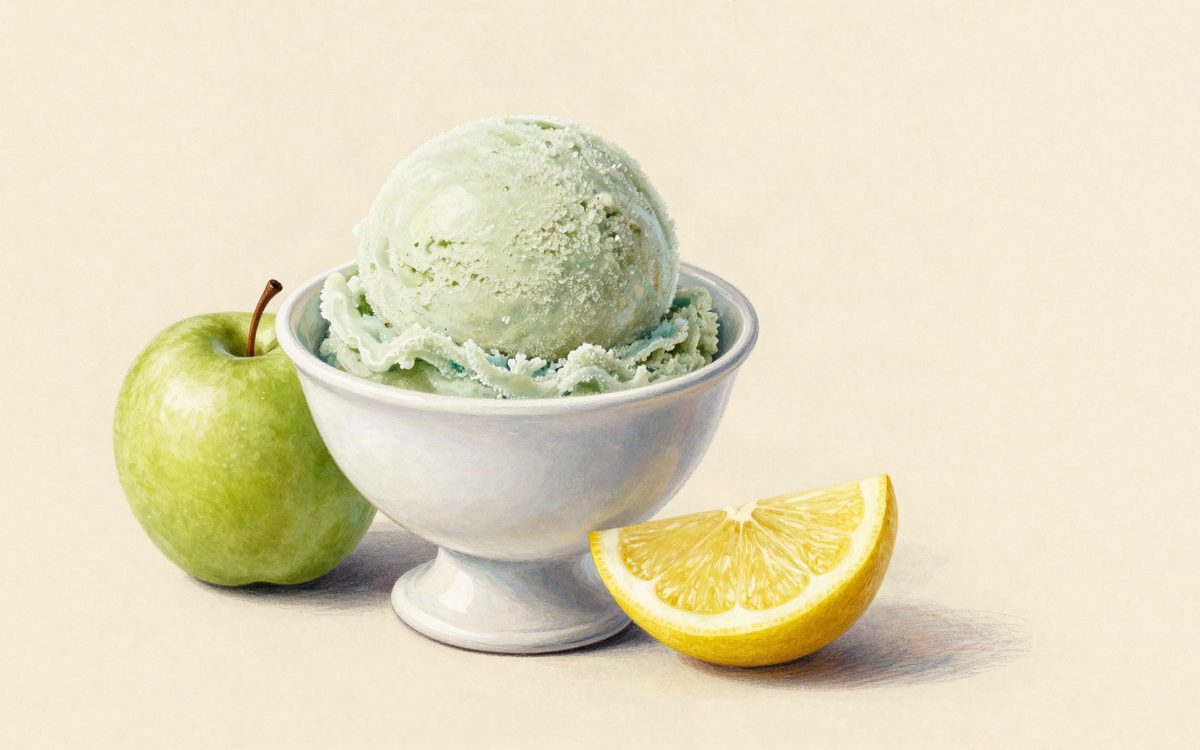
Two things go wrong with fruit sorbetto made at home. It sets into a block you have to chip at, and the fruit itself dulls to a brownish note within an hour of blending. Both are handled here. Maltodextrin and dextrose carry the solids and push PAC to 321.9, so the water riding in with 600 g of fruit sets fine rather than crunchy and the scoop gives cleanly after a short temper in the fridge. The 20 g of lemon juice is doing chemistry, not seasoning: its ascorbic acid works against the browning enzyme and its citric acid drops the pH away from where that enzyme is happiest, which is why this stays pale and tastes of the fresh fruit.
Apple is 10.4 percent sugar with a sweetening power of 14, so 600 g already deposits 6.2 points of sugar and 84 points of POD before anything is weighed. The sucrose comes in at 65 g, and the solids are finished with 87 g of maltodextrin and 75 g of dextrose, which build dry extract without spending much sweetening power. The final POD reads 205.87.
The 20 g of lemon juice is the most functional ingredient on the list and it is not there for taste. Ascorbic acid works as a reducing agent and a competitive inhibitor of polyphenol oxidase, turning the o-quinones back into o-diphenols, while citric acid drags the pH away from the enzyme's optimum of 5 to 7. Leave it out and the sorbet is beige before it ever reaches the freezer.
Ingredients
Makes 1000 g of finished base.
| Ingredient | Grams | Home measure |
|---|---|---|
| Apple | 600 | |
| Water | 149 | 1/2 cup plus 2 tablespoons |
| Maltodextrin | 87 | |
| Dextrose (Glucose) | 75 | 1/3 cup plus 1 tablespoon |
| Sugar (Sucrose) | 65 | 1/3 cup |
| Lemon Juice | 20 | |
| Carob Seed Flour | 3 | |
| Guar Gum | 1 |
Loads these exact grams into the free balancer, ready to edit.
Method
Freeze solid, then blitz
- 1Whisk every dry ingredient together first: sugars, milk powder, stabiliser and salt. Dry-blending them stops the stabiliser clumping when it meets liquid.
- 2Warm the liquids to 40 C (104 F), then rain the dry mix in while whisking hard.
- 3Heat to 82 C (180 F) and hold for 2 minutes so the stabiliser hydrates.
- 4Chill in an ice bath to under 5 C (41 F) within 2 hours. Slow cooling is where bacteria and coarse crystals both start.
- 5Age 6 to 12 hours in the fridge under 5 C (41 F). This is when the stabiliser and the milk protein take up water.
- 6Fold the fruit in cold, after ageing. Heating it costs you the fresh aroma and nothing is gained.
- 7Freeze in a shallow metal pan 2 to 3 cm deep, breaking the crystals with a fork every 30 to 40 minutes, 4 to 6 times.
- 8Freeze firm, then temper 10 to 15 minutes in the fridge before scooping.
The balance
All six against the professional range for Sorbetto.
This is a fat free, protein free mix, fat reads 0.01 percent and protein 0.21 percent, so nothing but sugars and hydrocolloids is standing between you and an ice block. That is why PAC is pushed to 321.9, in the upper part of 280 to 340: it is the only thing keeping the sorbet scoopable at cabinet temperature, around -12.9 C. Solids land at 30.8 percent inside 28 to 34, most of that built by maltodextrin rather than by sugar, which is how sugars stay at 27.88 percent inside 25 to 31 while sweetening power reads 205.87, just above its 200 floor. Water finishes at 69.2 percent inside 66 to 72. The apple itself accounts for 6.2 of the sugar points and 84 of the POD points, so the weighed sweeteners are working in a much narrower space than the totals suggest.
Estimated nutrition: ~123 kcal · Fat 0 g · Sugars 27.9 g · Protein 0.2 g (per 100 g of mix, from the balanced composition).
Enzymatic browning is the only real risk on this recipe and it works in seconds, not minutes. Two valid routes. Cold route: peel and process the apple straight into the 20 g of lemon juice, with as little air exposure as possible and no open blender jar. Thermal route, and the safer of the two: blanch the apple pieces for 2 to 3 minutes at 85 C to inactivate the polyphenol oxidase before you break the cells, then cool in an ice bath. Thermal inactivation before the tissue ruptures is complete and does not depend on the acid alone. Keep the skins of red apples if you want colour, but sieve afterwards. Apple is high in pectin and the pulp thickens by itself, so hold carob seed flour plus guar at 4 g total and no more. Age 6 to 12 hours at 4 C.
If it goes wrong
Polyphenol oxidase. The cut apple met air before it met either the acid or the heat.
Process the apple directly into the 20 g of lemon juice, or blanch the pieces 2 to 3 minutes at 85 C first and cool them in an ice bath.
Apple pectin plus too much hydrocolloid. The pulp was already thickening on its own.
Stay at 3 g of carob seed flour and 1 g of guar, 4 g in total, and do not top it up because the mix looks thin when warm.
The maltodextrin was treated as filler and cut. Without its 87 g the solids fall well under the 28 percent floor.
Keep the 87 g of maltodextrin: it is what holds solids at 30.8 percent while leaving sweetening power at 205.87.
Suitable for: Vegan, Vegetarian, Lactose-free, Egg-free
No ingredient in this recipe contains gluten.
- Arnold e colaboradores, Enzymatic browning in apple products and its inhibition treatments: a comprehensive review, Comprehensive Reviews in Food Science and Food Safety, 2022 (https://ift.onlinelibrary.wiley.com/doi/10.1111/1541-4337.13059)
- USDA FoodData Central, Apples, raw, with skin (agua cerca de 85,6 g/100 g, acucares totais 10,4 g/100 g, proteina 0,26 g/100 g)
- So Good Magazine, Fruit sorbets from a syrup base (https://www.sogoodmagazine.com/pastry-blog/pastry-chef-articles/fruit-sorbets-from-a-syrup-base-a-practical-resource/)
- Angelo Corvitto, Los secretos del helado (Vilbo), sorbetes de frutas de pomo
- The science behind it: Polyphenol Oxidase
- Ingredient sheet: Apple
Want to change an ingredient and watch the numbers move? Open the free balancer