Amaretto Gelato
Cold and quiet on the first spoon, then the marzipan lift arrives, and what stays is an apricot-kernel bitterness that keeps the sweetness from turning cloying.
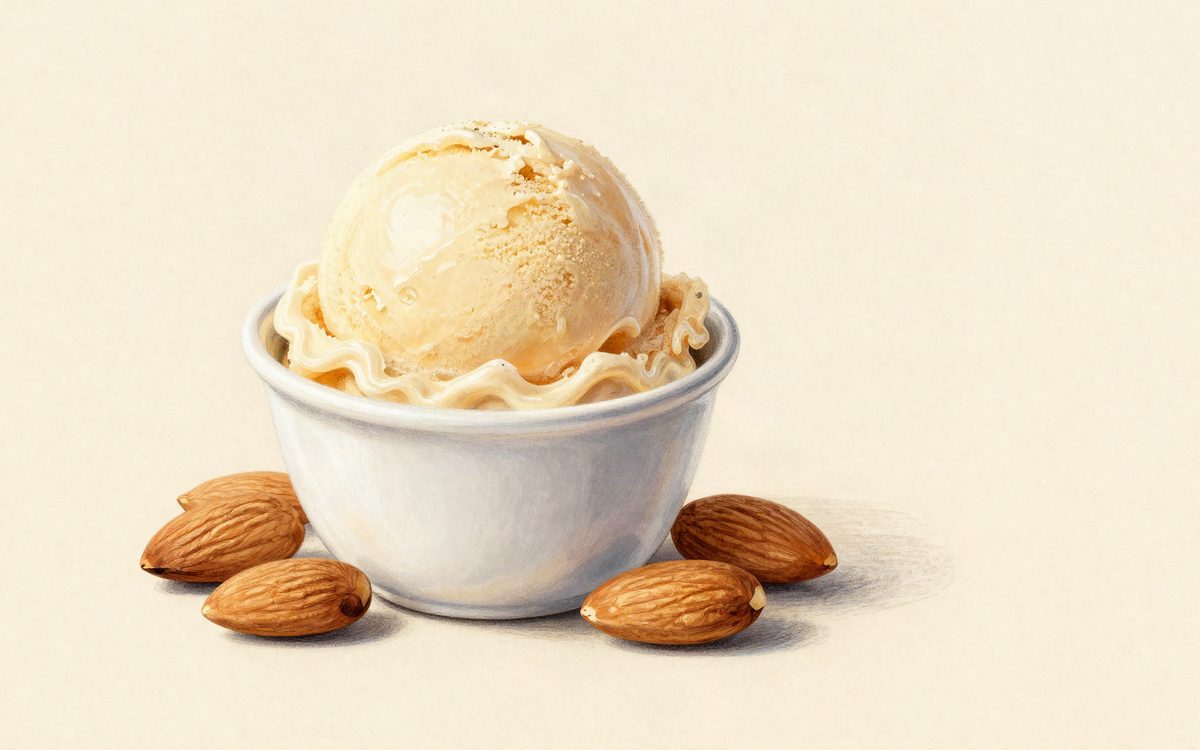
The first spoonful is quieter than the smell suggests. The body is soft rather than dense and warms fast against the tongue, and the aroma follows a beat behind, top note first, that sharp lift of benzaldehyde. On its own it would be gone before you swallow. It is not on its own: the paste underneath carries fat that clings to the palate and stretches the almond out over ten or fifteen seconds, so the finish turns nutty and faintly bitter instead of merely sweet. That second body is the entire job of the 50 g of almond paste sitting under 32 g of liqueur per kilo.
The dose of liqueur is limited by physics, not by taste. Amaretto scores PAC 259, close to three times sucrose, which is the measured version of the old shop rule that 100 g of alcohol lowers the freezing point about as much as 300 g of sucrose. At 32 g per kilo it consumes 83 of the 300 available PAC points, more than a quarter of the antifreeze budget, and still brings 16.5 g of sugar along with it. The finished sheet reads PAC 289.55, the softest setting gelato in this group by design.
Two levers were narrowed to pay for that. Dextrose was capped at 45 g per kilo, since at PAC 173 it competes for the same budget, and cream at 150 g, because almond paste at 55 percent fat already injects 27.5 g and the total was closing on 10 percent. Fat finishes at 9.91 percent. The paste at 50 g per kilo sits below the 60 to 100 g used when almond is the headline, deliberately: here it supports the liqueur rather than starring.
Ingredients
Makes 1000 g of finished base.
| Ingredient | Grams | Home measure |
|---|---|---|
| Whole Milk | 583 | 2 1/2 cups |
| Sugar (Sucrose) | 145 | 2/3 cup plus 1 tablespoon |
| Heavy Cream 35% | 145 | 1/2 cup plus 2 tablespoons |
| Almond Paste (unsweetened) | 50 | |
| Skim Milk Powder | 40 | 1/3 cup plus 2 tablespoons |
| Amaretto Liqueur | 32 | |
| Carob Seed Flour | 4 | |
| Salt | 1 |
Loads these exact grams into the free balancer, ready to edit.
Method
Coldest setting, scrape and stir
- 1Whisk every dry ingredient together first: sugars, milk powder, stabiliser and salt. Dry-blending them stops the stabiliser clumping when it meets liquid.
- 2Warm the liquids to 40 C (104 F), then rain the dry mix in while whisking hard.
- 3Heat to 82 C (180 F) and hold for 2 minutes so the stabiliser hydrates.
- 4Off the heat, whisk in the paste, then blend 60 seconds so the fat emulsifies instead of separating.
- 5Chill in an ice bath to under 5 C (41 F) within 2 hours. Slow cooling is where bacteria and coarse crystals both start.
- 6Age 6 to 12 hours in the fridge under 5 C (41 F). This is when the stabiliser and the milk protein take up water.
- 7Freeze in a shallow metal pan 2 to 3 cm deep, breaking the crystals with a fork every 30 to 40 minutes, 4 to 6 times.
- 8Freeze firm, then temper 10 to 15 minutes in the fridge before scooping.
The balance
All six against the professional range for Milk Gelato.
PAC and sugars tell the story between them. PAC at 289.55 is the highest of any milk gelato in this batch and sits near the top of the 220 to 300 range, because 83 of those points came from the alcohol rather than from sweeteners. That forces the mirror image on the other indicator: sugars land at 16.37 percent, close to the 16 percent floor, since the sweeteners could not be allowed to add antifreeze the liqueur had already spent. The rest follows: fat at 9.91 percent inside 6 to 12, MSNF at 9.84 percent and protein at 4.70 percent against a 5 percent ceiling, and lactose at 5.37 percent of the mix, the highest here but still under the 7 percent line, which is what the 40 g of skim milk powder cost.
Estimated nutrition: ~203 kcal · Fat 9.9 g · Sugars 16.4 g · Protein 4.7 g (per 100 g of mix, from the balanced composition).
The liqueur goes in during the last 60 to 90 seconds of churning, when the mix is already part frozen. Two independent reasons. At 85 C the ethanol evaporates and takes the aromatic esters with it, and added before churning it depresses the freezing point so far that the cylinder cannot form crystal, giving a product that stays soft and never reaches consistency. With 32 g of a liqueur around 24 percent alcohol by volume the finished mix ends near 0.8 percent alcohol, under the practical 1 to 1.5 percent line above which gelato will not harden. The almond paste is the opposite case and goes in early: slacken it with a little warm milk into a smooth emulsion before it meets the rest, since oily paste dropped into a cold mix lumps and releases oil at the surface. Pasteurise at 85 C with the paste already in and age 8 to 12 hours so the almond fat crystallises and gives body. Serve at -14.5 C, slightly colder than standard, to offset the alcohol.
If it goes wrong
The alcohol went in before churning, or the dose went past the 32 g on the sheet and crossed the 1 to 1.5 percent alcohol line in the finished mix.
Keep it at 32 g, which lands near 0.8 percent alcohol, and add it only in the last 60 to 90 seconds, when the mix is already part frozen.
The liqueur was in the pot during the 85 C pasteurisation. Ethanol leaves at 78 C and the aromatic esters leave with it.
Pasteurise the base with only the almond paste in it, and hold the liqueur back until the very end of churning.
The 50 g of paste was tipped straight into a cold mix instead of being loosened first.
Whisk the paste with a little warm milk into a smooth emulsion, then add it to the rest and pasteurise at 85 C.
Suitable for: Vegetarian, Egg-free
Contains alcohol.
Allergens: milk, tree nuts
- https://www.artigeniale.it/gelato-artigianale/alcool-nel-gelato-tecniche-di-bilanciatura/
- https://www.cucchiaio.it/ricetta/ricetta-gelato-allamaretto/
- https://blog.giallozafferano.it/millimuh/gelato-allamaretto/
- The science behind it: Alcohol in Gelato
- Ingredient sheet: Almond Paste (unsweetened)
Want to change an ingredient and watch the numbers move? Open the free balancer