Amarena Cherry Gelato
Sweet-sour dark fruit runs through a plain milk base, cool and slightly chewy where the pieces sit, with a tart edge that stops the syrup from cloying.
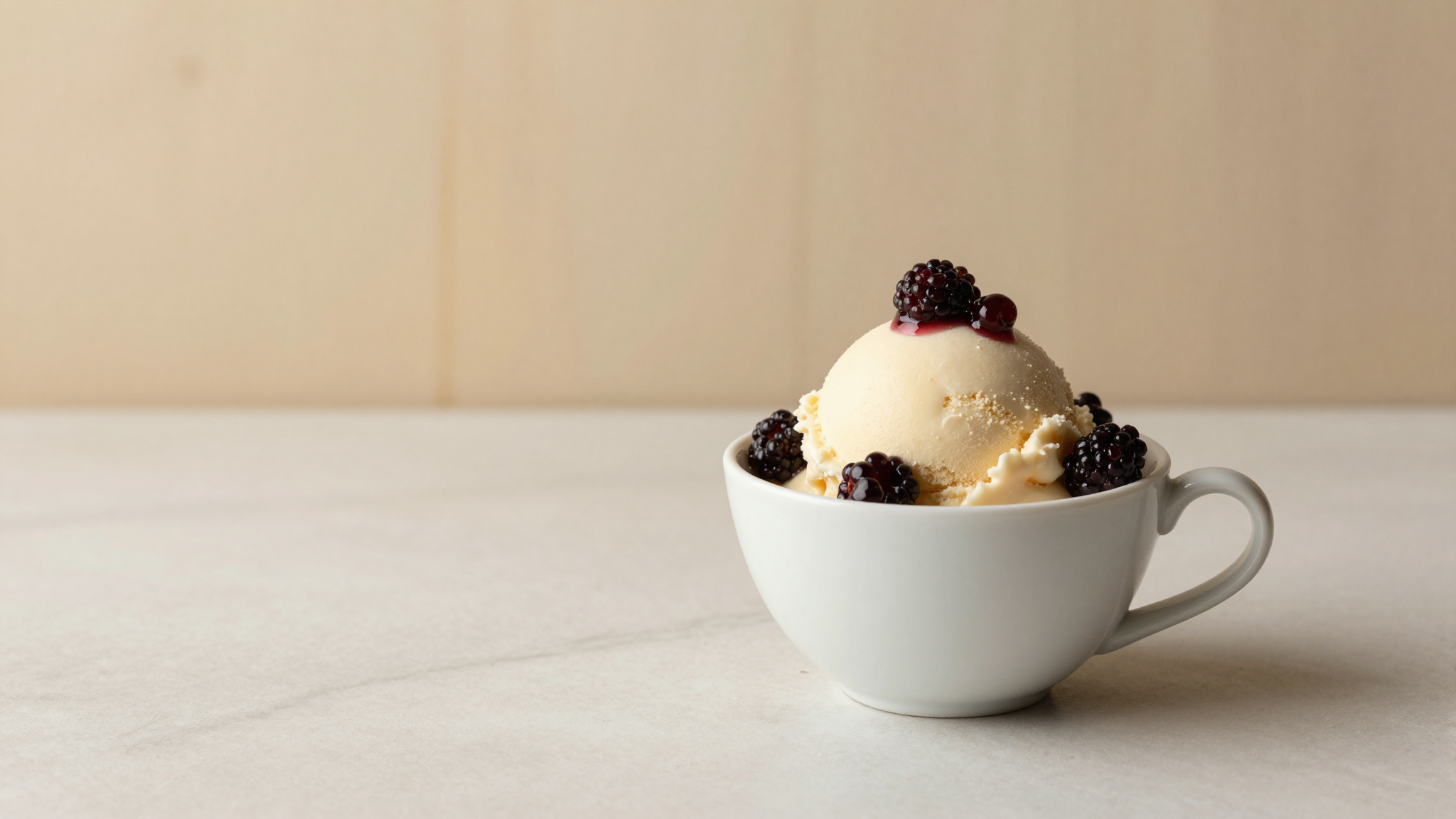
Two jars on the same shelf can hold very different things. The one worth buying lists fruit first and sugar second, and the syrup inside is thick and dark; the cheap one leads with glucose syrup, colouring and flavouring, and the cherries in it have gone pale and slack. That difference lands in the tub, because at 160 g per kilo the fruit is a sixth of the mix and brings 131 g of water with it. Weak fruit here means weak flavour and a wet set. The 5 g of lemon juice is doing none of the tasting work: it holds the pH low enough for the cherry pigment to stay red instead of drifting brown after two days in the cabinet.
The 160 g sits in the middle of amarena variegato practice, which runs between 120 and 200 g per kilo over a fiordilatte base. It is worth knowing what those cherries actually contribute: despite the word syrup, they bring only about 25 g of sugar to the kilo, which is why 130 g of sucrose is still weighed in and why glucose powder shows up at 35 g to finish the solids.
The 5 g of lemon juice is not there for lemon flavour, and at that dose you will not taste it. It nudges the pH down enough to hold the anthocyanins that give the cherry its red. In a neutral base those pigments fade toward brown, and a tub that looked right on day one looks like old cherry by day three.
Ingredients
Makes 1000 g of finished base.
| Ingredient | Grams | Home measure |
|---|---|---|
| Whole Milk | 494 | 2 cups |
| Cherry in Syrup | 160 | |
| Sugar (Sucrose) | 130 | 2/3 cup |
| Heavy Cream 35% | 125 | 1/2 cup plus 1 tablespoon |
| Non-Fat Dry Milk | 42 | 1/3 cup plus 2 tablespoons |
| Glucose Powder | 35 | 3 tablespoons |
| Lemon Juice | 5 | |
| Dextrose (Glucose) | 5 | 1 1/4 teaspoons |
| Stabilizer (Neutral) | 3 | |
| Salt | 1 |
Loads these exact grams into the free balancer, ready to edit.
Method
Fork freeze, ripple at the end
- 1Whisk every dry ingredient together first: sugars, milk powder, stabiliser and salt. Dry-blending them stops the stabiliser clumping when it meets liquid.
- 2Warm the liquids to 40 C (104 F), then rain the dry mix in while whisking hard.
- 3Heat to 82 C (180 F) and hold for 2 minutes so the stabiliser hydrates.
- 4Chill in an ice bath to under 5 C (41 F) within 2 hours. Slow cooling is where bacteria and coarse crystals both start.
- 5Age 6 to 12 hours in the fridge under 5 C (41 F). This is when the stabiliser and the milk protein take up water.
- 6Fold the fruit in cold, after ageing. Heating it costs you the fresh aroma and nothing is gained.
- 7Freeze in a shallow metal pan 2 to 3 cm deep, breaking the crystals with a fork every 30 to 40 minutes, 4 to 6 times.
- 8Freeze firm, then temper 10 to 15 minutes in the fridge before scooping.
The balance
All six against the professional range for Milk Gelato with Fruit.
The fruit water is the reason for every number. MSNF lands at 9.17 percent, high inside the 5 to 9.5 fruit window rather than in the 8 to 11.5 milk window, which is what keeps the body from going watery without stacking milk powder past the lactose limit: lactose ends at 5.0 percent of the mix. Fat comes to 6.18 percent inside 3.5 to 8, lower than a plain fiordilatte on purpose, because fat and fruit acidity fight each other on the palate. Sugars read 19.32 percent inside 17 to 25, mostly weighed sugar rather than fruit sugar. Sweetening power at 185.39 sits mid band in 150 to 230, and the last solids come from glucose powder while dextrose stays at a token 5 g. PAC at 256.39 is unremarkable in a 240 to 310 range, so this one serves at standard temperature.
Estimated nutrition: ~173 kcal · Fat 6.2 g · Sugars 19.3 g · Protein 3.5 g (per 100 g of mix, from the balanced composition).
The specific risk is curdling from acid. Cherry and lemon together drop the pH, and casein precipitates near pH 4.6. Do not pasteurise the fruit with the milk. Build the complete white base, milk, cream, sugars, milk powder and stabiliser, at 85 C, chill it to 4 C, and only then fold in the cherries and the lemon juice cold, since acidifying a cold mix does not flocculate casein the same way. Pasteurised together, the gelato comes out grainy and no blender recovers it. The cherries can go half into the mix, for colour and flavour, and half as a ripple at the end of churning, for whole fruit, but that ripple half is already counted inside the 160 g. Do not ladle extra syrup on top: amarena syrup is more antifreeze than the gelato itself, and an uncounted ripple leaves veins that never set and run in the tub.
If it goes wrong
The cherries and the lemon juice were heated with the milk. Around pH 4.6 the casein precipitates.
Pasteurise the white base alone at 85 C, chill it to 4 C, then stir the fruit and the 5 g of lemon in cold.
The lemon juice was left out. In a neutral base the cherry anthocyanins lose their colour.
Keep the 5 g of lemon juice. It is a functional ingredient on this sheet, not a flavouring, and it costs nothing in taste.
Extra syrup was added on top of the 160 g already counted, and amarena syrup is more antifreeze than the gelato itself.
Split the 160 g, half in the mix and half as ripple, and add nothing beyond it.
Suitable for: Vegetarian, Egg-free
Allergens: milk
- https://www.fabbri1905.com/professionisti/gelateria/ricette/variegato-amarena.kl
- http://www.toschi.it/ricette/ricette-dolci/gelati/gelato-al-fiordilatte-variegato-con-amarene-in-sciroppo
- https://www.recipesfromitaly.com/stracciatella-gelato/
- https://store.fabbri1905.com/products/variegato-amarena-fabbri-4-5kg
- The science behind it: Why Acidic Fruit Curdles Dairy Gelato, and How to Stop It
- Ingredient sheet: Cherry in Syrup
- The story of this recipe: Amarena Cherry Gelato Recipe
Want to change an ingredient and watch the numbers move? Open the free balancer