Almond Gelato
Cold and smooth on the first spoon, then roasted almond opens up and holds, closing faintly bitter with a saline edge that stops the sweetness going flat.
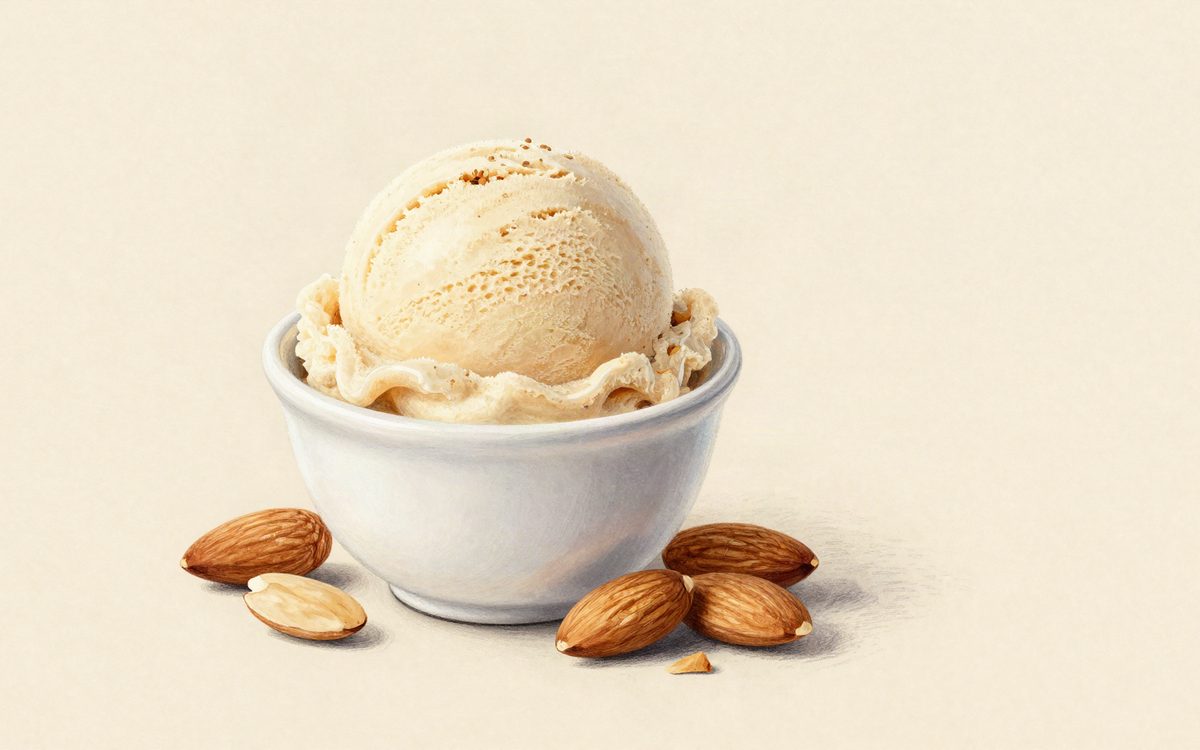
In Sicily the nut is drunk before it is ever frozen: latte di mandorla is almond ground to paste and let down with water, and this gelato is that habit taken into a machine. So the flavour is built from paste, 82 g of unsweetened almond paste per kilo against a white base of whole milk and a modest 45 g of cream. Almond carries less fat than hazelnut or macadamia, so the cream is what lifts the mix to 8.44 percent fat while the paste is left free to do the aroma. Use paste made from toasted almonds and the difference shows on the first spoon.
At 90 g of paste the sheet still closes, but protein lands at 4.93 percent with almost no headroom, so a scale that rounds up puts the batch outside the range before you have stirred anything. At 82 g protein reads 4.83 percent with real slack, and the almond still delivers 45 g of fat per kilo, 4.5 percent, plus more than enough aroma, because toasted almond has a low perception threshold and does not need volume to be heard.
The rest of the fat comes from dairy: 666 g of whole milk and 45 g of cream close the total at 8.44 percent, comfortably inside the 6 to 12 window. PAC lands at 264.12, mid range in 220 to 300, which is why this base scoops rather than shatters once tempered 10 to 15 minutes in the fridge.
Ingredients
Makes 1000 g of finished base.
| Ingredient | Grams | Home measure |
|---|---|---|
| Whole Milk | 666 | 2 3/4 cups |
| Sugar (Sucrose) | 140 | 2/3 cup plus 1 tablespoon |
| Almond Paste (unsweetened) | 82 | |
| Heavy Cream 35% | 45 | 3 tablespoons |
| Dextrose (Glucose) | 40 | 3 1/2 tablespoons |
| Non-Fat Dry Milk | 22 | 4 tablespoons |
| Carob Seed Flour | 4 | |
| Salt | 1 |
Loads these exact grams into the free balancer, ready to edit.
Method
Chilled tray, fork every 30 minutes
- 1Whisk every dry ingredient together first: sugars, milk powder, stabiliser and salt. Dry-blending them stops the stabiliser clumping when it meets liquid.
- 2Warm the liquids to 40 C (104 F), then rain the dry mix in while whisking hard.
- 3Heat to 82 C (180 F) and hold for 2 minutes so the stabiliser hydrates.
- 4Off the heat, whisk in the paste, then blend 60 seconds so the fat emulsifies instead of separating.
- 5Chill in an ice bath to under 5 C (41 F) within 2 hours. Slow cooling is where bacteria and coarse crystals both start.
- 6Age 6 to 12 hours in the fridge under 5 C (41 F). This is when the stabiliser and the milk protein take up water.
- 7Freeze in a shallow metal pan 2 to 3 cm deep, breaking the crystals with a fork every 30 to 40 minutes, 4 to 6 times.
- 8Freeze firm, then temper 10 to 15 minutes in the fridge before scooping.
The balance
All six against the professional range for Milk Gelato.
Two indicators explain almost every decision on this sheet. Protein at 4.83 percent sits just under the 5 percent ceiling, and that single number is what caps the almond paste at 82 g: nut protein and dairy protein compete for the same allowance. MSNF at 8.35 percent sits just above its 8 percent floor for the same reason, since pushing milk powder up would have cost protein the recipe does not have. Everything else has room: solids 38.25 against 36 to 42, sugars 18.01 against 16 to 22, POD 176.47 against 140 to 200, water 61.75 against 58 to 64. Lactose comes to 4.55 percent of the mix, under the 7 percent line, so sandiness from crystallised lactose is not a risk here.
Estimated nutrition: ~195 kcal · Fat 8.4 g · Sugars 18 g · Protein 4.8 g (per 100 g of mix, from the balanced composition).
The paste choice changes the product more than the dose does. Raw blanched paste gives the floral, milky latte di mandorla profile; toasted paste gives amaretto. Benzaldehyde, the compound behind the bitter almond note, is volatile and heat sensitive, so the paste goes into the base already cooled, below 40 C, never into the pot. Pasteurise the white base at 85 C for 30 seconds, chill to 4 C, emulsify the paste in, then age 8 to 12 hours. One texture trap: badly refined almond paste, coarser than about 25 microns, is read on the tongue as sand and gets blamed on lactose crystallisation, which at 4.55 percent of the mix is not what is happening.
If it goes wrong
The paste went into the hot pot. Benzaldehyde is volatile and leaves with the steam during pasteurisation.
Pasteurise the white base on its own at 85 C for 30 seconds, bring it below 40 C, and only then blend the 82 g of paste in.
Coarse almond paste, above roughly 25 microns. It is not lactose: this sheet sits at 4.55 percent lactose on the mix, under the 7 percent line.
Use a finely refined paste and blend the base a full minute. If the grit survives, the paste is the problem and no change to the balance will fix it.
Almond paste separates in the jar, so the fat was weighed unevenly and never fully emulsified.
Stir the jar back to uniform before weighing, and blend the base for 60 seconds after the paste goes in.
Suitable for: Vegetarian, Egg-free
Allergens: milk, tree nuts
No ingredient in this recipe contains gluten.
- https://gelatostore.it/en/products/pure-almond-paste-100-1kg
- https://plus.tekneitalia.com/en/product/pasta-di-mandorla-tostata-kg-3/
- https://gelatostore.it/en/products/sweet-almond-paste-3kg
- The science behind it: Almond Paste in Gelato
- Ingredient sheet: Almond Paste (unsweetened)
Want to change an ingredient and watch the numbers move? Open the free balancer