Strawberry Sorbet
Light on the tongue and quick to melt, it lands bright and sharp almost at once, keeps a lemon edge at the back and clears without leaving a film.
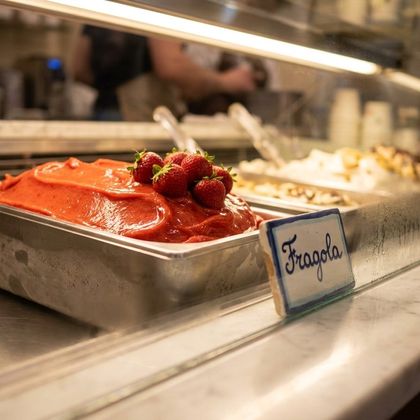
There is no fat in this to slow anything down, so the fruit arrives almost at once, bright and sharp, then clears fast and leaves the mouth clean instead of filmed. The body is light, the melt is quick, and the acidity sits at the back where it keeps the sweetness in check. Building that takes work, because the fruit is about 91 percent water: 520 g per kilo bring colour, aroma and acid and almost no structure, so four sugar lines and a stabiliser have to carry the texture on their own. The 15 g of lemon does a second job, holding the red from turning orange.
The 15 g of lemon juice is doing a job most recipes never explain. It pulls the mix to roughly pH 3.3, and pelargonidin-3-glucoside, the pigment that makes strawberry red, is only stable in its flavylium form at that acidity. Skip the acid and the sorbet drifts orange in a few days, even sitting frozen.
PAC lands at 323.81, in the upper part of the 280 to 340 band, and the 65 g of dextrose is most of the reason it sits there rather than at the stiff end. Protein closes at 0.37 percent against the 1 percent ceiling a sorbetto has to respect, and fat at 0.16 percent, so there is nothing here to soften the ice except sugar architecture.
Ingredients
Makes 1000 g of finished base.
| Ingredient | Grams | Home measure |
|---|---|---|
| Strawberry | 520 | |
| Water | 189 | 3/4 cup plus 1 tablespoon |
| Sugar (Sucrose) | 95 | 1/3 cup plus 2 tablespoons |
| Glucose Powder | 90 | 1/3 cup plus 2 tablespoons |
| Dextrose (Glucose) | 65 | 1/3 cup |
| Maltodextrin | 22 | |
| Lemon Juice (Squeezed) | 15 | |
| Stabilizer (Neutral) | 4 |
Loads these exact grams into the free balancer, ready to edit.
Method
Syrup cooked separately, raw puree folded in cold, three tray passes
- 1Whisk every dry ingredient together first: sugars, milk powder, stabiliser and salt. Dry-blending them stops the stabiliser clumping when it meets liquid.
- 2Warm the liquids to 40 C (104 F), then rain the dry mix in while whisking hard.
- 3Heat to 82 C (180 F) and hold for 2 minutes so the stabiliser hydrates.
- 4Chill in an ice bath to under 5 C (41 F) within 2 hours. Slow cooling is where bacteria and coarse crystals both start.
- 5Age 6 to 12 hours in the fridge under 5 C (41 F). This is when the stabiliser and the milk protein take up water.
- 6Fold the fruit in cold, after ageing. Heating it costs you the fresh aroma and nothing is gained.
- 7Freeze in a shallow metal pan 2 to 3 cm deep, breaking the crystals with a fork every 30 to 40 minutes, 4 to 6 times.
- 8Freeze firm, then temper 10 to 15 minutes in the fridge before scooping.
The balance
All six against the professional range for Sorbetto.
Two numbers set the shape of this sheet. Sugars at 28.69 percent against a 25 to 31 band are high for a fruit sorbet, and they have to be, because 520 g of a fruit that is 91 percent water contributes almost no solids of its own. PAC at 323.81 against 280 to 340 is the second: it is what makes a 68.75 percent water mix, in a 66 to 72 band, still scoop at display temperature, between -11 and -14 C, instead of setting into a block. Around those, solids read 31.25 against 28 to 34, POD 209.94 against 200 to 270, fat 0.16 and protein 0.37, each against a 1 ceiling. There is no MSNF at all, which is why lactose sits at zero and the sandiness check passes by definition.
Estimated nutrition: ~126 kcal · Fat 0.2 g · Sugars 28.7 g · Protein 0.4 g (per 100 g of mix, from the balanced composition).
The strawberry never gets heated. Cooked strawberry reads as jam, not as fruit, and no amount of balancing fixes that. Build the syrup on its own with the water, the sugars and the 4 g of neutral stabiliser, take it to 85 C, cool it to 4 C, and only then blend in the raw puree and the 15 g of lemon juice. Freeze the same day: even cold, strawberry puree darkens and loses its top notes within hours, so an overnight age costs you the aroma you paid 520 g for.
If it goes wrong
The lemon juice was left out or cut back, so the mix never reached the acidity the pigment needs.
Keep the full 15 g of lemon juice. It is what holds the pH near 3.3, where pelargonidin-3-glucoside stays in its red form.
The fruit was pasteurised together with the syrup.
Cook the syrup alone at 85 C, chill it to 4 C, then add the raw puree. The fruit should never go above fridge temperature.
The dextrose was replaced with more sucrose, which drops PAC well below the balanced figure.
Keep the 65 g of dextrose alongside the 95 g of sucrose. The blend is what puts PAC at 323.81, high in the band, instead of at the stiff end.
Suitable for: Vegan, Vegetarian, Lactose-free, Egg-free
- https://pastryartsmag.com/sponsored/simple-sorbet-science/
- https://www.sogoodmagazine.com/pastry-blog/pastry-chef-articles/fruit-sorbets-from-a-syrup-base-a-practical-resource/
- https://www.sciencedirect.com/science/article/abs/pii/S0308814620301461
- The science behind it: Anthocyanin Color Stability in Sorbet
- Ingredient sheet: Strawberry
- The story of this recipe: Sorbetto alla Fragola
Want to change an ingredient and watch the numbers move? Open the free balancer