Pineapple Sorbet
Sharp and cold on contact, juicy rather than creamy, the acidity dropping away into a sweet tropical tail that keeps going long after the spoon is empty.
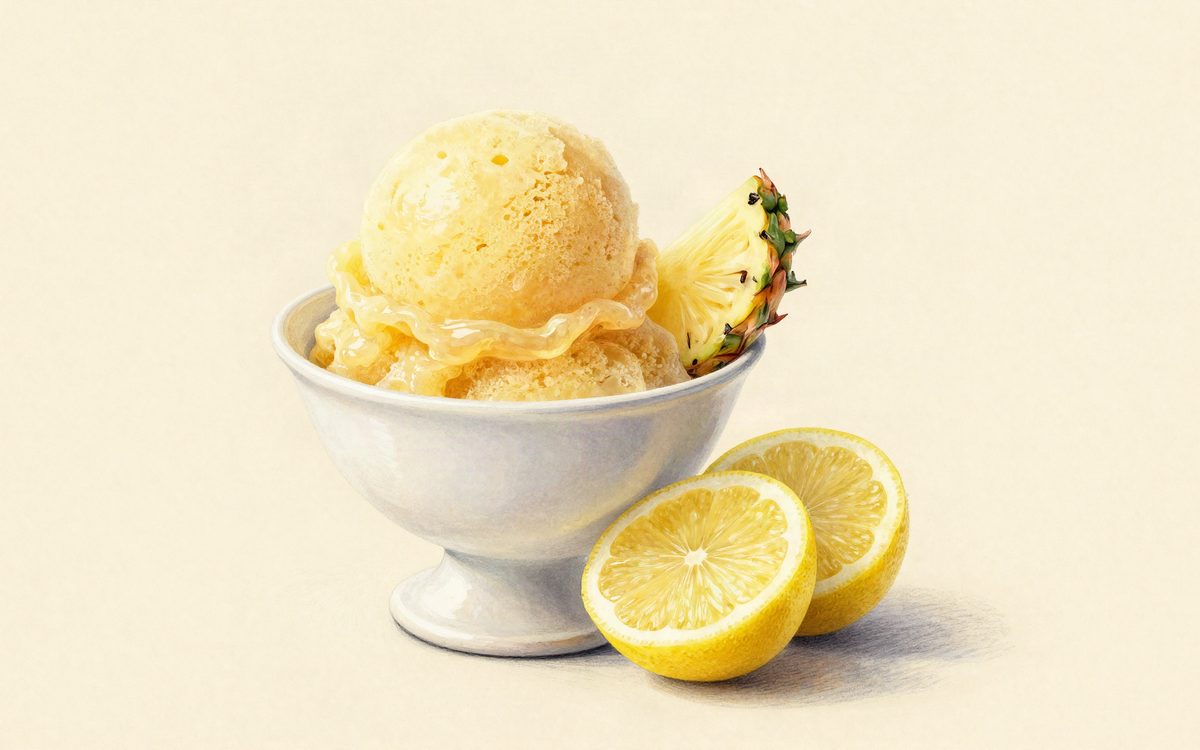
Straight out of the machine it lands cold and sharp, with no fat in the way to soften the hit, so the acidity is the first thing that registers. The body is light and juicy instead of creamy, closer to eating the fruit very cold than to eating an ice cream, and it melts fast. Then the order reverses: the acid falls away and a sweet, faintly resinous tail runs on for a good while afterwards. That length is what 520 g of fruit per kilo buys, and it is also why the lemon stops at 10 g. The fruit already runs pH 3.3 to 3.9, and more acid on top would turn bright into aggressive.
Sorbet works to a 1 percent protein ceiling, and pineapple runs near 0.5 g per 100 g of fruit, which is a friendly ratio. At 520 g the mix reads 0.26 percent protein, the widest margin against that ceiling in this group of recipes. Water lands at 69.16 percent inside a 66 to 72 band and solids at 30.84 percent inside 28 to 34, both comfortably mid range, because 80 g of glucose powder and 27 g of maltodextrin buy dry extract without buying sweetness.
Sugars close at 28.31 percent and POD at 206.87 against a 270 ceiling, so there is room left for a very ripe fruit without the sheet tipping into candy. PAC 313.76 sits mid band in 280 to 340: firm enough to hold a shape, soft enough to scoop cleanly after its 10 to 15 minutes in the fridge.
Ingredients
Makes 1000 g of finished base.
| Ingredient | Grams | Home measure |
|---|---|---|
| Pineapple | 520 | |
| Water | 224 | 3/4 cup plus 3 tablespoons |
| Glucose Powder | 80 | 1/3 cup plus 1 tablespoon |
| Sugar (Sucrose) | 70 | 1/3 cup |
| Dextrose (Glucose) | 65 | 1/3 cup |
| Maltodextrin | 27 | |
| Lemon Juice (Squeezed) | 10 | |
| Stabilizer (Neutral) | 4 |
Loads these exact grams into the free balancer, ready to edit.
Method
Shallow steel tray, forked every 30 minutes
- 1Whisk every dry ingredient together first: sugars, milk powder, stabiliser and salt. Dry-blending them stops the stabiliser clumping when it meets liquid.
- 2Warm the liquids to 40 C (104 F), then rain the dry mix in while whisking hard.
- 3Heat to 82 C (180 F) and hold for 2 minutes so the stabiliser hydrates.
- 4Chill in an ice bath to under 5 C (41 F) within 2 hours. Slow cooling is where bacteria and coarse crystals both start.
- 5Age 6 to 12 hours in the fridge under 5 C (41 F). This is when the stabiliser and the milk protein take up water.
- 6Fold the fruit in cold, after ageing. Heating it costs you the fresh aroma and nothing is gained.
- 7Freeze in a shallow metal pan 2 to 3 cm deep, breaking the crystals with a fork every 30 to 40 minutes, 4 to 6 times.
- 8Freeze firm, then temper 10 to 15 minutes in the fridge before scooping.
The balance
All six against the professional range for Sorbetto.
One number explains the shape of this recipe. PAC at 313.76 is the reason it scoops: the fruit brings only part of it, and the 65 g of dextrose finishes the job without pushing POD, which stays at 206.87 under a 270 limit. Around PAC, solids 30.84 percent and water 69.16 percent both sit mid band, so nothing on this sheet is being held together by a single tight constraint. Sugars at 28.31 percent inside 25 to 31 leave the small margin you want for fruit that varies from crate to crate.
Estimated nutrition: ~123 kcal · Fat 0 g · Sugars 28.3 g · Protein 0.3 g (per 100 g of mix, from the balanced composition).
The specific problem with pineapple is bromelain. In a base with no dairy it has no casein to attack, so it will not wreck the structure the way it would in a milk gelato, but it stays active at freezer temperature and keeps working on whatever protein is there. The practical effect is a sorbet that is clean in the first days and progressively rough and prickly on the tongue after that. Two honest options: eat it inside a week, or blanch the pineapple briefly before weighing the 520 g, accepting the loss of top note. Bromelain needs more heat to denature than kiwi actinidin, so a token dip will not do it. Discard the core: it is fibrous, poor in aroma, and functions as a diluter. Pasteurise only the syrup of water, sugars and the 4 g of stabiliser at 85 C, chill to 4 C, then blend in the cold pulp and the lemon.
If it goes wrong
Bromelain from raw pineapple is still working at freezer temperature. It does not stop when the mix freezes.
Either treat this as a one week sorbet, or blanch the fruit before weighing the 520 g. There is no fix once the texture has turned.
The core went into the blender with the flesh. It carries little aroma and a lot of fibre, so it dilutes the dose without paying for it.
Cut the core out and weigh 520 g of flesh only.
Extra lemon was added by habit. Pineapple already sits at pH 3.3 to 3.9, which is why the sheet uses only 10 g.
Keep lemon at 10 g per kilo. If the fruit is very ripe and tastes flat, correct with 5 g more, not 30.
Suitable for: Vegan, Vegetarian, Lactose-free, Egg-free
- https://casadesante.com/blogs/digestive-enzymes/does-kiwi-eat-you-back-the-science-behind-fruit-enzymes
- https://pastryartsmag.com/sponsored/simple-sorbet-science/
- https://www.sogoodmagazine.com/pastry-blog/pastry-chef-articles/fruit-sorbets-from-a-syrup-base-a-practical-resource/
- The science behind it: How to Balance a Sorbetto Recipe
- Ingredient sheet: Pineapple
Want to change an ingredient and watch the numbers move? Open the free balancer