Orange Sorbet
Bright and almost brittle at the front, it gives way easily under the spoon, and the peel oil is what stays behind once the juice has washed off.
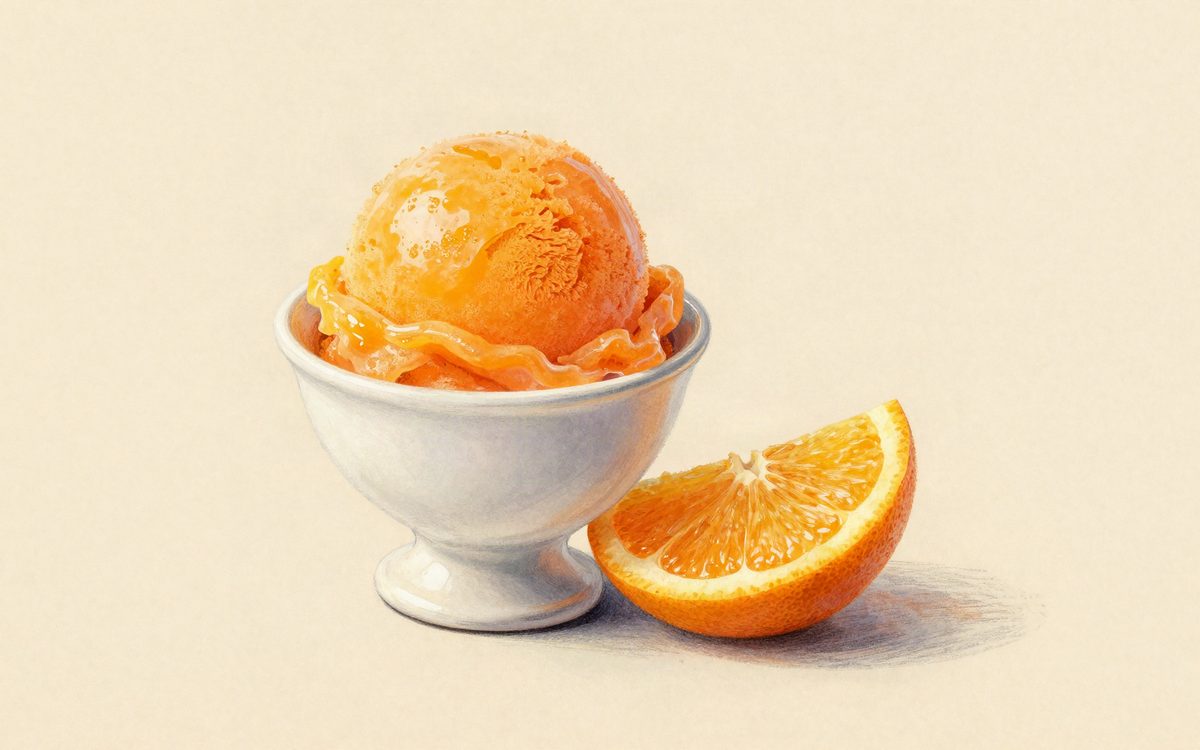
A block you cannot get a spoon into, and a scoop that tastes like cold sugar water, are the same failure wearing two faces. Both come from too few dissolved solids, and from asking juice to carry an aroma it never held in the first place. The sugar side here is split three ways, sucrose, dextrose and maltodextrin, which drops the freezing point far enough to keep the texture yielding without dragging the sweetness up with it, while carob and guar hold on to whatever free water is left. The 5 g of zest per kilo is the part that keeps it tasting of the fruit rather than of the juice.
Because the juice is roughly 88 percent water, it also replaces almost all the free water in the formula. Added water is down to 165 g, which turns it from the main lever into a fine adjustment. What the juice does not bring is solids: it contributes about 4.9 points of sugar, and total solids still have to reach 28 to 34 percent. That is why 61 g of maltodextrin sits in the list, carrying solids and body with almost no sweetness attached, while 110 g of sucrose and 75 g of dextrose do the sweetening and the freezing.
Five grams of zest is the line that separates a sorbetto from a frozen juice pop. Squeezed juice has acid and sugar and almost no aroma, because orange aroma lives in the essential oil of the flavedo, not in the flesh. Sugars close at 28.52 percent inside 25 to 31, POD at 218.64 inside 200 to 270 and PAC at 323.75 inside 280 to 340, so the sheet has the sweetness and the softness of a proper sorbetto and the zest supplies what the juice left out.
Ingredients
Makes 1000 g of finished base.
| Ingredient | Grams | Home measure |
|---|---|---|
| Orange Juice | 580 | |
| Water | 165 | 2/3 cup |
| Sugar (Sucrose) | 110 | 1/2 cup plus 1 tablespoon |
| Dextrose (Glucose) | 75 | 1/3 cup plus 1 tablespoon |
| Maltodextrin | 61 | |
| Orange Zest | 5 | |
| Carob Seed Flour | 3 | |
| Guar Gum | 1 |
Loads these exact grams into the free balancer, ready to edit.
Method
Zest infused in the hot syrup, juice stirred in cold, tray freeze
- 1Whisk every dry ingredient together first: sugars, milk powder, stabiliser and salt. Dry-blending them stops the stabiliser clumping when it meets liquid.
- 2Warm the liquids to 40 C (104 F), then rain the dry mix in while whisking hard.
- 3Heat to 82 C (180 F) and hold for 2 minutes so the stabiliser hydrates.
- 4Chill in an ice bath to under 5 C (41 F) within 2 hours. Slow cooling is where bacteria and coarse crystals both start.
- 5Age 6 to 12 hours in the fridge under 5 C (41 F). This is when the stabiliser and the milk protein take up water.
- 6Freeze in a shallow metal pan 2 to 3 cm deep, breaking the crystals with a fork every 30 to 40 minutes, 4 to 6 times.
- 7Freeze firm, then temper 10 to 15 minutes in the fridge before scooping.
The balance
All six against the professional range for Sorbetto.
The number that shapes this sheet is solids at 30.9 percent against 28 to 34: juice that is 88 percent water cannot deliver those solids, so 61 g of maltodextrin does it without adding sweetness. With that fixed, sugars land at 28.52 against 25 to 31, POD at 218.64 against 200 to 270, PAC at 323.75 against 280 to 340, water at 69.1 against 66 to 72, fat at 0.12 against 0 to 1 and protein at 0.44 against 0 to 1. Dextrose is deliberately high at 75 g because it lifts PAC harder than sucrose per gram, which is how the sheet stays scoopable at that solids level.
Estimated nutrition: ~124 kcal · Fat 0.1 g · Sugars 28.5 g · Protein 0.4 g (per 100 g of mix, from the balanced composition).
Squeeze the oranges the same day and strain through a fine sieve to remove coarse pulp and pips, but do not clarify it: the fine particles in suspension are what give the sorbetto its opacity and its body, and a clear juice freezes glassy. Do not press the fruit to the last drop and do not twist it hard, because that extracts albedo and brings naringin bitterness with it. Cook the syrup to 85 C with water, sugars and stabiliser only, with the zest steeping in it, then strain and chill to 4 C; the juice goes in cold at the end. This is the most aroma-perishable sheet in the batch, so churn it the same day, and keep it out of a blender, since whipping air into it oxidises limonene to carvone and the flavour turns to old peel.
If it goes wrong
The fruit was pressed too hard or reamed too deep, pulling albedo and naringin into the 580 g of juice.
Squeeze gently and stop early. Losing 30 g of juice costs you nothing here, because added water at 165 g is available to make up the difference.
The juice was over-clarified, through a cloth or a fine filter, and the suspended particles that carry body were removed with the pulp.
Strain only for pips and coarse pulp and keep the juice cloudy. Do not skip the 61 g of maltodextrin either, since it is the other half of that body.
Air was whipped into the juice, or the finished mix sat for a day before freezing. Limonene oxidises to carvone very quickly.
Mix with a spatula, never a blender, and freeze the same day the fruit is squeezed.
Suitable for: Vegan, Vegetarian, Lactose-free, Egg-free
No ingredient in this recipe contains gluten.
- Recipes from Italy, Homemade Orange Sorbet Recipe with Fresh Oranges (https://www.recipesfromitaly.com/orange-sorbet-recipe/)
- USDA FoodData Central, Orange juice, raw (agua cerca de 88,3 g/100 g, acucares totais 8,4 g/100 g)
- Angelo Corvitto, Los secretos del helado (Vilbo), sorbetes de citricos
- Dream Scoops, Ice Cream Calculator (https://www.dreamscoops.com/ice-cream-science/ice-cream-calculator/)
- The science behind it: Supreming Citrus for Sorbet
- Ingredient sheet: Orange Juice
Want to change an ingredient and watch the numbers move? Open the free balancer