Lime Sorbet
Sharp enough to tighten the jaw, then it opens out clean and cold, scoopable once tempered in the fridge, with no grit and no shards of ice.
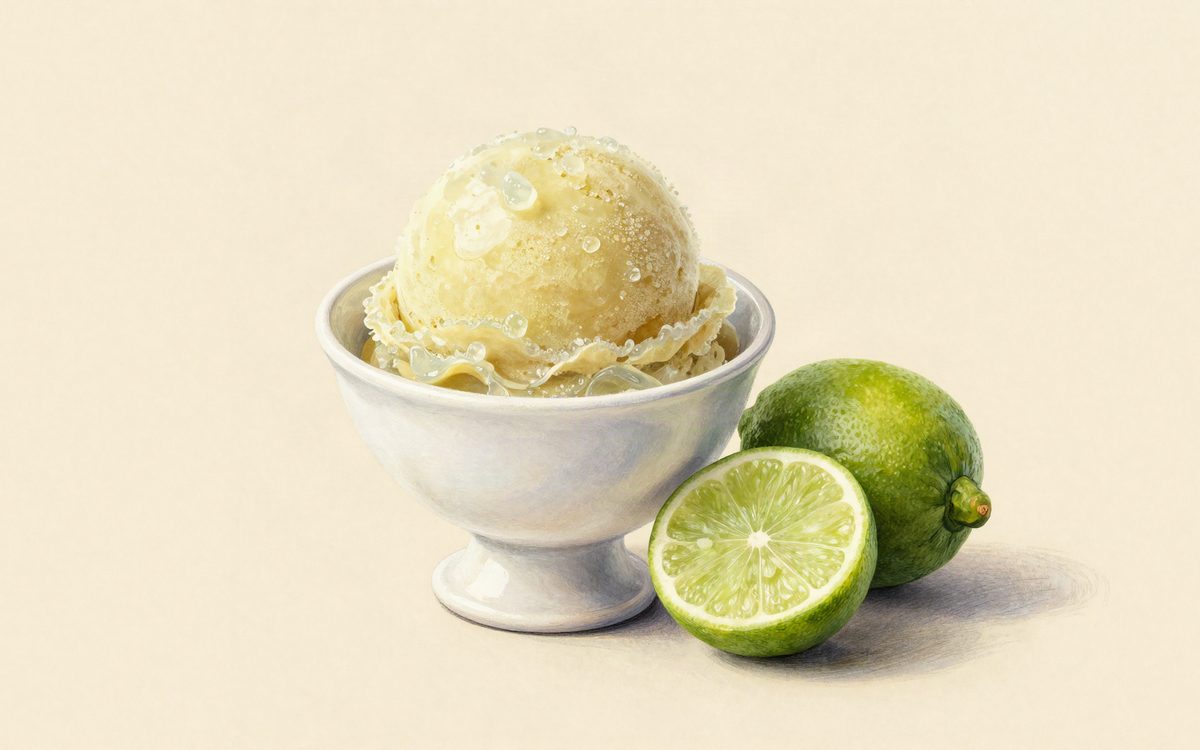
Why does a homemade citrus sorbet come out of the freezer as a block you have to chip at? Because juice is almost entirely water and acid, and water sets hard unless something is dissolved in it. More fruit is not the answer either: at pH 2.2 to 2.4 the juice turns aggressive long before it turns more flavourful, so the load stays at 170 g per kilo and the work moves to the sugars. Sucrose at 110 g, dextrose at 80 g and glucose powder at 95 g put PAC at 326 and keep it scoopable after a brief rest in the fridge, while 3 g of carob flour, 1 g of guar and 22 g of maltodextrin hold the free water still and give body without extra sweetness.
The balancing consequence is that the fruit contributes almost nothing measurable: about 0.3 of a point of sugar and 3 points of POD. The entire 31.19% of solids, the 29.68% of sugars and the whole 326.18 of PAC come from the added levers, and water is the dominant one at 519 g/kg.
Sugar here does two jobs at once, which is why this recipe needs the most of it in the group. It builds dry matter and it neutralizes perceived acidity. The split is 110 g sucrose, 80 g dextrose, 95 g glucose powder and 22 g maltodextrin, the heaviest dextrose load here, landing POD at 208.32, still near the bottom of the 200 to 270 band.
Protein finishes at 0.09% against a 1% limit. It is the one indicator in this formula that is nowhere near pressure, which tells you where the real difficulty lives: acid management, not composition.
Ingredients
Makes 1000 g of finished base.
| Ingredient | Grams | Home measure |
|---|---|---|
| Water | 519 | 2 1/4 cups |
| Tahitian Lime | 170 | |
| Sugar (Sucrose) | 110 | 1/2 cup plus 1 tablespoon |
| Glucose Powder | 95 | 1/2 cup |
| Dextrose (Glucose) | 80 | 1/3 cup plus 2 tablespoons |
| Maltodextrin | 22 | |
| Carob Seed Flour | 3 | |
| Guar Gum | 1 |
Loads these exact grams into the free balancer, ready to edit.
Method
Stainless tray, two stick blender passes
- 1Whisk every dry ingredient together first: sugars, milk powder, stabiliser and salt. Dry-blending them stops the stabiliser clumping when it meets liquid.
- 2Warm the liquids to 40 C (104 F), then rain the dry mix in while whisking hard.
- 3Heat to 82 C (180 F) and hold for 2 minutes so the stabiliser hydrates.
- 4Chill in an ice bath to under 5 C (41 F) within 2 hours. Slow cooling is where bacteria and coarse crystals both start.
- 5Age 6 to 12 hours in the fridge under 5 C (41 F). This is when the stabiliser and the milk protein take up water.
- 6Freeze in a shallow metal pan 2 to 3 cm deep, breaking the crystals with a fork every 30 to 40 minutes, 4 to 6 times.
- 7Freeze firm, then temper 10 to 15 minutes in the fridge before scooping.
The balance
All six against the professional range for Sorbetto.
PAC at 326.18 sits high inside 280 to 340, and in a lime sorbet that is a deliberate trade. High PAC means a lower freezing point and a softer block, and soft is what you want when the mix has zero fat and zero MSNF to give it any creaminess, because the alternative is a hard shard of flavored ice. Solids at 31.19% inside 28 to 34 are built almost entirely from the sugar blend, since the fruit brings roughly 0.3 of a point of sugar, and water at 68.81% is what the 3 g of carob seed flour and 1 g of guar gum are there to manage. The pair matters more here than a single gum would: guar hydrates fast and covers the first hours of freezing, carob hydrates slowly and builds body that holds through storage.
Estimated nutrition: ~125 kcal · Fat 0 g · Sugars 29.7 g · Protein 0.1 g (per 100 g of mix, from the balanced composition).
There is no Tahitian lime zest in the ingredient catalog, only lemon zest and orange zest, and neither is the right peel: in a lime sorbet either one reads as an off flavor. On the bench, infuse 4 g of zest taken from the limes themselves in the hot syrup instead. The critical point for flavor is when you squeeze. Lime limonene degrades in an acid medium, and juice left standing for a few hours pushes the sorbet toward detergent and bitter peel. Squeeze at the last minute, strain, and add to a syrup that has already been pasteurized at 85 C and cooled to 4 C. Do not mature after the juice goes in: churn immediately. Work in stainless steel or plastic only, because at pH 2.3 aluminum is attacked and transfers a metallic taste.
If it goes wrong
The mix touched aluminum. At pH around 2.3 lime juice attacks it.
Use stainless steel or plastic for the pan, the tray and the whisk.
The juice was squeezed ahead of time and the limonene degraded in the acid.
Squeeze at the last minute, strain, add it to syrup already at 4 C, and churn without maturing.
More fruit than the 170 g/kg this formula uses. Lime carries 6 to 8% citric acid, so extra juice adds acid faster than sugar can cover it.
Stay at 170 g/kg and get the lift from 4 g of zest infused in the hot syrup.
Suitable for: Vegan, Vegetarian, Lactose-free, Egg-free
No ingredient in this recipe contains gluten.
- Angelo Corvitto, Los secretos del helado (Vilbo), sorbete de limon e proporcao reduzida de fruta em citricos muito acidos
- USDA FoodData Central, Lime juice, raw (acido citrico e acucares totais cerca de 1,7 g/100 g, proteina 0,42 g/100 g)
- Bread and Basil, How to Make Sorbet: Master Ratio and Guide (https://www.breadandbasil.nyc/recipes/sorbet-guide)
- H. D. Goff e R. W. Hartel, Ice Cream, 7a edicao (Springer), efeito de solidos soluveis e acidez sobre percepcao e ponto de congelamento
- The science behind it: Supreming Citrus for Sorbet
- Ingredient sheet: Tahitian Lime
Want to change an ingredient and watch the numbers move? Open the free balancer