Cherry Sorbet
The cold lands before the fruit does; then sourness opens, stone fruit fills the middle and a rounded sweetness closes behind it, soft to the spoon rather than icy.
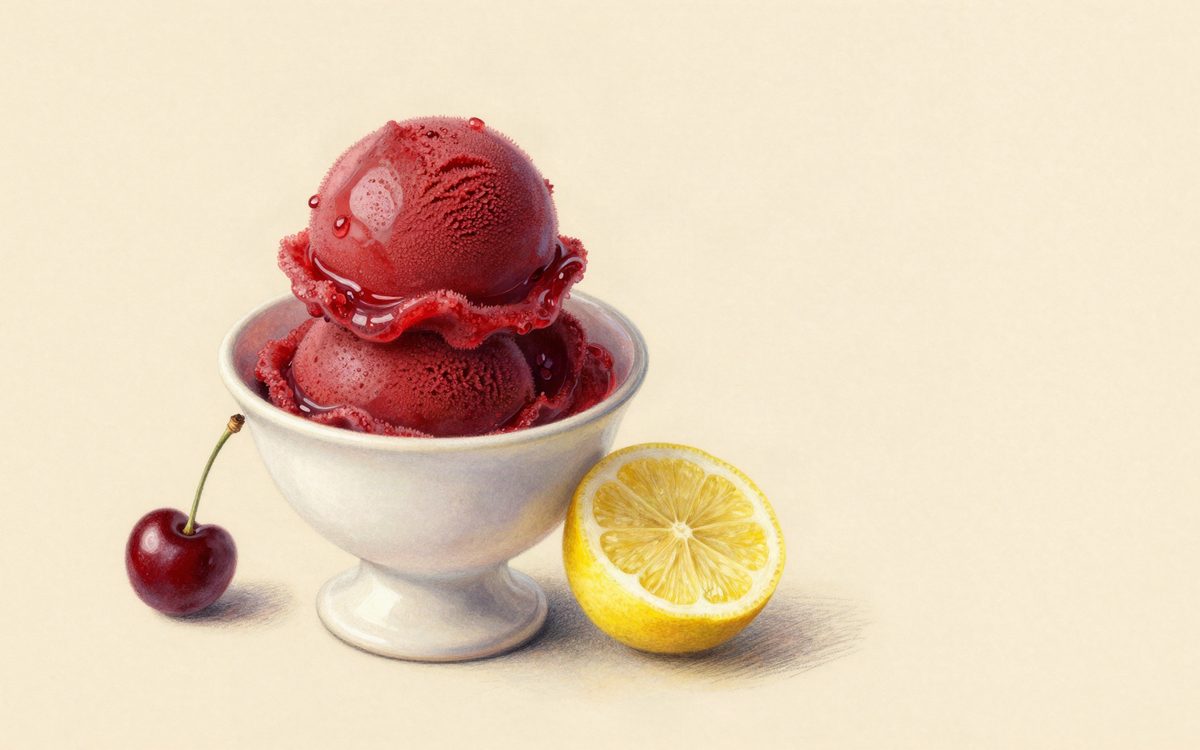
Cold registers first, and only a beat later does the fruit open: sour at the front, stone fruit and a trace of skin bitterness through the middle, sweetness arriving last and settling underneath. The body is what makes that sequence readable. It scrapes soft instead of chipping, wets the tongue without going syrupy, and gives the flavour something to sit on while it fades. Holding that texture meant pushing most of the added sweetener away from table sugar, since this fruit carries an unusually high PAC of its own, and squeezed lemon at 15 g/kg puts back the edge that ripe sweet cherries leave rounded off.
This formula puts 450 g of pitted cherry in every kilo and then spends the rest of the budget undoing what the fruit does to the freezing point. There are 245 g of added sweetener per kilo, but only 75 g of it is sucrose. Glucose powder at 90 g and maltodextrin at 45 g carry the bulk: they add solids and body while contributing very little antifreeze, which is the only way to hold that much cherry and still get a scoop.
The result reads PAC 327.46 inside a working band of 280 to 340, in its upper part, with water at 68.77 percent and fat at 0.09 percent, which is to say none. Everything you feel in the mouth here is sugar solids, fruit pulp and 4 g of neutral stabilizer.
Ingredients
Makes 1000 g of finished base.
| Ingredient | Grams | Home measure |
|---|---|---|
| Cherry | 450 | |
| Water | 286 | 1 1/4 cups |
| Glucose Powder | 90 | 1/3 cup plus 2 tablespoons |
| Sugar (Sucrose) | 75 | 1/3 cup plus 1 tablespoon |
| Maltodextrin | 45 | |
| Dextrose (Glucose) | 35 | 3 tablespoons |
| Lemon Juice (Squeezed) | 15 | |
| Stabilizer (Neutral) | 4 |
Loads these exact grams into the free balancer, ready to edit.
Method
Shallow tray freeze with three blender passes
- 1Whisk every dry ingredient together first: sugars, milk powder, stabiliser and salt. Dry-blending them stops the stabiliser clumping when it meets liquid.
- 2Warm the liquids to 40 C (104 F), then rain the dry mix in while whisking hard.
- 3Heat to 82 C (180 F) and hold for 2 minutes so the stabiliser hydrates.
- 4Chill in an ice bath to under 5 C (41 F) within 2 hours. Slow cooling is where bacteria and coarse crystals both start.
- 5Age 6 to 12 hours in the fridge under 5 C (41 F). This is when the stabiliser and the milk protein take up water.
- 6Fold the fruit in cold, after ageing. Heating it costs you the fresh aroma and nothing is gained.
- 7Freeze in a shallow metal pan 2 to 3 cm deep, breaking the crystals with a fork every 30 to 40 minutes, 4 to 6 times.
- 8Freeze firm, then temper 10 to 15 minutes in the fridge before scooping.
The balance
All six against the professional range for Sorbetto.
Two readings explain the whole build. Total sugars land at 29.31 percent against a ceiling of 31, so there is almost no headroom left for more sweetener of any kind, which is why the blend had to move toward low-antifreeze solids instead of simply adding sugar. Meanwhile total solids sit at 31.23 percent in the middle of a 28 to 34 band, which is the comfortable place to be for a sorbet you intend to freeze without a machine, and water at 68.77 percent is low enough that the ice crystals have somewhere to hide.
Estimated nutrition: ~125 kcal · Fat 0.1 g · Sugars 29.3 g · Protein 0.5 g (per 100 g of mix, from the balanced composition).
Pit the cherries before you weigh them, and weigh only the flesh. The stone is 8 to 12 percent of the whole fruit, and forgetting that is the usual reason a cherry sorbet ends up underdosed in fruit. A small handful of crushed stones infused in the hot syrup is traditional in Italy for the almond note, benzaldehyde, but stones carry amygdalin, so keep it to a small handful, infuse and strain, never blend them in. Cherry anthocyanins are heat sensitive, so the fruit goes into a syrup that is already cold, never into a hot pot. The 15 g of lemon juice is there because sweet cherry is a low acid fruit, pH roughly 3.9 to 4.5, and without it the sorbet reads flat rather than bright.
If it goes wrong
Fruit weighed with stones still in, or very ripe cherries pushing the sugars past the 29.31 percent this balance assumes. Either way the freezing point went lower than planned.
Weigh pitted flesh only. If your cherries are very ripe, take 10 to 15 g out of the sucrose and put the same weight back as maltodextrin, which adds solids without adding antifreeze.
The anthocyanins were cooked, or the puree sat exposed to air before it went into the freezer.
Heat only the water, the sugars and the stabilizer. Cool that syrup completely, then blend the cold cherries and the 15 g of lemon juice into it, and get it into the freezer straight away.
The neutral stabilizer never hydrated, or the mix sat undisturbed while it froze.
Disperse the 4 g of stabilizer with part of the dry sugars and take the water phase to about 85 C so it hydrates. Then blend the freezing mix at least three times, roughly every 40 minutes, while it is still slushy.
Suitable for: Vegan, Vegetarian, Lactose-free, Egg-free
- https://www.sciencedirect.com/science/article/abs/pii/S0924224409002271
- https://pastryartsmag.com/sponsored/simple-sorbet-science/
- https://www.iceicedaddy.com/en/sugar_expert.php
- The science behind it: Anthocyanin Color Stability in Sorbet
- Ingredient sheet: Cherry
Want to change an ingredient and watch the numbers move? Open the free balancer