Yuzu Sorbet
Nothing lingers heavily here: the acid wakes the whole mouth, the floral note lands between grapefruit and mandarin, and the tongue is left clean.
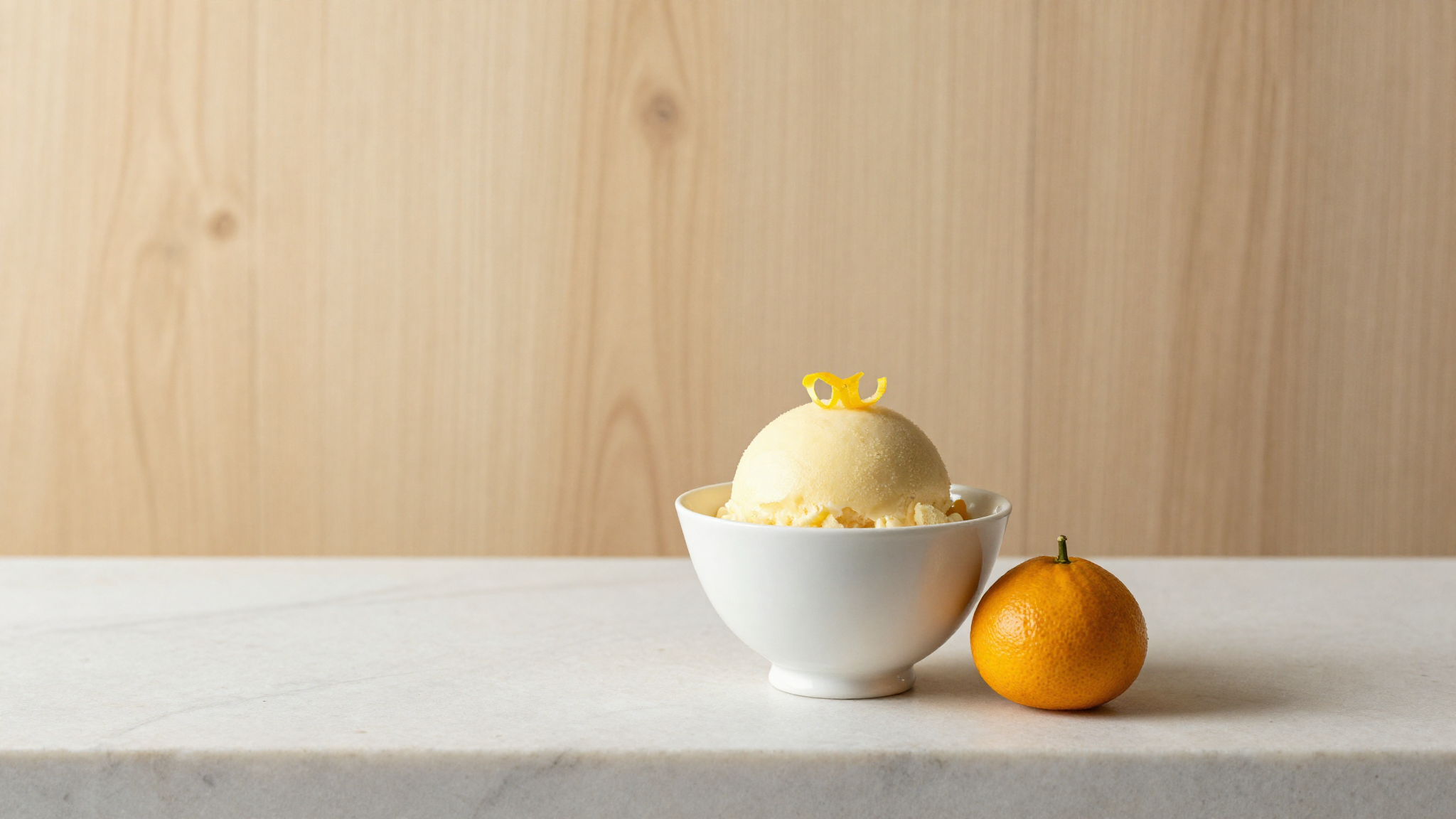
Grown in Japan and prized there for its skin and scent as much as its juice, this citrus behaves nothing like a lemon on a balance sheet. The juice runs 2.97 to 4.75 percent citric acid, roughly three times a common lemon, so the professional 45 percent fruit rule collapses: at 300 g per kilo the result would be unswallowable. It goes in at 150 g, the dose that gives the floral profile, somewhere between grapefruit and mandarin, at an acidity you can eat as dessert. The catch is that the juice brings almost no solids and no sugar, so every gram of body comes from added sugars, with glucose powder at 90 g carrying what sucrose cannot without going too sweet.
That decision has a structural price. Yuzu juice is around 8 percent solids and only 1.8 percent sugar, so it contributes almost nothing to the body of the mix. Every point of dry extract has to be bought: 135 g of sucrose, 70 g of dextrose and 90 g of glucose powder, against 551 g of plain water. Total sugars finish at 28.69 percent inside a 25 to 31 band, and solids at 30.02 percent inside 28 to 34.
Glucose powder gets the largest single lever, 90 g, precisely because it is inefficient as a sweetener: POD 44 and PAC 72 mean it adds mass and freezing point control without adding sweetness. Dextrose finishes the PAC, which lands at 325.4, high in 280 to 340. Fat is 0.01 percent and protein 0.07 percent, so there is nothing else in this mix. Sugar and 4 g of stabiliser are all that stand between you and coarse ice.
Ingredients
Makes 1000 g of finished base.
| Ingredient | Grams | Home measure |
|---|---|---|
| Water | 551 | 2 1/3 cups |
| Yuzu Juice | 150 | |
| Sugar (Sucrose) | 135 | 2/3 cup |
| Glucose Powder | 90 | 1/3 cup plus 2 tablespoons |
| Dextrose (Glucose) | 70 | 1/3 cup plus 1 tablespoon |
| Stabilizer (Neutral) | 4 |
Loads these exact grams into the free balancer, ready to edit.
Method
Pasteurised syrup, chilled and aged, juice stirred in cold at the last minute
- 1Whisk every dry ingredient together first: sugars, milk powder, stabiliser and salt. Dry-blending them stops the stabiliser clumping when it meets liquid.
- 2Warm the liquids to 40 C (104 F), then rain the dry mix in while whisking hard.
- 3Heat to 82 C (180 F) and hold for 2 minutes so the stabiliser hydrates.
- 4Chill in an ice bath to under 5 C (41 F) within 2 hours. Slow cooling is where bacteria and coarse crystals both start.
- 5Age 6 to 12 hours in the fridge under 5 C (41 F). This is when the stabiliser and the milk protein take up water.
- 6Freeze in a shallow metal pan 2 to 3 cm deep, breaking the crystals with a fork every 30 to 40 minutes, 4 to 6 times.
- 7Freeze firm, then temper 10 to 15 minutes in the fridge before scooping.
The balance
All six against the professional range for Sorbetto.
Keeping sweetness in check is what dictates the whole sugar blend, and POD closes at 222.4, low in a 200 to 270 band. Total sugars have to reach 28.69 percent to lift solids from the roughly 1 percent the juice provides up to 30.02 percent, and sucrose alone would make the mix far sweeter getting there. That is why 90 g of glucose powder carry the biggest share: at POD 44 they buy dry extract at a fraction of the sweetness cost. PAC at 325.4 sits high in 280 to 340, which is what makes a mix that is 69.98 percent water still scoopable rather than a block. Protein at 0.07 and fat at 0.01 mean there is no fat or protein network holding crystals apart, so the 4 g of stabiliser and the sugar are doing all of it, which is exactly why neither can be trimmed.
Estimated nutrition: ~120 kcal · Fat 0 g · Sugars 28.7 g · Protein 0.1 g (per 100 g of mix, from the balanced composition).
Yuzu is the most volatile ingredient you will handle in a sorbetto. Exposed to heat or air, the floral top notes are gone in minutes and what remains is acid and bitterness, the opposite of the point. The rule is absolute: the juice never goes into the pasteurisation. Pasteurise the syrup, water, sucrose, dextrose, glucose powder and stabiliser, at 85 C, chill fast to 4 C, age 4 hours, then stir in the cold juice immediately before freezing, not hours ahead. Frozen juice is thawed at 4 C, never over hot water. There is a second reason beyond aroma: strong acid in a hot mix inverts sucrose into glucose and fructose, which raises both POD and PAC and moves a balanced sheet off its numbers. Keeping the juice out of the heat protects the balance as much as the smell. Serve at about -13 C, where its PAC puts it.
If it goes wrong
The juice went through the heat, or sat in the warm syrup while it cooled. Yuzu top notes do not survive either.
Pasteurise the syrup alone, chill it to 4 C, and add the 150 g of cold juice right before it goes into the freezer. There is no way to put the aroma back afterwards.
The stabiliser was reduced, or left out. With fat at 0.01 percent and protein at 0.07 percent there is nothing else in this recipe controlling crystal size.
Keep the full 4 g per kilo and hydrate it in the syrup during pasteurisation. In a sorbetto with almost no fruit solids this is not an optional ingredient.
Sucrose inverted. Acid this strong plus heat splits it into glucose and fructose, which pushes POD above the 222.4 and PAC above the 325.4 the sheet was built for.
Keep the juice away from anything warm. If it has already happened, the batch will still eat well, it will just behave like a softer sorbetto: serve it colder, at -14 C.
Suitable for: Vegan, Vegetarian, Lactose-free, Egg-free
- https://www.jstage.jst.go.jp/article/jjshs1925/73/3/73_3_293/_article/-char/en
- https://www.chimia.ch/chimia/article/download/2018_728/831/11486
- https://blog.giallozafferano.it/dolcipocodolci/sorbetteria-bilanciamento-sorbetti-con-zucchero-eritritolo/
- https://icecreamcalc.com/stabilizers/
- The science behind it: Supreming Citrus for Sorbet
- Ingredient sheet: Yuzu Juice
- The story of this recipe: Yuzu Sorbet Recipe
Want to change an ingredient and watch the numbers move? Open the free balancer