Peach Sorbet
Eats soft rather than icy, the ripeness opening slowly across the palate and settling into an almost floral finish with very little acid bite.
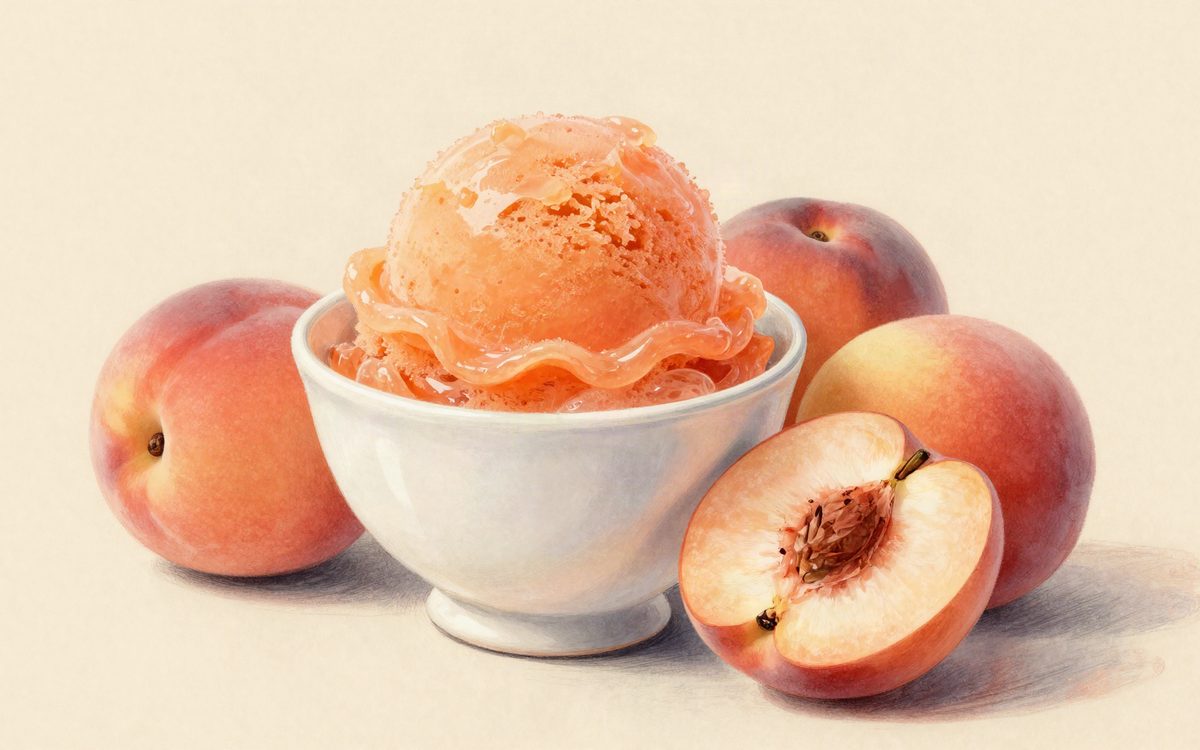
It arrives quietly, closer to a chilled purée than to ice, and the flavour takes its time: nothing sharp at the front, then a ripe sweetness that opens across the middle of the spoon and sits at the back of the palate afterwards. That gentleness is why the fruit has to be genuinely ripe and why the skin stays in the purée, since the lactones behind the recognisable aroma are sitting there. Fruit stops at 450 g per kilo, so the sugar blend carries almost all of the solids, and the 15 g of lemon juice arrives only at the very end to stop the finish going slack.
With the fruit at 450 g, the sugar blend has to build the body: 90 g sucrose, 65 g dextrose, 90 g glucose powder and 22 g maltodextrin, against 264 g of added water. Peach is only 11.5 percent solids and 8 percent sugar, so almost all of the 31.25 percent total solids on this sheet come from the blend rather than from the fruit. Sugars close at 29.19 percent inside a 25 to 31 window.
The skin stays in, and that is the single decision that lifts the intensity. The lactones that make peach smell like peach sit in and just under the skin, so the dairy version peels and this one does not. POD closes at 209.74 in a 200 to 270 range and PAC at 317.53 in a 280 to 340 band, which is high enough that the sorbet stays soft and releases aroma the moment it is served.
Ingredients
Makes 1000 g of finished base.
| Ingredient | Grams | Home measure |
|---|---|---|
| Peach | 450 | |
| Water | 264 | 1 cup |
| Sugar (Sucrose) | 90 | 1/3 cup plus 2 tablespoons |
| Glucose Powder | 90 | 1/3 cup plus 2 tablespoons |
| Dextrose (Glucose) | 65 | 1/3 cup |
| Maltodextrin | 22 | |
| Lemon Juice (Squeezed) | 15 | |
| Stabilizer (Neutral) | 4 |
Loads these exact grams into the free balancer, ready to edit.
Method
Skin on puree blended straight into the lemon, cold syrup, same day
- 1Whisk every dry ingredient together first: sugars, milk powder, stabiliser and salt. Dry-blending them stops the stabiliser clumping when it meets liquid.
- 2Warm the liquids to 40 C (104 F), then rain the dry mix in while whisking hard.
- 3Heat to 82 C (180 F) and hold for 2 minutes so the stabiliser hydrates.
- 4Chill in an ice bath to under 5 C (41 F) within 2 hours. Slow cooling is where bacteria and coarse crystals both start.
- 5Age 6 to 12 hours in the fridge under 5 C (41 F). This is when the stabiliser and the milk protein take up water.
- 6Fold the fruit in cold, after ageing. Heating it costs you the fresh aroma and nothing is gained.
- 7Freeze in a shallow metal pan 2 to 3 cm deep, breaking the crystals with a fork every 30 to 40 minutes, 4 to 6 times.
- 8Freeze firm, then temper 10 to 15 minutes in the fridge before scooping.
The balance
All six against the professional range for Sorbetto.
The fruit stops at 450 g when the literature would happily put 600 in, and that is the reason the sugar blend is as large as it is. Solids at 31.25 percent inside 28 to 34 come almost entirely from those 267 g of sugars, because peach contributes barely 52 g of solids of its own. PAC at 317.53 in a 280 to 340 range follows from a blend that is a quarter dextrose, and it is what keeps this sorbet scoopable at a cabinet temperature of -12.7 C. POD at 209.74 against a 270 ceiling still holds a reserve, useful because peach ripeness varies more than most fruit and a firmer, less sweet batch can take a little more sugar without breaking anything.
Estimated nutrition: ~125 kcal · Fat 0 g · Sugars 29.2 g · Protein 0.5 g (per 100 g of mix, from the balanced composition).
Peach polyphenol oxidase browns the puree within minutes of cutting, and ascorbic acid is the effective inhibitor, which is why the 15 g of squeezed lemon juice is on the list for two reasons rather than one. Blanch and peel only if the fuzz is actually noticeable in the mouth, because blanching costs aroma and this sheet has little to spare at 450 g of fruit. Work in the right order: blend the fruit straight into the acid, then add the cold syrup at once. Do not leave the puree standing while you finish something else, and do not make the puree the day before.
If it goes wrong
Polyphenol oxidase. The fruit was cut and left in contact with air, or blended before the acid went in.
Put the 15 g of lemon juice into the jug first and blend the peach directly into it, then get the cold syrup in immediately.
A fuzzy variety went in with the skin on. The skin is deliberate here for the aroma, but on some cultivars the down is perceptible.
Rub the fruit hard with a damp cloth before weighing. Blanching and peeling works too, but it costs aroma the recipe cannot easily replace.
Underripe fruit. Peach carries 8 percent sugar and 11.5 percent solids at best, so an unripe one contributes almost nothing against 267 g of sugars.
Use fruit that is soft at the stem and fragrant before it is cut.
Suitable for: Vegan, Vegetarian, Lactose-free, Egg-free
- https://www.ncbi.nlm.nih.gov/pmc/articles/PMC9818785/
- https://pastryartsmag.com/sponsored/simple-sorbet-science/
- https://extension.psu.edu/preserving-color-and-preventing-browning-of-foods
- The science behind it: Polyphenol Oxidase
- Ingredient sheet: Peach
Want to change an ingredient and watch the numbers move? Open the free balancer