Papaya Sorbet
Almost creamy for something made without dairy, sweet and slow to spread, with lime arriving late enough to keep the finish from sitting heavy.
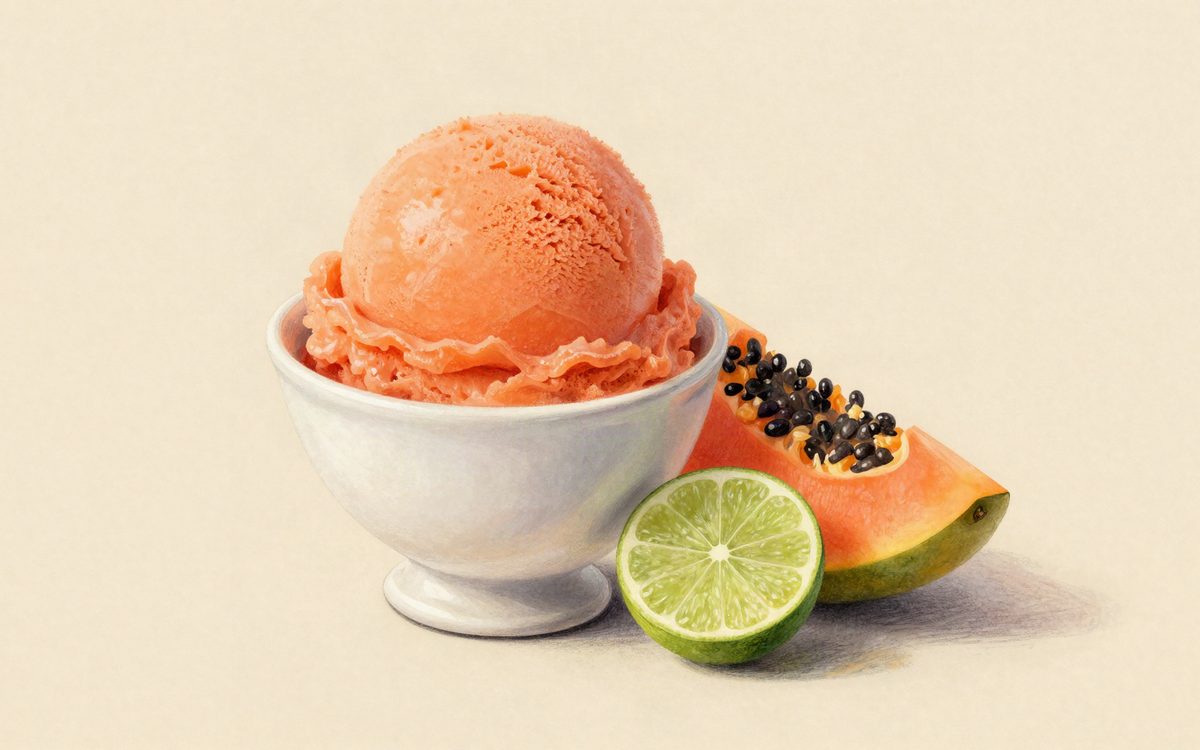
Eating this is closer to spooning cold ripe fruit than to eating ice. It gives way at once, and the sweetness spreads wide and even instead of peaking. The lift comes late: 45 g per kilo of Tahitian lime, a heavy citrus dose for a sorbet, arrives at the back of the mouthful and cuts a sweetness that would otherwise turn cloying and stay there. What is left afterwards is perfume rather than sugar. Fruit runs at 500 g per kilo, and that volume is exactly what makes the body so soft, because this is a low solids fruit with a gentle flavour that needs quantity to be tasted at all.
Tahitian lime at 45 g is the biggest citrus dose of any pulp sorbet in the batch, and it is not seasoning. Ripe papaya has very low titratable acidity, and without acid its aroma profile reads soapy or cloying rather than fruity. The lime is what converts papaya into a dessert. It also drops the pH, which helps suppress whatever papain survives in the fruit.
Sucrose 130 g, dextrose 40 g and 75 g of glucose powder bring POD to 236.95, mid band in 200 to 270, while solids land at 30.3 percent inside 28 to 34 and PAC at 329.46 inside 280 to 340. The glucose powder is doing the heavy lifting there: the fruit brings very few solids and very little sweetening power, so something had to carry dry matter upward without pushing POD through the roof.
Ingredients
Makes 1000 g of finished base.
| Ingredient | Grams | Home measure |
|---|---|---|
| Papaya | 500 | |
| Water | 206 | 3/4 cup plus 2 tablespoons |
| Sugar (Sucrose) | 130 | 2/3 cup |
| Glucose Powder | 75 | 1/3 cup plus 1 tablespoon |
| Tahitian Lime | 45 | |
| Dextrose (Glucose) | 40 | 3 1/2 tablespoons |
| Stabilizer (Neutral) | 4 |
Loads these exact grams into the free balancer, ready to edit.
Method
Syrup heated alone, purée and lime folded in cold, 4 hour age, tray freeze
- 1Whisk every dry ingredient together first: sugars, milk powder, stabiliser and salt. Dry-blending them stops the stabiliser clumping when it meets liquid.
- 2Warm the liquids to 40 C (104 F), then rain the dry mix in while whisking hard.
- 3Heat to 82 C (180 F) and hold for 2 minutes so the stabiliser hydrates.
- 4Chill in an ice bath to under 5 C (41 F) within 2 hours. Slow cooling is where bacteria and coarse crystals both start.
- 5Age 6 to 12 hours in the fridge under 5 C (41 F). This is when the stabiliser and the milk protein take up water.
- 6Freeze in a shallow metal pan 2 to 3 cm deep, breaking the crystals with a fork every 30 to 40 minutes, 4 to 6 times.
- 7Freeze firm, then temper 10 to 15 minutes in the fridge before scooping.
The balance
All six against the professional range for Sorbetto.
The number that shapes this sheet is solids at 30.3 against 28 to 34. The sugar split is three ways rather than the usual two: glucose powder at 75 g raises solids and body while contributing far less sweetening power per gram than sucrose would. Solids at 30.3 explain why 500 g of an 11.5 percent solids fruit is not enough on its own and 206 g of water is still in the list as the balancing lever. The rest closes comfortably, with sugars 27.84 against 25 to 31, POD 236.95 against 200 to 270, PAC 329.46 against 280 to 340, water 69.7 against 66 to 72, fat 0.15 against 0 to 1 and protein 0.32 against 0 to 1.
Estimated nutrition: ~122 kcal · Fat 0.2 g · Sugars 27.8 g · Protein 0.3 g (per 100 g of mix, from the balanced composition).
Both of the real risks here come from the same mistake, which is using underripe fruit. Benzyl isothiocyanate, the pungent medicinal compound in papaya, falls from roughly 109 micrograms per gram in green fruit to roughly 10 in fully ripe fruit, a tenfold drop, and no amount of sugar corrects a sorbet made at the wrong stage. Use fruit that smells sweet and yields to the thumb. The second is papain, an active protease that keeps cleaving protein in the mouth and exposing bitter amino acids. In a dairy-free sorbet there is no structural damage to worry about, but the bitterness is real, and again ripe fruit plus the low pH from the lime is the defence. Clean the cavity thoroughly, since the seeds and the inner membrane concentrate both compounds. Pasteurise the syrup alone at 85 C, chill to 4 C, fold in the purée and the lime cold and age 4 hours at 4 C.
If it goes wrong
Underripe papaya. Benzyl isothiocyanate runs around 109 micrograms per gram in green fruit against roughly 10 in ripe fruit.
Only use fully ripe fruit, sweet smelling and soft to the touch, and scrape the cavity clean of seeds and membrane where the compound concentrates.
Residual papain continuing to work in the mouth, again from fruit picked or used too early.
Ripe fruit, clean cavity, and keep the full 45 g of lime, which lowers the pH and holds the enzyme back.
The lime was cut back because 45 g looked like a lot for one kilo.
Put it back. The dose is high on purpose, since papaya has almost no acidity of its own, and the sheet already carries 27.84 percent sugars for it to balance against.
Suitable for: Vegan, Vegetarian, Lactose-free, Egg-free
- https://www.sciencedirect.com/science/article/abs/pii/S0031942200902589
- https://www.mdpi.com/1422-0067/27/8/3438
- https://ashs.org/news/639696/Bitterness-of-Papaya-Mil-Related-to-Protein-and-Free-Amino-Acid-Contents.htm
- https://www.professionalgelatotraining.com/discover-gelato/cold-vs-hot-process-in-gelato
- The science behind it: How to Balance a Sorbetto Recipe
- Ingredient sheet: Papaya
Want to change an ingredient and watch the numbers move? Open the free balancer