Mixed Berry Sorbet
Sharp and bright at the front, raspberry perfume above everything else, then a deeper, faintly astringent back note that gives the finish its length.
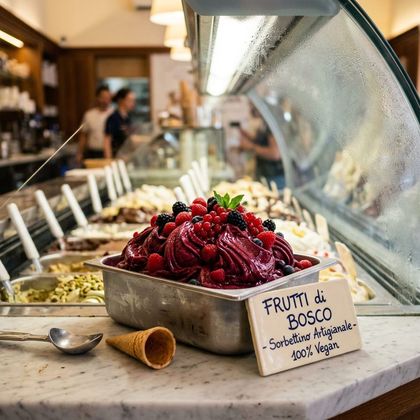
Equal parts is the mistake. Split 450 g of fruit per kilo evenly across four berries and the raspberry runs over the top of everything. The split here is uneven on purpose: strawberry at 150 g for body and gentle sweetness, raspberry at 110 g for the perfume people actually recognise as red fruit, blackberry at 90 g for deep colour and structuring acidity, blueberry at 100 g for the astringent back note that gives the flavour its length. Protein lands at 0.45%, and the sugars are left free to keep the texture soft.
Protein finishes at 0.45% against a 0 to 1 range, mid band, and raspberry and blackberry are the two protein heavy berries in the set.
Because the blend is poor in sugar and poor in sweetening power on its own, the sugar architecture is free to go classical: 110 g of sucrose, 80 g of dextrose, 15 g of glucose powder and 53 g of maltodextrin per kilo, plus 276 g of added water. The 12 g of lemon juice are there to bring four different fruit pH values into line rather than to make it sour.
Ingredients
Makes 1000 g of finished base.
| Ingredient | Grams | Home measure |
|---|---|---|
| Water | 276 | 1 1/4 cups |
| Strawberry | 150 | |
| Raspberry | 110 | |
| Sugar (Sucrose) | 110 | 1/2 cup plus 1 tablespoon |
| Blueberry | 100 | |
| Blackberry | 90 | |
| Dextrose (Glucose) | 80 | 1/3 cup plus 2 tablespoons |
| Maltodextrin | 53 | |
| Glucose Powder | 15 | 1 1/2 tablespoons |
| Lemon Juice | 12 | |
| Carob Seed Flour | 3 | |
| Guar Gum | 1 |
Loads these exact grams into the free balancer, ready to edit.
Method
Fruits processed separately, cold purees into a cooled syrup
- 1Whisk every dry ingredient together first: sugars, milk powder, stabiliser and salt. Dry-blending them stops the stabiliser clumping when it meets liquid.
- 2Warm the liquids to 40 C (104 F), then rain the dry mix in while whisking hard.
- 3Heat to 82 C (180 F) and hold for 2 minutes so the stabiliser hydrates.
- 4Chill in an ice bath to under 5 C (41 F) within 2 hours. Slow cooling is where bacteria and coarse crystals both start.
- 5Age 6 to 12 hours in the fridge under 5 C (41 F). This is when the stabiliser and the milk protein take up water.
- 6Fold the fruit in cold, after ageing. Heating it costs you the fresh aroma and nothing is gained.
- 7Freeze in a shallow metal pan 2 to 3 cm deep, breaking the crystals with a fork every 30 to 40 minutes, 4 to 6 times.
- 8Freeze firm, then temper 10 to 15 minutes in the fridge before scooping.
The balance
All six against the professional range for Sorbetto.
PAC finishes at 322.69 in a 280 to 340 window, in its upper part, and 80 g of dextrose per kilo are what get it there. A sorbet has no fat and no milk solids to give it body, 69.15% of the mix is water, so the freezing point depression is doing structural work, not just softening. POD lands at 206.95 against a 200 to 270 window and total sugars at 27.57% inside 25 to 31. The 53 g of maltodextrin are the quiet part of the design: they add dry matter with almost no sweetness and very little freezing point effect, which is how total solids reach 30.85% inside 28 to 34 without POD climbing toward its ceiling. Carob seed flour at 3 g and guar at 1 g hold the water phase in the absence of any dairy. Fat reads 0.2%, all of it from the seeds, and MSNF is 0.0.
Estimated nutrition: ~124 kcal · Fat 0.2 g · Sugars 27.6 g · Protein 0.5 g (per 100 g of mix, from the balanced composition).
The specific risk in this flavour is aromatic washout: four berries processed together turn into a generic purple compote. Process them separately. Strawberry and raspberry go in raw and sieved, because their key volatiles, furaneol in strawberry, alpha-ionone and raspberry ketone in raspberry, are heat labile and are lost above 60 C. Blueberry and blackberry can take a brief heating to 70 C, which pulls anthocyanin out of the skins and improves the colour. Combine the four purees cold into the pasteurized and cooled syrup, then sieve the whole thing through a 1 mm mesh to catch raspberry and blackberry drupelet seeds. Work in stainless steel and keep the mix away from light: anthocyanins from four different sources copigment, and the colour actually improves over the first 12 hours of maturation at 4 C before it starts to brown.
If it goes wrong
All four were blended and heated together, and the delicate strawberry and raspberry volatiles were cooked off.
Keep strawberry and raspberry raw and sieved, heat only blueberry and blackberry, briefly, to 70 C.
Raspberry and blackberry drupelet seeds that survived a coarse strainer.
Sieve the combined puree through a 1 mm mesh before it meets the syrup.
Anthocyanin oxidation, accelerated by light and by reactive metal.
Mix and mature in stainless steel, away from light, and churn within the first day. The 12 g of lemon juice are part of this defence, do not cut them.
Suitable for: Vegan, Vegetarian, Lactose-free, Egg-free
No ingredient in this recipe contains gluten.
- USDA FoodData Central, entradas Strawberries raw, Raspberries raw, Blackberries raw e Blueberries raw (perfis de acucar, proteina e agua usados na proporcao do blend)
- So Good Magazine, Fruit sorbets from a syrup base (https://www.sogoodmagazine.com/pastry-blog/pastry-chef-articles/fruit-sorbets-from-a-syrup-base-a-practical-resource/)
- Luca Caviezel, Scienza e Tecnologia del Gelato Artigianale, sorbetti de frutti di bosco
- Pastry Arts Magazine, Simple Sorbet Science (https://pastryartsmag.com/sponsored/simple-sorbet-science/)
- The science behind it: Anthocyanin Color Stability in Sorbet
- Ingredient sheet: Mixed Red Berries
Want to change an ingredient and watch the numbers move? Open the free balancer