Blood Orange Sorbet
The first spoon is sharp and very cold, then a red berry bitterness opens underneath, and the peel oils stay long after the cold has gone.
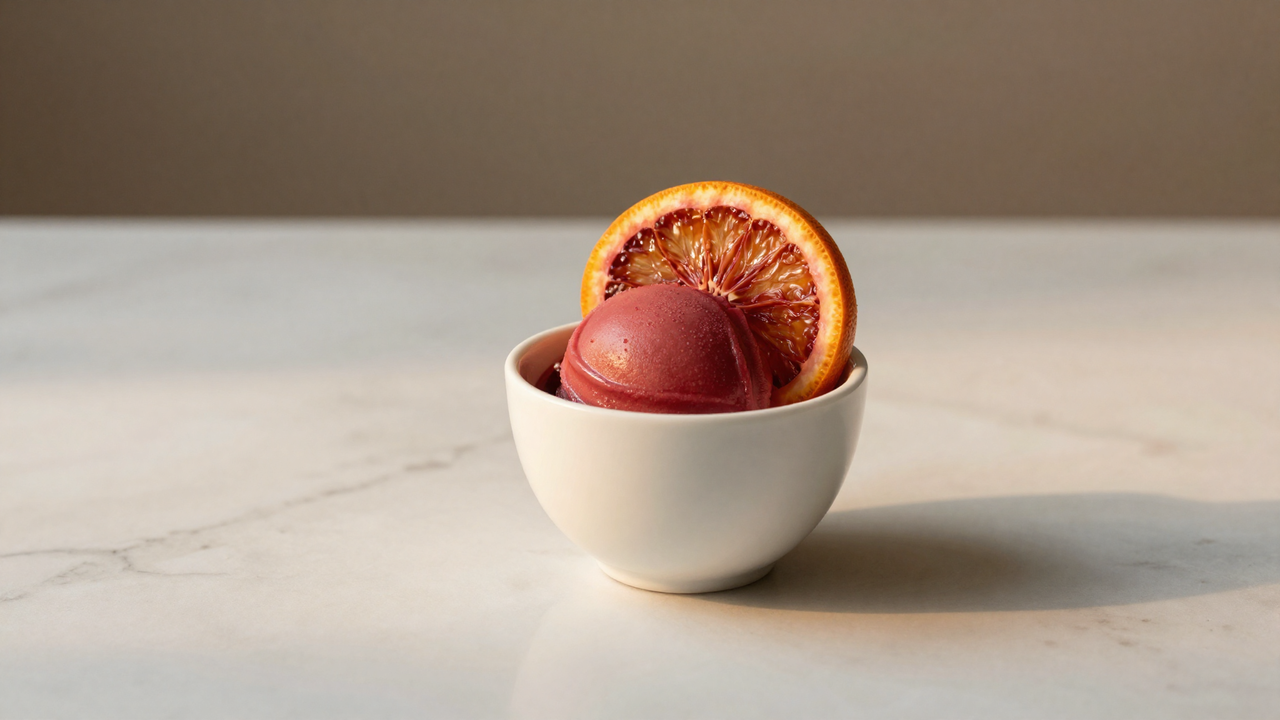
The cold arrives before anything else here, and it arrives undiluted, because fat is what normally blunts it and this sheet has almost none. Acidity lands next, bright and narrow, and then widens into something rounder with a faint bitterness sitting behind it that ordinary orange never gives you. The finish is where it separates from a plain citrus sorbet: long after the chill has left the mouth the aroma is still there, and that part belongs to the 4 g of zest rather than to the juice, since the volatile oils live in the peel. Body comes from sugar and 3 g of carob seed flour, so it stays light and melts clean instead of coating.
The 4 g of orange zest is not decoration. The juice carries the acid and the sugar, but orange aroma lives in the oil glands of the peel, in limonene, valencene and linalool. Leave the zest out and you get a sweet and sour ice with no orange on the nose. Blood orange adds cyanidin-3-glucoside on top of that, which gives both the red color and a faintly bitter red fruit undertone that a common orange does not have.
Because the juice supplies only about 4.4 points of sugar and 49 of POD, the sugar architecture does most of the work: 110 g of sucrose, 80 g of dextrose and 63 g of maltodextrin per kilo. That puts the mix at 28.66% sugars, inside the 25 to 31 sorbet window, and 31.07% solids, inside 28 to 34.
Ingredients
Makes 1000 g of finished base.
| Ingredient | Grams | Home measure |
|---|---|---|
| Blood Orange | 480 | |
| Water | 259 | 1 cup |
| Sugar (Sucrose) | 110 | 1/2 cup plus 1 tablespoon |
| Dextrose (Glucose) | 80 | 1/3 cup plus 2 tablespoons |
| Maltodextrin | 63 | |
| Orange Zest | 4 | |
| Carob Seed Flour | 3 | |
| Guar Gum | 1 |
Loads these exact grams into the free balancer, ready to edit.
Method
Zest infused into the syrup, juice folded in cold, pan scraped every 20 minutes
- 1Whisk every dry ingredient together first: sugars, milk powder, stabiliser and salt. Dry-blending them stops the stabiliser clumping when it meets liquid.
- 2Warm the liquids to 40 C (104 F), then rain the dry mix in while whisking hard.
- 3Heat to 82 C (180 F) and hold for 2 minutes so the stabiliser hydrates.
- 4Chill in an ice bath to under 5 C (41 F) within 2 hours. Slow cooling is where bacteria and coarse crystals both start.
- 5Age 6 to 12 hours in the fridge under 5 C (41 F). This is when the stabiliser and the milk protein take up water.
- 6Freeze in a shallow metal pan 2 to 3 cm deep, breaking the crystals with a fork every 30 to 40 minutes, 4 to 6 times.
- 7Freeze firm, then temper 10 to 15 minutes in the fridge before scooping.
The balance
All six against the professional range for Sorbetto.
POD lands at 216.41, in the lower part of the 200 to 270 sorbet window. Spreading that sweetness across sucrose and dextrose rather than sucrose alone lets PAC reach 325.82 in a 280 to 340 band without the sorbet turning cloying. Maltodextrin at 63 g/kg then carries solids to 31.07% while adding neither sweetness nor POD, which matters because the fruit itself brings almost nothing but water: those 480 g account for most of the 68.93% water in the finished mix.
Estimated nutrition: ~125 kcal · Fat 0.1 g · Sugars 28.7 g · Protein 0.5 g (per 100 g of mix, from the balanced composition).
Never heat citrus juice. Heat in an acid medium turns limonene into alpha-terpineol, which is the cooked juice smell of long life orange, and it destroys the anthocyanin that makes this sorbet red instead of orange. Pasteurize only the syrup, water plus sugars plus stabilizer, at 85 C, cool it to 4 C, and add juice that has just been squeezed and strained. Take the zest from the colored layer only, no white pith, and infuse it hot in the syrup for 20 minutes before straining it out: the pith carries naringin and limonin, which are bitter. Then watch for the late bitterness that is specific to citrus, since limonin forms by acid hydrolysis over hours. Age this mix 4 hours at most, then freeze. Final pH is around 3.4, one more reason for stainless steel and no aluminium.
If it goes wrong
Limonin formed by acid hydrolysis during a long rest, and pith in the zest made it worse.
Zest the colored layer only, and hold the aging to 4 hours at most before freezing.
The juice was heated with the syrup, turning limonene into alpha-terpineol.
Pasteurize the syrup alone at 85 C, cool it to 4 C, and add fresh strained juice at the end.
Heat or a long hold destroyed the cyanidin-3-glucoside, or the fruit was simply not deeply pigmented.
Keep the juice cold from squeezing to freezing, and choose fruit from the part of the season when pigment is highest. Nothing in the formula creates that color, it comes from the fruit.
Suitable for: Vegan, Vegetarian, Lactose-free, Egg-free
No ingredient in this recipe contains gluten.
- David Lebovitz, Blood Orange Sorbet (https://www.davidlebovitz.com/blood-orange-so/)
- Ice Cream Nation, Blood orange sorbet (https://www.icecreamnation.org/2012/02/blood-orange-sorbet/)
- USDA FoodData Central, Oranges, raw, all commercial varieties (agua cerca de 86,8 g/100 g, proteina 0,94 g/100 g)
- Angelo Corvitto, Los secretos del helado (Vilbo), sorbetes de citricos e uso de raspa
- The science behind it: Supreming Citrus for Sorbet
- Ingredient sheet: Blood Orange
Want to change an ingredient and watch the numbers move? Open the free balancer