Apricot Sorbet
Sharp and cold on the first spoon, then the stone-fruit perfume opens up as it softens, finishing tart and clean with no dairy weight behind it.
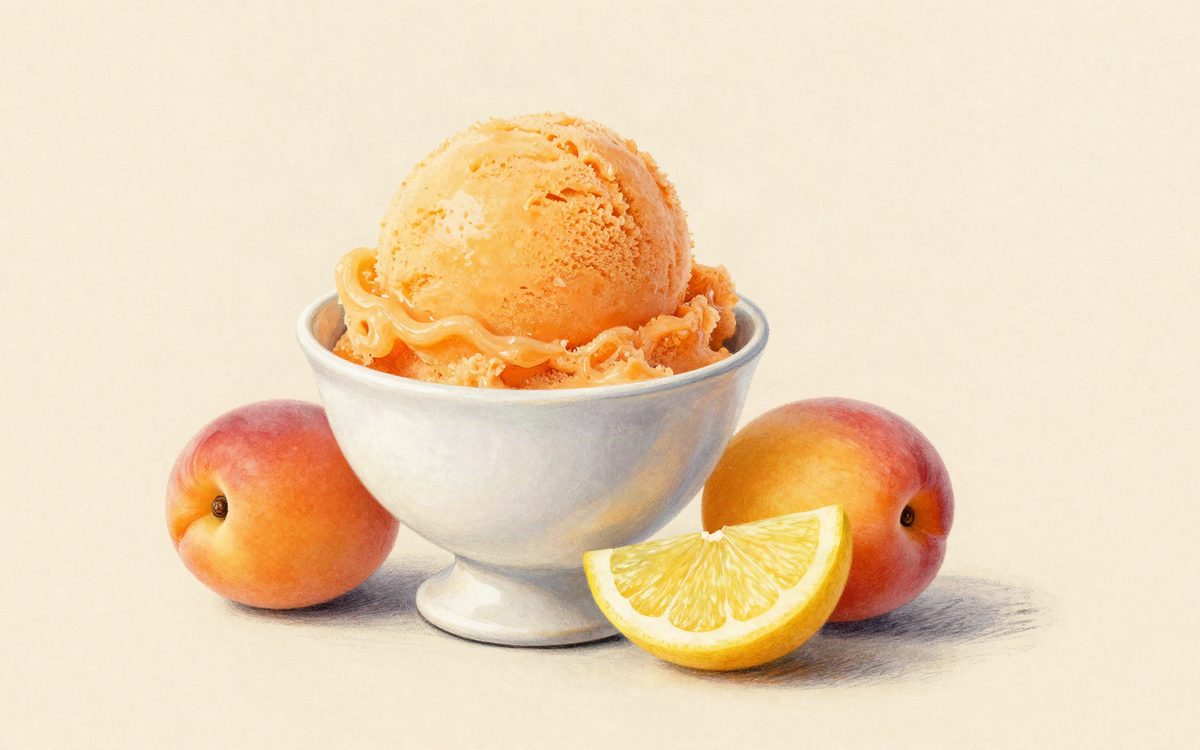
Most home-made stone fruit sorbets fail in the same two places: the tub sets into a block that splinters under the spoon, and the perfume that was obvious in the raw fruit goes missing the moment it is cold. Both faults come back to free water and to aroma that needs help carrying at low temperature. Three sugars instead of one spread the freezing over a range, the neutral stabiliser at 4 g/kg holds the water that would otherwise grow into crystals, and 15 g of lemon juice drops the pH just enough for the fruit's own lactones to read. What comes out is soft, tart and unmistakably apricot, not sugar water with fruit on top.
So the aroma is bought a different way: 15 g of lemon juice, which drop the pH and lift the apricot lactone bouquet without adding a flavour of their own. Apricot also arrives with PAC 12.5 against 9.2 percent sugar, the signature of the native sorbitol in stone fruit, so part of the antifreeze work is done before you weigh a single gram of dextrose.
The rest is the standard sorbetto trio against 321 g of water: 120 g of sucrose for the backbone of sweetness, 55 g of dextrose to push PAC, and 75 g of glucose powder as the brake that lets solids climb to 30.18 percent while POD stops at 225.96.
Ingredients
Makes 1000 g of finished base.
| Ingredient | Grams | Home measure |
|---|---|---|
| Apricot | 410 | |
| Water | 321 | 1 1/3 cups |
| Sugar (Sucrose) | 120 | 1/2 cup plus 2 tablespoons |
| Glucose Powder | 75 | 1/3 cup plus 1 tablespoon |
| Dextrose (Glucose) | 55 | 1/4 cup plus 1 tablespoon |
| Lemon Juice | 15 | |
| Stabilizer (Neutral) | 4 |
Loads these exact grams into the free balancer, ready to edit.
Method
Frozen cube blender sorbet
- 1Whisk every dry ingredient together first: sugars, milk powder, stabiliser and salt. Dry-blending them stops the stabiliser clumping when it meets liquid.
- 2Warm the liquids to 40 C (104 F), then rain the dry mix in while whisking hard.
- 3Heat to 82 C (180 F) and hold for 2 minutes so the stabiliser hydrates.
- 4Chill in an ice bath to under 5 C (41 F) within 2 hours. Slow cooling is where bacteria and coarse crystals both start.
- 5Age 6 to 12 hours in the fridge under 5 C (41 F). This is when the stabiliser and the milk protein take up water.
- 6Fold the fruit in cold, after ageing. Heating it costs you the fresh aroma and nothing is gained.
- 7Freeze in a shallow metal pan 2 to 3 cm deep, breaking the crystals with a fork every 30 to 40 minutes, 4 to 6 times.
- 8Freeze firm, then temper 10 to 15 minutes in the fridge before scooping.
The balance
All six against the professional range for Sorbetto.
Two ceilings shape this one. POD stops at 225.96 with 270 available, and solids still have to reach at least 28 percent for it to be a sorbet rather than a granita. Those two pull against each other, because most sugars raise both at once. Glucose powder is what separates them: it carries solids at a low sweetening power, so the recipe reaches 30.18 percent solids with POD still well short of the limit. PAC lands at 321.06 in a 280 to 340 band, in its upper part, which is why this scrapes into a scoop instead of shattering. Fat at 0.17 percent and MSNF at zero confirm what it is: nothing in this bowl comes from an animal.
Estimated nutrition: ~122 kcal · Fat 0.2 g · Sugars 27.9 g · Protein 0.5 g (per 100 g of mix, from the balanced composition).
The specific risk with apricot is enzymatic browning. Polyphenol oxidase in Prunus armeniaca oxidises catechin, epicatechin and type B procyanidins, and the flesh goes from orange to beige in minutes on contact with air. Two defences that actually work: blanch the cut fruit for 60 to 90 seconds and drop it into iced water before blending, or work with ascorbic acid alongside the 15 g of lemon juice, which reduces the quinones back to colourless phenol. Lemon on its own is a pH effect, not a reducing one, so it slows browning without stopping it. Pasteurize only the syrup, meaning water, sugars and stabilizer, at 85 C, chill to 4 C, and only then fold in the cold apricot purée and the lemon. That order keeps the volatile lactones, which are the whole reason it smells like apricot, out of the pasteurizer. Mature 4 hours at 4 C. The lemon goes in last and cold: acid on a hot mix inverts sucrose and moves the PAC you just calculated.
If it goes wrong
Polyphenol oxidase acting on the cut flesh as soon as it meets air.
Blanch the cut fruit 60 to 90 seconds and cool it in iced water, or add ascorbic acid alongside the 15 g of lemon juice. Lemon by itself only slows the reaction.
The stabilizer went in as a lump, or the mix skipped maturation, so the 4 g never hydrated.
Disperse the 4 g of stabilizer dry into part of the sugar, take the syrup to 85 C, and give the mix the full 4 hours at 4 C before freezing.
Extra sugar added by eye after tasting the cold mix.
If it reads flat, add acid rather than sugar.
Suitable for: Vegan, Vegetarian, Lactose-free, Egg-free
- https://blog.giallozafferano.it/dolcipocodolci/sorbetteria-bilanciamento-sorbetti-con-zucchero-eritritolo/
- https://pmc.ncbi.nlm.nih.gov/articles/PMC6804514/
- https://www.ncbi.nlm.nih.gov/pmc/articles/PMC8789516/
- https://www.sosa.cat/en/stabilize-ice-creams-sorbets/
- The science behind it: Polyphenol Oxidase
- Ingredient sheet: Apricot
Want to change an ingredient and watch the numbers move? Open the free balancer