Passion Fruit Sorbet
Sourness hits first and hard, then the floral, tropical aroma spreads out behind it and hangs on, icy and clean with nothing sweet to cushion it.
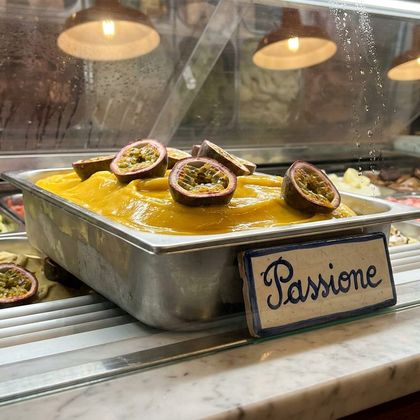
The acid lands before anything else does, bright and immediate, and for a second it is the whole experience; then the aroma opens out behind it, floral and tropical and far wider than the sourness suggested, and it stays a long time. That length is why the pulp stops at 280 g per kilo where a milder fruit would take half the batch: the aroma is already complete at that dose while the acid is still something you can finish a bowl of. Nothing on the list sharpens it any further, which is why no lemon juice appears anywhere in it.
With the fruit that low, the sugar blend has to carry the structure on its own: 95 g sucrose, 65 g dextrose, 90 g glucose powder and 28 g maltodextrin, so 278 g of dry sugar solids against 438 g of added water. Total sugars close at 29.43 percent, high inside a 25 to 31 window, and that is deliberate. Sugar is the only lever on this sheet that buffers how sharp the acid reads on the tongue.
The rest of the numbers follow from those two decisions. Solids land at 31.23 percent with water at 68.77 percent, POD at 209.66 inside 200 to 270, and PAC at 320.13 in a 280 to 340 band. That PAC is in the upper half on purpose: a sorbet this acidic is unpleasant when it is served hard and glassy, and it wants to be soft enough to release aroma the moment it hits the tongue. Protein reads 0.39 percent inside 0 to 1, fat 0.14 percent, and there is no dairy at all.
Ingredients
Makes 1000 g of finished base.
| Ingredient | Grams | Home measure |
|---|---|---|
| Water | 438 | 1 3/4 cups |
| Passion Fruit Pulp | 280 | |
| Sugar (Sucrose) | 95 | 1/3 cup plus 2 tablespoons |
| Glucose Powder | 90 | 1/3 cup plus 2 tablespoons |
| Dextrose (Glucose) | 65 | 1/3 cup |
| Maltodextrin | 28 | |
| Stabilizer (Neutral) | 4 |
Loads these exact grams into the free balancer, ready to edit.
Method
Cold syrup, raw pulp stirred in, shallow tray forked often
- 1Whisk every dry ingredient together first: sugars, milk powder, stabiliser and salt. Dry-blending them stops the stabiliser clumping when it meets liquid.
- 2Warm the liquids to 40 C (104 F), then rain the dry mix in while whisking hard.
- 3Heat to 82 C (180 F) and hold for 2 minutes so the stabiliser hydrates.
- 4Chill in an ice bath to under 5 C (41 F) within 2 hours. Slow cooling is where bacteria and coarse crystals both start.
- 5Age 6 to 12 hours in the fridge under 5 C (41 F). This is when the stabiliser and the milk protein take up water.
- 6Fold the fruit in cold, after ageing. Heating it costs you the fresh aroma and nothing is gained.
- 7Freeze in a shallow metal pan 2 to 3 cm deep, breaking the crystals with a fork every 30 to 40 minutes, 4 to 6 times.
- 8Freeze firm, then temper 10 to 15 minutes in the fridge before scooping.
The balance
All six against the professional range for Sorbetto.
Two numbers explain the whole sheet. Sugars at 29.43 percent sit high in a 25 to 31 range because sugar is doing double duty here, buying solids and blunting an acidity that no other fruit in this family throws at you. PAC at 320.13 in a 280 to 340 band is the consequence: a 278 g blend that includes 65 g of dextrose depresses the freezing point far harder than sucrose alone would, so this sorbet stays scoopable at a cabinet temperature of -12.8 C instead of setting like ice. POD at 209.66 against a 270 ceiling still leaves headroom, which matters because pulp acidity varies with the batch and you may want to sweeten a very sharp one. Protein at 0.39 percent is comfortably under 1 percent, and with no dairy on the sheet, lactose is zero, so a sandy body is not a risk you have to manage here.
Estimated nutrition: ~126 kcal · Fat 0.1 g · Sugars 29.4 g · Protein 0.4 g (per 100 g of mix, from the balanced composition).
The acidity is the entire technical problem. Never pasteurise the pulp together with the sugars. At pH 2.7 and 85 C sucrose inverts into glucose and fructose within minutes, PAC climbs well past the 320.13 this sheet was balanced at, and what you get will not hold shape in the tub. Heat the syrup alone, which means the water, the sugars and the stabiliser, chill it to 4 C, and only then stir the raw 280 g of pulp in cold. The seeds are traditionally left in for texture and for the look. Sieve only if you want the smooth style, and if you do, weigh the 280 g after sieving, not before, because the seeds are a meaningful share of the weight.
If it goes wrong
The pulp was heated with the syrup. At pH 2.7 the sucrose inverted, which pushes PAC above the 320.13 the recipe was balanced at, and a higher PAC means a lower freezing point.
Pasteurise the syrup on its own, cool it to 4 C, then stir the raw pulp in. There is no way to walk an inverted mix back, so the batch has to be made again.
More than 280 g of pulp went in, or the pulp came from a very sharp batch.
Weigh the pulp instead of counting fruit. You cannot buy the acid back with extra sucrose either, since sugars are already at 29.43 percent against a 31 percent ceiling.
Whole seeds left in a mix that also has 438 g of added water, so there is nothing thick around them to soften the bite.
Sieve half the pulp and leave the other half seeded, then reweigh so you still have 280 g going into the mix.
Suitable for: Vegan, Vegetarian, Lactose-free, Egg-free
- https://pmc.ncbi.nlm.nih.gov/articles/PMC6033812/
- https://pastryartsmag.com/sponsored/simple-sorbet-science/
- https://www.sogoodmagazine.com/pastry-blog/pastry-chef-articles/fruit-sorbets-from-a-syrup-base-a-practical-resource/
- The science behind it: How to Balance a Sorbetto Recipe
- Ingredient sheet: Passion Fruit Pulp
- The story of this recipe: Passion Fruit Sorbet
Want to change an ingredient and watch the numbers move? Open the free balancer