What Carrageenan Is
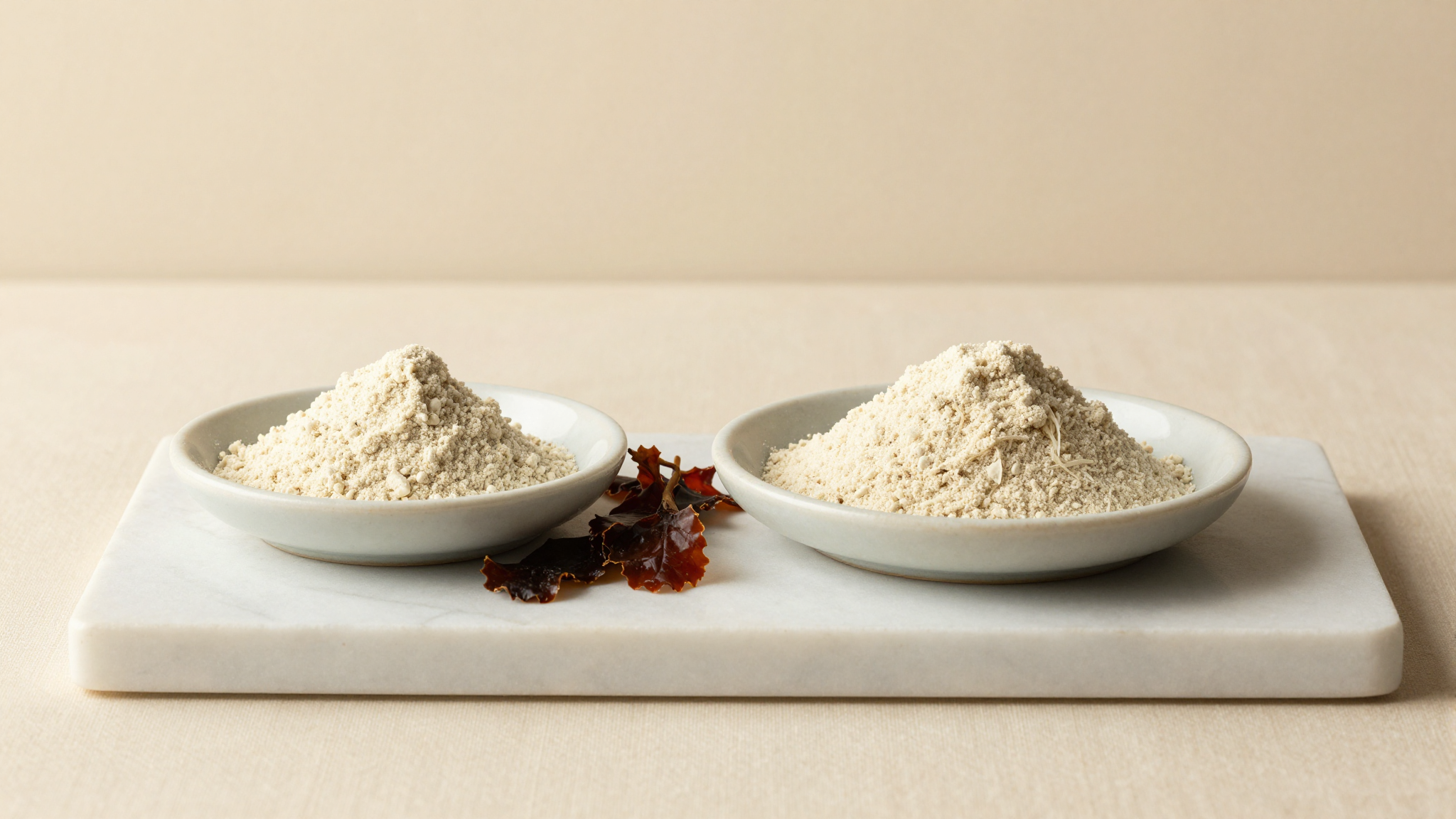
Carrageenan (E407) is a family of sulfated polysaccharides extracted from red seaweeds — primarily Chondrus crispus (Irish moss), Eucheuma cottonii, and Eucheuma spinosum. Used in dairy products for over 600 years (originally as Irish moss extract for blancmange).
What makes carrageenan unique among gelato stabilizers: it interacts directly with milk proteins (specifically κ-casein), forming a network that prevents whey separation in cold-stored dairy mixes. No other gum has this property.
The Three Carrageenan Types
| Type | Sulfate level | Behavior in milk | Gelato role |
|---|---|---|---|
| Kappa (κ) | Low | Firm, brittle gel — interacts strongly with κ-casein | Vegan applications, aspic-style desserts |
| Iota (ι) | Medium | Soft, elastic gel — interacts with proteins moderately | Standard for dairy gelato |
| Lambda (λ) | High | Non-gelling, thickens only | Cold-prepared dairy products (chocolate milk) |
For artisan gelato, iota is the relevant type. Most pre-blended neutro products contain a small percentage of iota carrageenan specifically for whey-separation prevention during 5–7 day showcase storage.
How Carrageenan Works with Milk Proteins
Carrageenan's negatively-charged sulfate groups bind to positively-charged regions on κ-casein. This creates a protein-polysaccharide complex that:
- Prevents whey separation — keeps the aqueous phase bound to the protein matrix
- Stabilizes air cells — the protein network reinforced by carrageenan resists collapse
- Improves texture cleanliness — no "watery" feel during the late portion of the showcase day
Without carrageenan in a stabilizer blend, gelato that sits 5–7 days in the showcase often shows visible whey pooling at the base of the pan. With even 0.01% carrageenan, this effect is dramatically reduced.
Quick reference. Iota carrageenan: 0.01–0.03% of mix weight. Always in a blend, never solo. Specific role: prevents whey separation in stored gelato.
Recommended Doses
| Use case | Iota carrageenan dose |
|---|---|
| Standard dairy gelato (in blend with guar + LBG) | 0.01–0.02% (10–20 mg/kg) |
| Premium dairy gelato (extended shelf life) | 0.02–0.03% (20–30 mg/kg) |
| Sorbet (no milk proteins) | Avoid — no functional benefit |
| Vegan gelato (no dairy proteins) | Avoid — use other gums instead |
For sorbet and vegan applications, carrageenan provides no functional advantage over the other galactomannans — there's no milk protein for it to interact with.
Why Carrageenan Goes Wrong
Two common mistakes:
1. Overdose. At 0.05% or above, the texture becomes rubbery — a result of excessive milk-protein crosslinking. Stick to ≤0.03% in gelato.
2. Wrong type. Using kappa carrageenan in a dairy mix produces a brittle, broken texture (kappa forms a hard gel with κ-casein at any meaningful concentration). Always confirm you have iota carrageenan when buying.
How to Add Carrageenan
Pre-blend with sucrose at a 50:1 sugar:carrageenan ratio (the small dose makes weighing critical — use a 0.01 g precision scale). Add to the mix during pre-pasteurization. Carrageenan needs heat ≥70°C to fully solubilize and interact with proteins.
For commercial production, use a neutro blend that already contains the right ratio of carrageenan — much easier than weighing 0.02% by hand.
Sourcing
| Source | Price (EUR/kg) |
|---|---|
| Iota carrageenan (food-grade) | €30–50 |
| Premium dairy-grade iota | €50–80 |
Carrageenan is one of the more expensive gums, but you use very little — €0.05–0.10 of carrageenan per kg of gelato is enough.
Carrageenan and the Health Debate
The carrageenan controversy you may have read about online refers to degraded carrageenan (poligeenan, E407a) — a low-molecular-weight version produced by acid hydrolysis, used in lab research. Food-grade carrageenan (E407, high molecular weight) is not the same molecule and is approved by EFSA, FDA, and JECFA. Use food-grade only — which is what every commercial supplier provides anyway.
Related Concepts
- Locust bean gum (LBG) and guar gum — primary gums in pro blends
- Xanthan gum — alternative third gum
- Stabilizers and emulsifiers — overview category
Test how a small carrageenan addition affects perceived body in the free balancing calculator — even 0.01% shifts the texture profile noticeably in dairy systems.
Run these numbers live
Open the free balancer and adjust ingredients as you read.