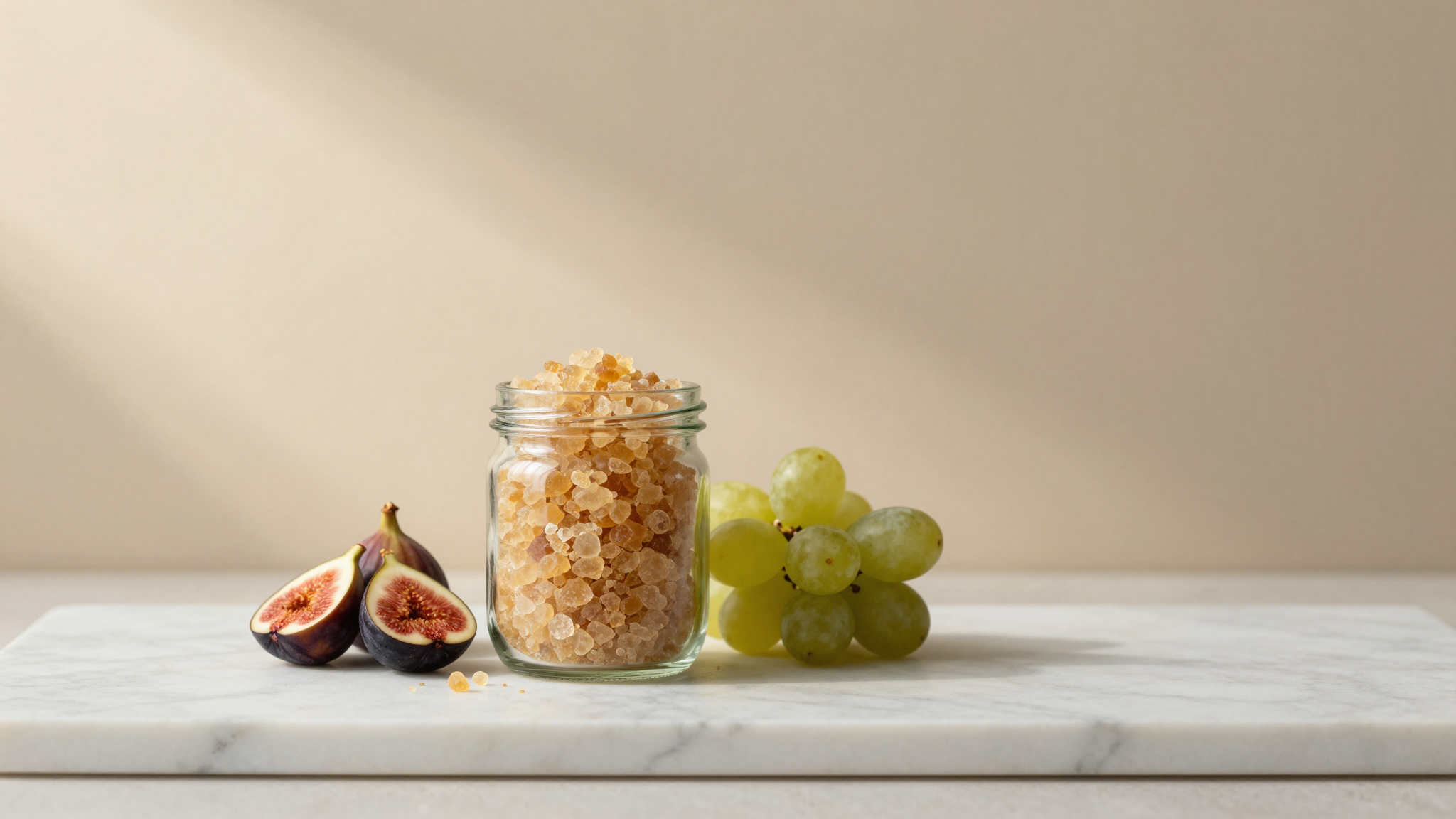
Fructose is a monosaccharide naturally found in fruit and honey, and the sweetest of the common sugars in gelato balancing — POD 173, with PAC 190. It is rarely used as an added pure sugar in artisan gelato (too expensive, too hygroscopic), but it shows up implicitly in every fruit sorbet via the fruit's own sugar profile. Understanding fructose matters mostly for sorbetto balancing, where the natural fruit fructose contributes significantly to PAC and POD.
What Fructose Is
Fructose is the simplest "fruit sugar" — a monosaccharide with chemical formula C₆H₁₂O₆ (same as glucose, different molecular geometry). Molecular weight 180 g/mol. It is sweeter than any other common sugar at room temperature; the perception of sweetness drops slightly at colder temperatures, which is one reason fructose-heavy fruit sorbets can taste less sweet than the math suggests.
Pure crystalline fructose is produced industrially from corn or beet sugar via enzymatic conversion. Used at small scale in some specialty applications.
Natural Fructose in Fruit and Honey
Almost all fruit contains a fructose-glucose mix in roughly 50/50 proportions. Some fruits skew toward fructose (apples 60% fructose), others toward glucose (cherries 40% fructose). For gelato/sorbetto purposes, fruit sugar is generally treated as inverted sugar equivalent (PAC 190, POD 130) — close enough for most balancing purposes.
| Fruit (puree) | Total sugar (%) | Roughly equivalent to |
|---|---|---|
| Strawberry | 6% | inverted sugar |
| Mango | 14% | inverted sugar |
| Banana | 12% | inverted sugar (slight glucose skew) |
| Pineapple | 10% | inverted sugar |
| Lemon (juice) | 2.5% | inverted sugar (much higher acid) |
Honey is naturally ~80% sugar — about 38% fructose, 31% glucose, 1% sucrose, 9% other sugars. Functionally treated as inverted sugar plus 17% water content.
Use as Added Sugar
Pure crystalline fructose is occasionally used in:
1. Boost POD without raising bulk. A small dose of fructose (10–20 g per kg) raises perceived sweetness more than the same weight of sucrose, useful for under-sweet recipes.
2. Sorbets where natural fruit sugar is insufficient. When making a low-sugar fruit (like raspberry at 4% sugar), adding 10–15 g of pure fructose mimics the fruit's natural sugar profile better than adding pure sucrose.
3. Replacement for inverted sugar in restricted formulas. Some certifications (kosher, organic) restrict commercial inverted sugar; pure fructose can substitute with similar PAC/POD profile (PAC 190 vs 190; POD 173 vs 130 — sweeter result).
Quick reference. Fructose: PAC 190 · POD 173 · TS 100% · price ~€5–10/kg. Use sparingly — usually <2% of mix weight.
Caveat: Fructose Is Hygroscopic
Fructose absorbs water from the surroundings more aggressively than sucrose or dextrose. In a gelato mix this is invisible, but in storage:
- Fructose-heavy gelato develops surface stickiness if exposed to humid air (showcase poorly closed)
- Fructose contributes to slightly faster surface dehydration if the showcase is too dry
- Pure crystalline fructose absorbs moisture from ambient air during storage — keep tightly sealed
For most artisan recipes, fructose is incidental (from fruit) rather than added. When you do add pure fructose, keep it under 2% of mix weight to avoid hygroscopicity issues.
Related Concepts
Account for fruit sugars. When balancing sorbets in the Free Gelato Balancing App, select your fruit purée from the ingredient database — the fructose contribution to PAC and POD is calculated automatically.
JSON-LD Schema
{
  "@context": "https://schema.org",
  "@graph": [
    {
      "@type": "DefinedTerm",
      "name": "Fructose",
      "alternateName": ["Fruit sugar", "Levulose"],
      "description": "Fructose is a monosaccharide naturally found in fruit and honey. PAC 190, POD 173 — the sweetest common sugar in gelato balancing. Rarely added as pure crystal; most fructose in gelato comes from fruit.",
      "termCode": "Fructose",
      "inDefinedTermSet": { "@type": "DefinedTermSet", "name": "Free Gelato Balancing App Glossary", "url": "https://freegelatobalancing.app/learn/glossary/" }
    },
    {
      "@type": "BreadcrumbList",
      "itemListElement": [
        { "@type": "ListItem", "position": 1, "name": "Home", "item": "https://freegelatobalancing.app/" },
        { "@type": "ListItem", "position": 2, "name": "Learn", "item": "https://freegelatobalancing.app/learn" },
        { "@type": "ListItem", "position": 3, "name": "Glossary", "item": "https://freegelatobalancing.app/learn/glossary" },
        { "@type": "ListItem", "position": 4, "name": "Fructose" }
      ]
    },
    {
      "@type": "FAQPage",
      "mainEntity": [
        { "@type": "Question", "name": "What's the PAC of fructose?", "acceptedAnswer": { "@type": "Answer", "text": "PAC 190 — same as dextrose and inverted sugar. Roughly twice as effective as sucrose at lowering freezing point." } },
        { "@type": "Question", "name": "What's the POD of fructose?", "acceptedAnswer": { "@type": "Answer", "text": "POD 173 — about 73% sweeter than sucrose. The sweetest of common gelato sugars. Perceived sweetness drops slightly at low temperatures." } },
        { "@type": "Question", "name": "Should I add pure fructose to my gelato?", "acceptedAnswer": { "@type": "Answer", "text": "Rarely. Most recipes get enough from fruit. Useful for under-sweet recipes (10–20g/kg). Keep under 2% of mix weight to avoid hygroscopicity issues." } },
        { "@type": "Question", "name": "Is fructose found in all fruit?", "acceptedAnswer": { "@type": "Answer", "text": "Yes — virtually all fruits contain fructose, usually 30–60% of total fruit sugar. Honey is ~38% fructose." } },
        { "@type": "Question", "name": "Why is fructose more hygroscopic than sucrose?", "acceptedAnswer": { "@type": "Answer", "text": "Fructose has a more open molecular structure with more hydrogen-bonding sites for water. Absorbs ambient moisture faster — relevant for storage and showcase exposure." } }
      ]
    }
  ]
}
QA Report
🍨 Technical review
- PAC 190 / POD 173 standard reference values
- Monosaccharide structure (C6H12O6) accurate
- Hygroscopicity property correctly attributed to molecular structure
- Fruit sugar profiles (apple 60% fructose, etc.) approximately correct per USDA data
- Honey composition (38/31/1/9) per published apicultural science
🎯 SEO review
- Primary keyword "Fructose" + numerical anchors PAC 190 / POD 173 in title
- "Fruit sugar" alternateName captured
- Fruit sugar table for snippet
- Internal links: 6 varied anchors
- FAQ: 5 questions
- Description: 152c
- OG/Twitter complete
Run these numbers live
Open the free balancer and adjust ingredients as you read.