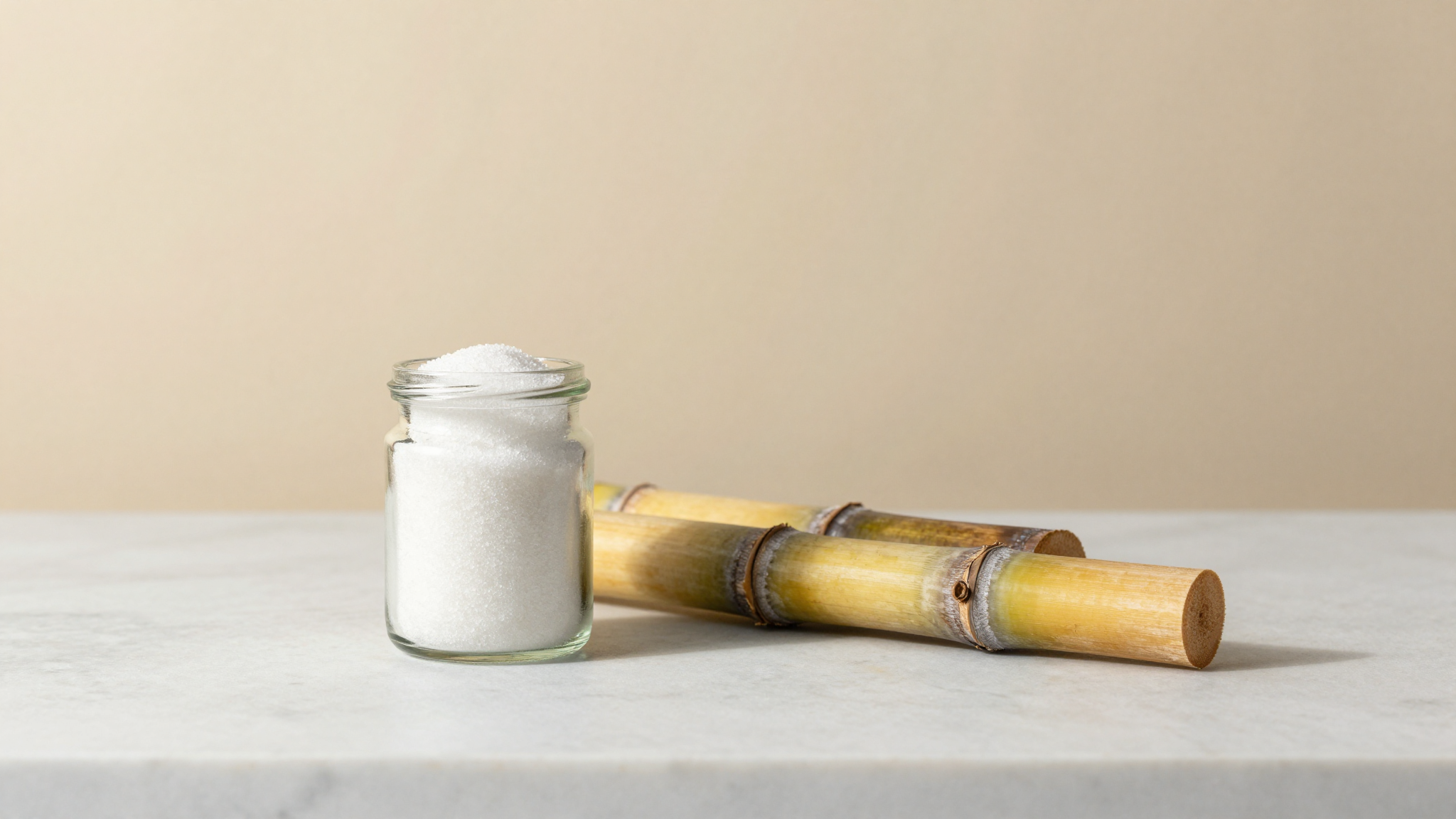
Sucrose is common table sugar — the reference sugar against which all other sugars in gelato balancing are measured. Its PAC (anti-freezing power) is set at 100 and its POD (sweetness power) is also set at 100. Every other sugar — dextrose, fructose, trehalose, inverted sugar — is rated relative to sucrose. In a typical artisan gelato recipe, sucrose makes up 50–80% of the total sugar mass; the rest is dextrose, inverted, or specialty sugars used to fine-tune PAC and POD independently.
What Sucrose Is
Sucrose is a disaccharide composed of one glucose molecule bonded to one fructose molecule. Chemical formula: C₁₂H₂₂O₁₁. Molecular weight 342 g/mol. It is extracted from sugar cane or sugar beet and refined into the white crystalline product universally known as table sugar.
In food science, sucrose's medium molecular weight makes it a moderate freezing-point depressor (PAC 100) and the standard sweetness reference (POD 100). In an aqueous solution, sucrose stays as the intact disaccharide — it doesn't split into glucose and fructose unless exposed to acid + heat or to the enzyme invertase.
Role in Gelato Balancing
Sucrose plays four roles in a gelato recipe:
1. Bulk sweetness. Provides the body of the perceived sweetness. Most of the recipe's POD comes from sucrose.
2. Freezing point depression. Lowers the freezing point of the water in the mix by an amount proportional to its concentration.
3. Total Solids contribution. Pure sucrose is 100% solids — every gram added raises Total Solids by the same gram (proportional to mix weight).
4. Texture body. Sucrose increases the viscosity of the unfrozen syrup phase that surrounds ice crystals, contributing to the smooth mouthfeel.
Quick reference. Sucrose: PAC 100 · POD 100 · TS 100% · price ~€1/kg. Reference sugar for all calculations.
Why Pros Blend Sucrose with Other Sugars
A pure sucrose-only recipe locks PAC and POD together — every gram added moves both at the same rate. That makes it impossible to fine-tune separately. By replacing some sucrose with dextrose (PAC 190, POD 75), you can lower the freezing point without raising sweetness as much. By replacing some with trehalose (PAC 100, POD 45), you can keep PAC the same while lowering sweetness. By replacing some with inverted sugar (PAC 190, POD 130), you raise both PAC and POD plus add moisture retention.
This independent control of PAC and POD is the central skill of professional balancing — and it requires sucrose as the anchor that the other sugars are blended against.
Typical Proportions in Recipes
In a 1000 g gelato mix containing ~140–180 g of total sugar:
| Sugar | Typical weight | Role |
|---|---|---|
| Sucrose | 100–150 g | Main sweetener, body |
| Dextrose | 25–60 g | PAC adjuster |
| Inverted or trehalose | 10–30 g (optional) | Specialty fine-tune |
For sorbets, total sugar climbs to 200–250 g, with sucrose still the largest component but a higher proportion of dextrose / inverted to compensate for the missing fat structure.
Related Concepts
- PAC (anti-freezing power)
- POD (sweetness power)
- Dextrose, inverted sugar, trehalose
- Sugar Substitution Tool
- Complete professional gelato guide
Test your sugar blend. Open the Free Gelato Balancing App and adjust sucrose, dextrose and trehalose proportions — see PAC and POD update live.
Run these numbers live
Open the free balancer and adjust ingredients as you read.