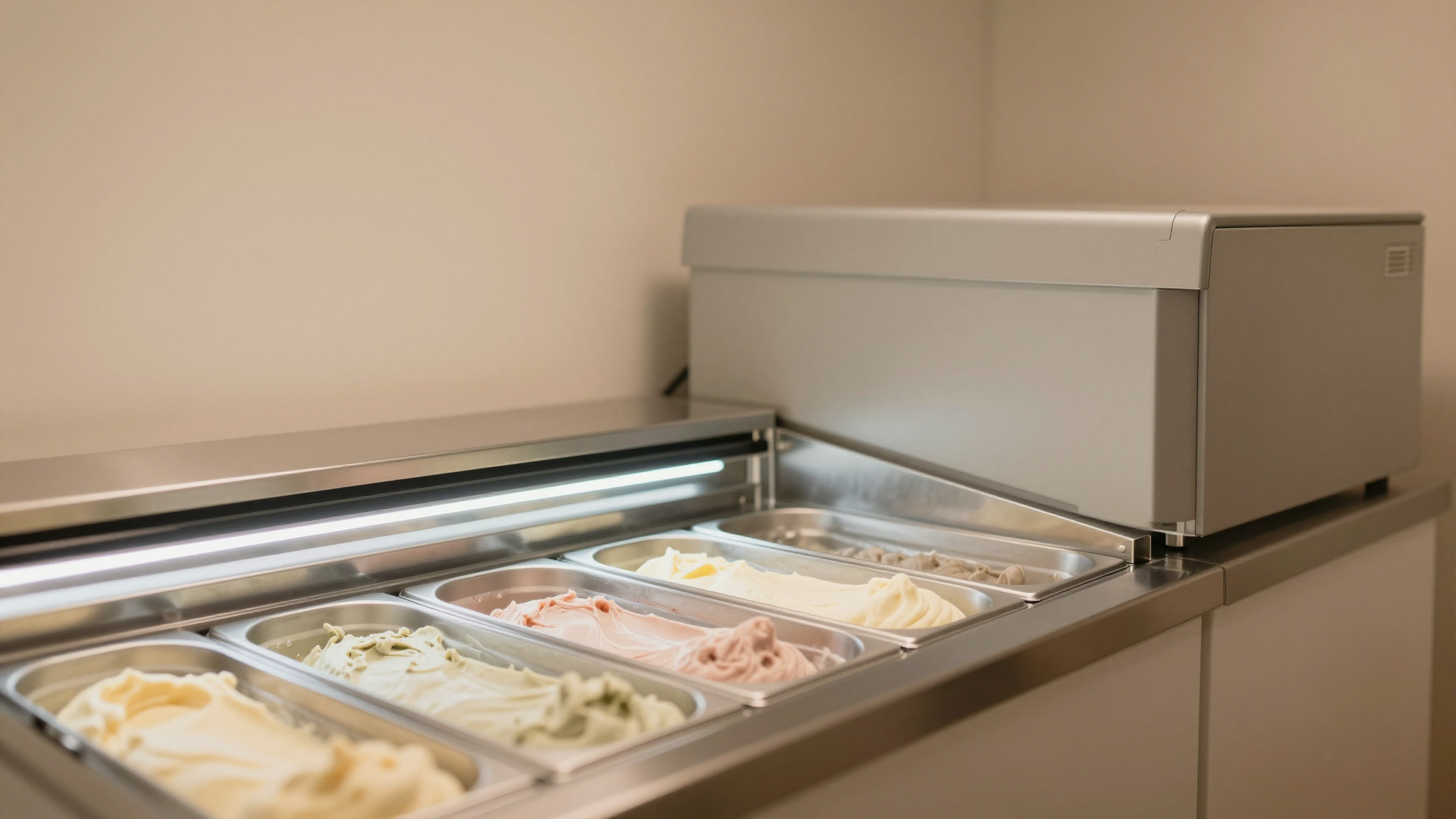
Abbattimento (ah-baht-tee-MEN-toh) is the Italian term for blast-freezing — the rapid post-mantecazione step that drops freshly-extracted gelato from −8°C to −18°C in 20–40 minutes inside a blast chiller (abbattitore). Skipping this step or using a standard freezer instead is a common silent killer of artisan texture: the slower the freeze, the larger the ice crystals that form, and the grainer the final product.
What Abbattimento Means
The verb abbattere means "to knock down" or "to bring down forcefully." In gelato terminology it refers specifically to "knocking down" the temperature of the just-churned product as fast as possible. The English equivalent is "blast freezing" or "shock freezing."
After mantecazione, the gelato exits the mantecatore at −8 to −10°C — soft-serve consistency. To stabilize it for storage and showcase service, it must reach −18°C as quickly as possible. The faster the drop, the smaller the ice crystals that form during this final freezing phase.
Blast Chiller vs Standard Freezer
| Equipment | −8°C → −18°C time | Crystal size result |
|---|---|---|
| Blast chiller (abbattitore) | 20–40 minutes | Microscopic, smooth texture |
| Standard −20°C cabinet | 3–6 hours | Visible, slightly icy |
| Domestic freezer | 8–24 hours | Large, definitely icy |
The reason: between −8°C and −18°C, water that didn't freeze during mantecazione continues freezing slowly. The slower the cooling, the more time water molecules have to migrate and join existing ice crystals — making them larger. A blast chiller flash-freezes the surface and locks in the structure before crystals can grow.
Quick reference. Target: drop from extraction temperature (−8 to −10°C) to storage temperature (−18°C) in under 40 minutes. Use a dedicated blast chiller (abbattitore); standard freezer is not sufficient.
Time and Temperature
A typical artisan blast chiller cycle:
- Cycle target: −18°C core temperature (measured with a probe in the densest part of a tray)
- Time: 20–40 minutes for standard 1.5–5 L gelato trays
- Air temperature inside chiller: −30 to −40°C
- After cycle completes: transfer to standard −20°C storage cabinet
For a gelateria producing 60+ L/day, a blast chiller is non-negotiable. For very small operations (under 20 L/day), some artisans skip the dedicated chiller and use a high-quality −24°C freezer with the trays spread thin to maximize surface area — works in a pinch, takes ~2 hours, texture is acceptable but not optimal.
Equipment and Cost
| Tier | Capacity | Brands | Price (EUR, new) |
|---|---|---|---|
| Compact | 3–5 trays | Polaris, Friulinox, Cool Head | €2,500–€5,000 |
| Mid | 6–10 trays | Carpigiani, Bravo, Frigomat | €5,000–€12,000 |
| Large | 12+ trays | Carpigiani BLC, Bravo BC | €12,000–€20,000 |
Used blast chillers can be found at 40–60% of new price. Verify the cooling cycle still hits −18°C in spec time — the compressor is the part most prone to wear.
If you have one piece of "luxury" equipment to add to a starting gelateria budget, the answer is almost always: a blast chiller. The investment shows in the texture of every batch.
Related Concepts
- Mantecazione (churning) — the step before abbattimento
- Mantecatore (batch freezer)
- How to prevent heat shock
- Complete professional gelato guide
The blast chiller is the texture multiplier. A perfectly balanced recipe in the Free Gelato Balancing App still needs proper abbattimento to reach its texture potential. Pair good math with good equipment.
Run these numbers live
Open the free balancer and adjust ingredients as you read.