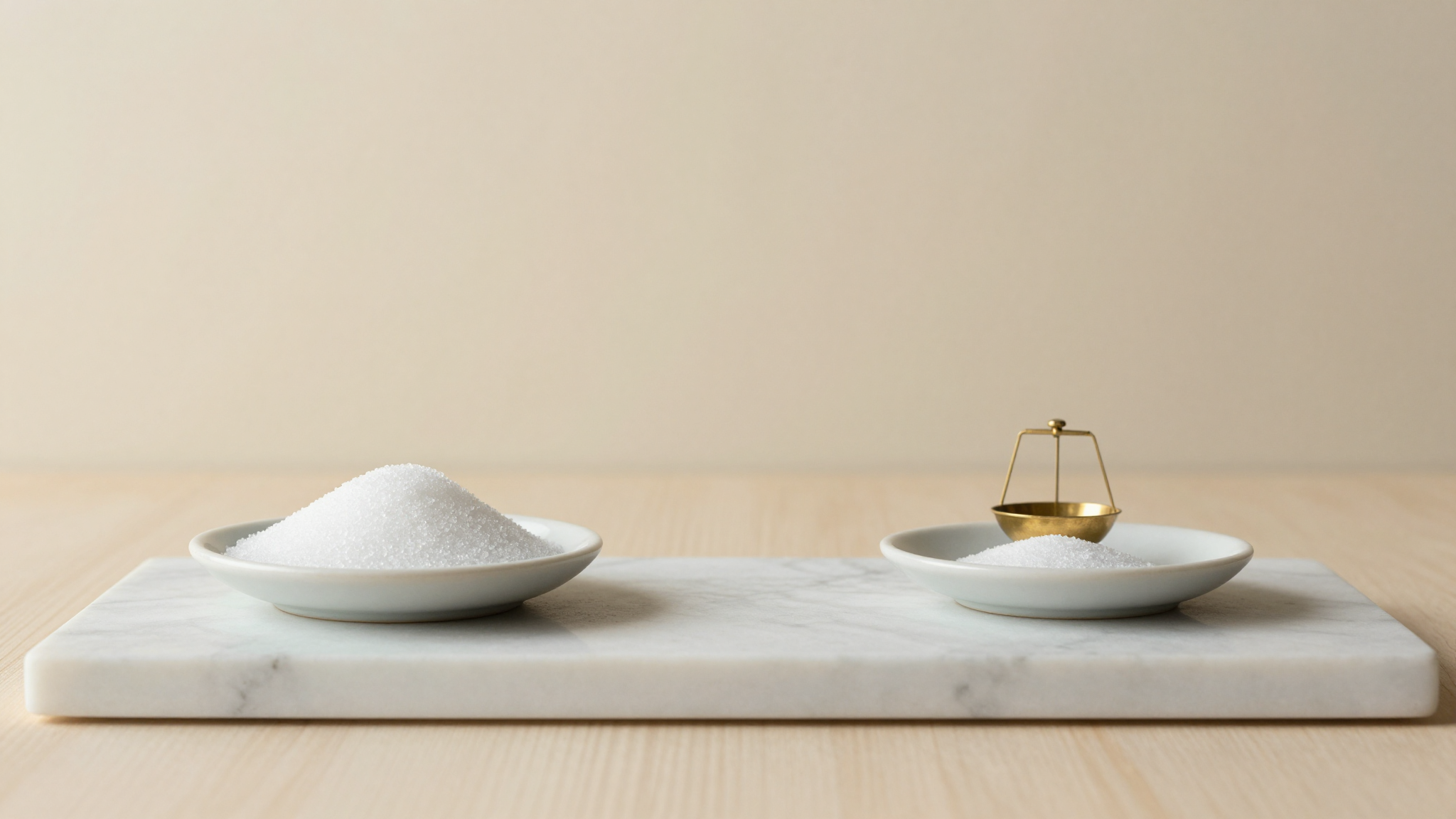
Erythritol and allulose are the two professional-grade sugar-free sweeteners for gelato, both with PAC 180 and POD 70. They are the only viable single-ingredient replacements for sucrose in keto, diabetic-friendly, and sugar-free gelato lines — most other sugar-free sweeteners (stevia, monk fruit) lack the bulk to replace sugar 1:1. Each has a distinct trade-off: erythritol can produce a cooling sensation on the palate; allulose browns more easily during pasteurization but is more neutral in taste.
What Erythritol and Allulose Are
Erythritol is a sugar alcohol (polyol) found naturally in small amounts in fruits and fermented foods. Commercial erythritol is produced by fermenting glucose with yeasts. Chemical formula C₄H₁₀O₄. About 70% as sweet as sucrose. Almost zero calories — humans absorb erythritol but excrete it largely unchanged via urine. Glycemic index: 0.
Allulose is a "rare sugar" — a monosaccharide that occurs in tiny amounts in figs, raisins, and wheat. Commercial allulose is produced from corn-derived fructose via enzymatic conversion. Chemical formula C₆H₁₂O₆ (same as fructose, different molecular geometry). About 70% as sweet as sucrose. About 0.4 calories per gram (vs 4 for sugar). Glycemic index: 0.
Both are FDA-approved (allulose since 2019) and EFSA-approved for food use. Cost: erythritol ~€8–12/kg, allulose ~€15–25/kg.
Erythritol vs Allulose
| Property | Erythritol | Allulose |
|---|---|---|
| PAC | 180 | 180 |
| POD | 70 | 70 |
| Calories | ~0.2 kcal/g | ~0.4 kcal/g |
| Glycemic index | 0 | 0 |
| Browning during pasteurization | None (no Maillard) | Some (browns easily) |
| Cooling sensation | Yes (mild to moderate) | None |
| Digestive tolerance | Up to ~30 g/serving | Up to ~25 g/serving |
| Sourcing | Fermented from glucose | Enzymatic from fructose |
| Cost (EU 2026) | ~€8–12/kg | ~€15–25/kg |
The main practical difference: erythritol has a measurable cooling sensation on the tongue (because dissolution is endothermic — absorbs heat from the saliva). Some consumers like this in mint flavors but find it odd in vanilla or chocolate. Allulose has no cooling but browns during pasteurization — careful temperature control needed.
Use in Sugar-Free Gelato
Standard approach for a sugar-free fior di latte (1000 g mix):
| Ingredient | Standard recipe | Sugar-free version |
|---|---|---|
| Sucrose | 130 g | 0 g |
| Dextrose | 35 g | 0 g |
| Erythritol or allulose | 0 g | 100–120 g |
| Trehalose | 0 g | 30–40 g (POD lowering) |
| Inulin | 41 g | 60 g (more body) |
| Stabilizer | 4 g | 5 g (compensates for missing sugar body) |
| Maltodextrin | 0 g | 30 g (Total Solids backfill) |
Result: PAC ~250 (target 220–280 ✓), POD ~14 (lower than standard 18–22 — accept and market accordingly), Total Solids ~38% (target 36–42 ✓).
Quick reference. A sugar-free gelato is doable with erythritol or allulose + trehalose for POD lowering + inulin and maltodextrin for body. Expect lower perceived sweetness (POD 12–15) and slightly different mouthfeel — market the recipe as "less sweet" rather than trying to mimic standard sweetness.
Limits and Trade-Offs
Erythritol cooling sensation. At doses above 80 g per kg of mix, the cooling becomes prominent. Some consumers love it, others find it strange. Test with target audience.
Allulose browning. During pasteurization at 85°C, allulose Maillard-reacts with milk proteins and produces visible browning. Mitigation: lower pasteurization to 75°C × 15 min, or use allulose only in bases without dairy (sorbets).
Digestive tolerance. Both are well-tolerated up to typical serving sizes (80–100 g per serving). Above that — possible bloating or laxative effect for some individuals. Keep individual servings reasonable.
Cost. Allulose is 2–3× more expensive than erythritol, which is 6–10× more expensive than sucrose. Sugar-free gelato has higher ingredient costs that need to be reflected in pricing.
Related Concepts
- PAC (anti-freezing power), POD (sweetness power)
- Trehalose — common partner for POD lowering in sugar-free recipes
- No-added-sugar gelato guide
- Complete professional gelato guide
Build a sugar-free recipe. Open the Free Gelato Balancing App and replace sucrose with erythritol or allulose — see PAC stay in range while POD drops and calories disappear. The math behind sugar-free gelato.
Run these numbers live
Open the free balancer and adjust ingredients as you read.